 Playable Books
Percy Goetschius · section 13 of 24
Chapter XI. The large species of chorale-figuration
Read and hear this section in the playable edition →The large species of chorale-figuration
First variety: invention with chorale
99. In this larger and more elaborate species, the thematic or figural voices are the chief, essential factors, while the chorale melody is (at least apparently) an incidental factor. The first Line of the c.f. is preceded by an introductory exposition of the Motive; similar thematic Interludes occur between the Lines of the chorale; and a more or less lengthy Postlude follows the final Line. Hence the chorale melody has the appearance of entering incidentally, when convenient, into the thematic texture, while the lower parts pursue the imitatory development of the adopted Motive (precisely as in the Invention), as aim and burden of the entire composition.
Of the Large Species there are several varieties, the first and simplest of which is called " Invention with Chorale."
Cantus. firmus in soprano
100. This — as in the Small Species — is the most natural, and probably most common, location for the chorale melody (c. J.).
a. The Motive is usually at least a mneasure long, often much longer. It may be invented "free," i.e., independent of the c. J., and in that case it is wise to select some melodic progression (of two or three tones) that occurs frequently in the course of the chorale (as, for instance, the tone-repetitions in chorale No. 24 of the above table), and invent the Motive as characteristic counterpoint to that figure; this ensures its availability at these points, at least.
b. But it is somewhat more likely that the Motive will be derived from the first Line of the c. f.,— possibly, though rarely, from the last line, or even some other (striking) line of the chorale. The derivation may be simple, as shown in Ex. 126 (which see). Or it may be elaborate; for example, all the following motives (and many more) are derived by Bach from the first line of the same chorale:
Ex128-1-3
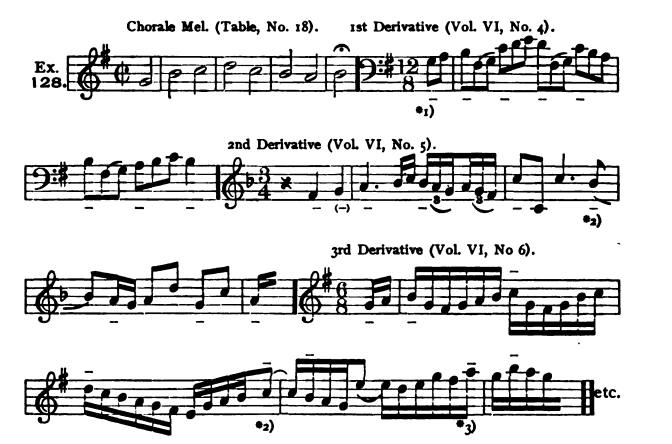
Chorale Mel. (Table, No. 18). 1st Derivative (Vol. VI, lo. 4).
Ex128-4-8
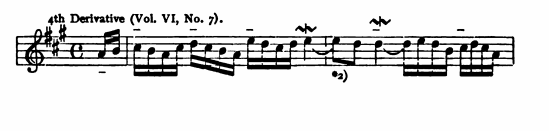
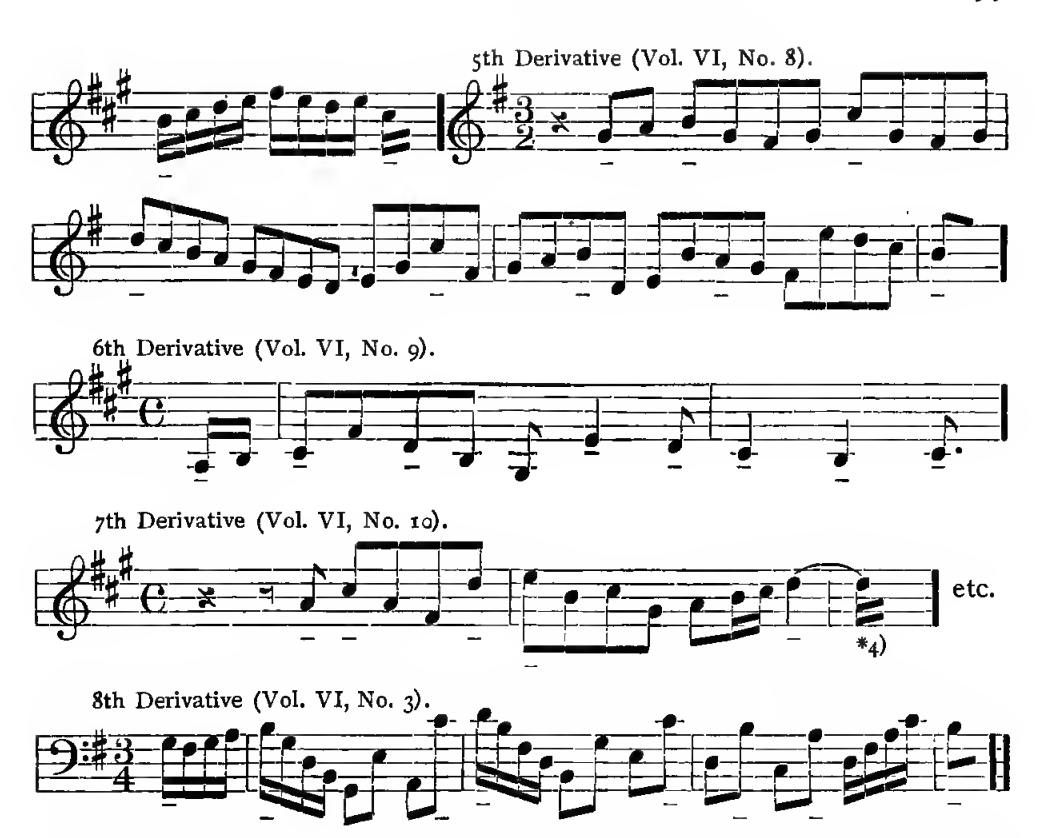
*1) The rhythmic arrangement of the original tones is preserved, in this Derivative; i.e., the accents of the successive groups, regularly, represent the successive chorale notes (marked - -). This is desirable, but not obligatory.
*2) Here the original tones are shifted a trifle; and at
*3) they are transferred to the higher octave.
*4) The remainder of the chorale line is vague, — probably intentionally abandoned.
It will be seen that, despite the freedom in choice and extent of added tones, the Derivatives all bear a distinctly recognizable relation to the original c. f.line; the latter "sounds out " plainly through the new array of tones. Observe the variety of measure (12/8, 3/4, 6/8, 4/4, 3/2).
c. Not infrequently, two or even three Motives are used (par. 52).
d. The introductory measures, or "Prelude," are a regular Exposition of the Motive, as in the Invention, and subject to the same rules (par. 40); but a cadence is not made, as a rule, until the c. J. (the first line of the chorale) has entered and has been conducted to its end.
The first tone of each line of the c. f. must be some chord-interval, but may be either consonance or dissonance (7th, 9th, etc.). The final tone of each line may be Root, 3rd or 5th of the chosen triad, but the latter must be fundamental (Root in Bass).
The c. J. should not be modified, excepting by an occasional, strictly unessential, passing-note; or by some other equally harmless change.
Care must be taken not to proceed into a new chord or key so soon after the final tone of each c. f. line, as to leave the latter (after its cessation) an implied dissonance; that is, the final tone should, for at least a full beat after its conclusion, appear (in the hearer's recollection) to harmonize with the thematic voices, and fade away in their subsequent conduct.
e. The end of each "Line" is, practically, the termination of a Section of the Invention, — though a definite cadence is not obligatory. Each succeeding Section begins with an " Interlude," devoted to continued thematic development in the figural voices while the c. f. voice pauses; very similar in character and conduct to the "Prelude," but more free. The length of these Interludes is optional; usually a measure or two, often more, — the c. f. reëntering, each time, when convenient. Review par. 99.
J. The very last tone of the c. f. (the final tone of the last line) should be a Root, if possible. The voice which has the c. f.— the Soprano, in this instance — may, after prolonging the final tone a few beats, join in the thematic elaboration, usually beginning its participation with an announcement of the Motive. This extension, the "Postlude," may be of any reasonable length.
101. In executing the task, the thematic (or figural) parts and the c. f. (when the latter is present) may be carried along abreast of each other, with constant regard to the announcements of the Motive; or the M. alone may be inserted, beforehand, in one part and then another, where it promises to agree well with the c. f. — somewhat after the manner of leading parts (par. 64, which review).
At all events, the Motive should appear very frequently, if not incessantly, in some part or other; and therefore great freedom may (must) be exercised in rendering the M. adjustable, by altering the quantity of its interval-progressions (rarely, however, by changing its rhythm, excepting for possible Augmentations, complete or partial).
Contrary motion, shifted rhythm, and stretto Imitations are to be freely employed.
The Pedal-bass should be conducted, in general, more quietly than the manual parts. It may, occasionally, be independent (par. 93).. Progressions in alternate opposite direction, with or without skips, are peculiarly adapted to pedal-technique:
Ex129

For general illustration of the process (No. 16 of the above Table
Ex130
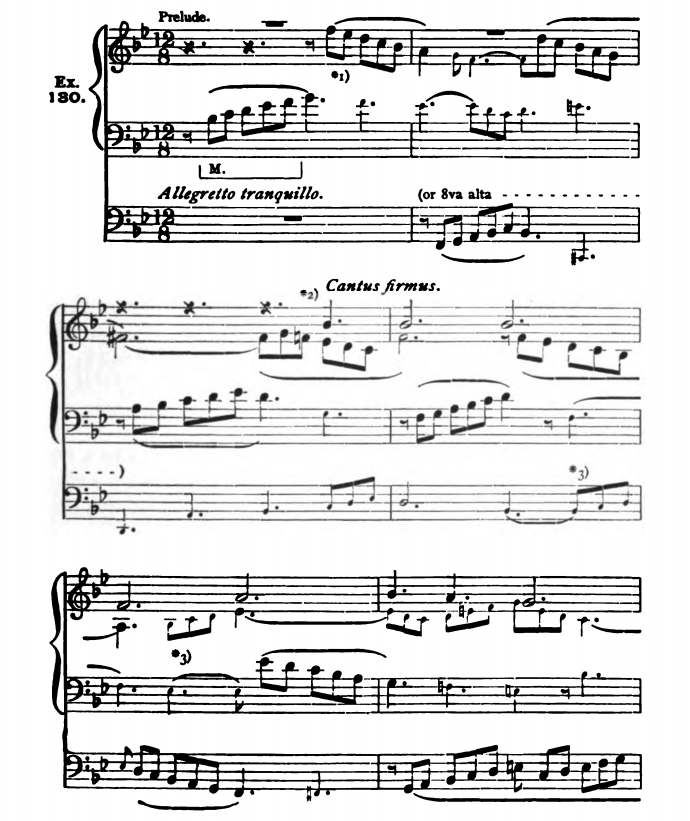
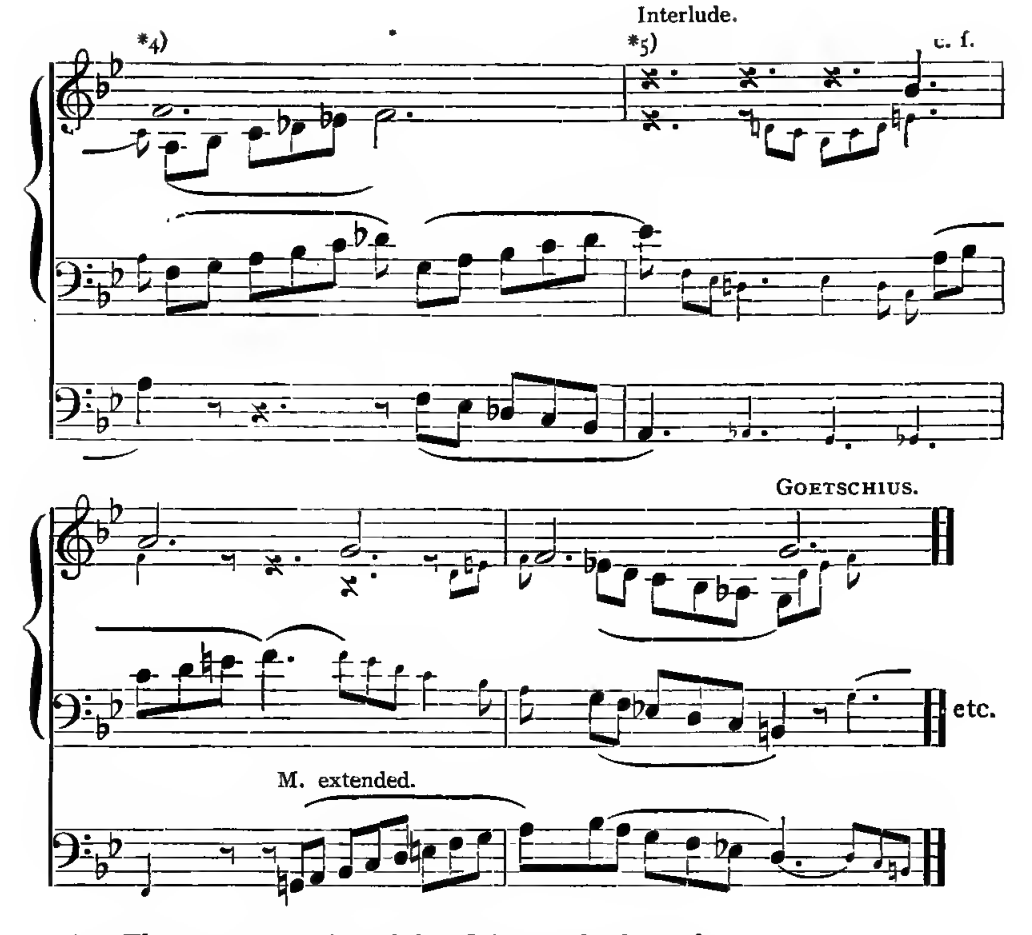
*1) The contrary motion of the M. is very freely used.
*2) The c. J. enters as chord-seventh. See beginning of second Line, also. This is effective.
#3) Fragments of the Motive.
*4) The Line ends as chord-root,
*5) Observe that the abandoned c. f. tone (f) is understood as harmonic tone through the following half-measure; par. 1ood, last clause.
See also Ex. 131, and analyze, thoroughly, the following:
4-voice elaborations. Bach, Organ Comp., Vol. VII, No. 42 (first four measures introductory, but thematic). Vol. VII, No. 48, Verse I (no Pedal; c. f. slightly embellished; an "introductory" motive, and a small figural motive; after entrance of c. f. the Tenor part discontinues). Vol. VI, No. 24 (several small motives; Pedal consists chiefly of canonic Imitations of the c. f. in Soprano).
3-voice elaborations. Bach, Vol. VI, No. 4 (quite free; mostly fragments of motive). Vol. VII, No. 46 (c. f. embellished; two motives; quasi 3-Part Songform).
5-voice elaboration. Bach, Vol. VI, No. Iza (c. J. slightly embellished; quasi two motives, from chorale). — Brahms, Choral-Vorspiele, op. 122, No. 3; c. J. in Sopr., embellished.
Exercise 29
A. Iwo examples of the Invention with chorale (minor and major, respectively), according to the above directions. Cantus firmus in the Soprano; 4-voice; the Motive at least one or two measures long; fairly strict manipulation.
B. One example for 3 voices, preferably for manual (without Pedal-bass). C. One example for 5 voices. Review par. 81. Pedal-bass low.
Cantus firmus in bass
102. When used as lowermost part, the c. f. is written for the Pedals, of course. The final tone of each line must be a chord-root. Especial care must be taken to avoid implied dissonance for a beat or more after the cessation of each final tone (review par. Iood, last clause). All other details correspond precisely to those given above (pars. 100, 10I).
For general illustration (chorale 22 of the Table):
Ex131
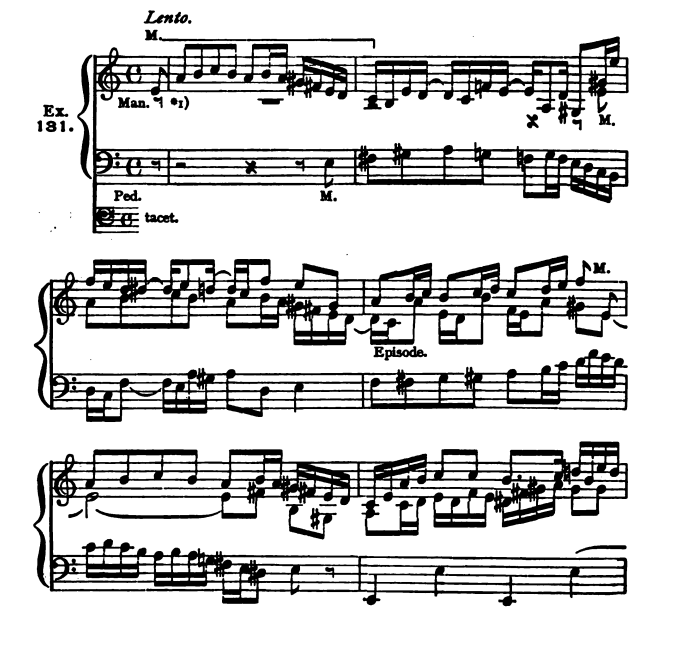
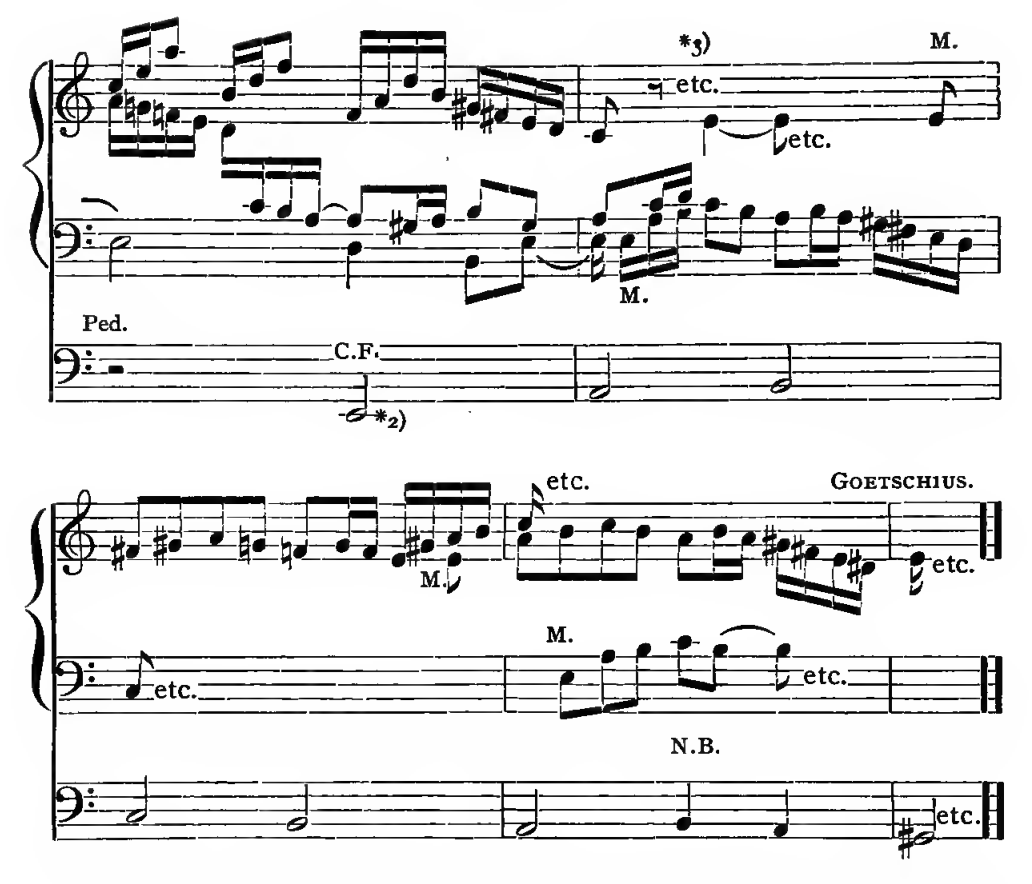
*1) The Motive is derived from the first Line of the chorale (par. 100b).
*2) The c. f. enters with a harsh dissonance; but its relation to the preceding bass tone (organ-point e), and its location as lowermost tone, render it permissible and extremely effective.
*3) From here on, the contrapuntal parts are purposely omitted, so as to exhibit more clearly the manner and places in which the M. is inserted. See par. I01, first clause.
Bach, Organ Comp., Vol. VII, No. 35, Stanza II (meas. II to end); M. small, —
Bach, Vol. VII, No. 51; 3 Motives, — M. I during Part I, meas. I-12; M. 2 from meas. 13-19, thereatter in alternation with M. I, to meas. 31; M. 3 from meas. 32 to 36, thereafter in alternation with M. I to end; 4-voice. Vol. VII, No. 36; very elabo rate, quasi Fantasia (par. 109); 4-voice; 2 motives in close alternation; a new, 3rd, M. is added for the last Line.
Cantus firmus in tenor
103. The general details agree exactly with those given for the Soprano.
a. The c. J. may be written in the Tenor part in the usual manner; but it is desirable, and customary, so to arrange the parts that the chorale melody may be made prominent by being played upon a separate (louder) manual of the organ. In this case it stands alone on the middle staff, and, during its presence, the two thematic voices above it (Soprano and Alto) must be so written that they are playable together with one hand (ie., within the compass of an octave). During the Prelude and the Interludes, this restraint is, of course, removed.
b. Or, the c. f. may be assigned to the Pedals (written in Bass register), and played with a 4-foot stop, so as to sound an octave higher, — ie., in Tenor register. The middle staff then belongs to the Bass proper, and care must be taken to keep it below the c. f. (Tenor), as a rule; and, being played with the hand, it may be more free and lively than an ordinary Pedal-bass.
See Bach, Organ Comp., Vol. VI, No. 126; 4-voice; c. J. written in Tenor part, somewhat embellished ; M. in Soprano, meas. I-4, derived from c. f
Vol. VII, No. 56; 4-voice; c. f. written in Pedal (in Tenor register); M. in Bass, ½ measure (free).
Vol. VII, No. 63; 3-voice; c. f. in Pedal, as Tenor; M. in upper part, 1 measure
Vol. VII, No. 59; 4-voice; 2-Part Song-form, M. for each Part, derived from .. f.; Bass chiefly independent, but based on a fragment of M. I; c. f. in Pedal, an 8ve below Tenor register.
Vol. VII, No. 38; 3-voice; c. f. in Pedal, slightly embellished; each voice its independent M.
Mozart, " Magic Flute," Finale of ad Act, Adagio, ₵-time, c minor (scene with "2 men in armor"); 4-voice, c. f. doubled in 8ves; small motive, one measure, and thematic Figure of 3 notes.
Cantus firmus in alto
104. This is rare, especially in 4-voice counterpoint. Rules the
same as for Soprano.
See Bach, Vol. VI, No. 5; 3-voice, no Pedal; 2 Motives (Soprano, meas. 3 and meas. 5) in close alternation and occasional conjunction.
Vol. VI, No. 16; 3-voice, no Pedal; 2-Part Form, and 2 Motives, derived from
Vol. VII, No. 48, Stanza II; 3-voice, no Pedal; small figural MI.
Cantus firmus in alternate voices
105. Successive Lines of the chorale may be assigned to different voices; or, if definite 2- or 3-Part Form, different voices may assure the successive Parts. Or, at any point where it appears desirable or convenient, a change of voice may be made, — never, however, during a Line of the chorale.
On the termination of its share of the c. f., the voice in question may (as at the end, during the Postlude — see par. 100/) immediately join the contrapuntal parts, usually, here again, with an announcement of the Motive.
The voice to which the c. f. is next to be given must rest during the whole (or a good portion) of that Interlude.
The choice of voice for the c. f. is wholly optional; but some attention is due to technical considerations; and the voices should be so written that, if possible, the c. f. may be played upon a separate manual, — when not in the Pedal-bass (comp. par. Ioза).
See Bach, Vol. VI, No. 6; 3-voice; some of the Lines are repeated; the rests before the c. f. are very brief; Pedal independent.
Vol. VI, No. 29, Division I (f time); 3-voice; 2 Motives in conjunction (Double counterpoint).
Raff, Pianoforte Suite, op. 71, " Preludio" (c. f. original).
Exercise 30
A. An example with c. f. in Bass; 4-voice; one Motive; strict manipulation.
B. C. f. in Tenor, written on middle staff; 4-voice. C. C. f. in Tenor, written in Pedal; 4-voice.
D. C. f. in Alternate voices; one Motive; 4-voice.
E. C. f. in Alto; 3-voice; one Motive.
F. C. f. optional; 4-voice; two Motives, one for each Part of chorale.
G. 5-voice; two Motives.
Second variety: chorale as invention-group
106. This variety differs from the preceding only in that a nee Motive is devised and used for each Line of the chorale in succession. Consequently, each Line appears to constitute a complete brief Invention by itself, usually with a fairly decided cadence; and the whole is a group of Inventions.
As a rule (though not necessarily), the Motives are each time derived from the corresponding (following) Line of the chorale. They will, therefore, be independent; but they should all agree with each other pretty closely in character, especially as concerns their rhythmic formation. The first Motive may be reverted to, incidentally, at any moment. All rules as before.
See Bach, Organ Comp., Vol. VI, No. I4; 4-voice; c. f. in Soprano; new M. for each Line, in almost regular alternation with the contrary motion, and in stretto (comp. par. 73a).
Vol. VI, No. 23; 4-voice; c. f. in Soprano.
Vol. VI, No. I; 4-voice; c. f. in Soprano; Motives from chorale, but distributed irregularly.
Vol. VII, No. 43; 4 voice; .. f. in Soprano; M. for each Line, but only as Prelude — not with the c. J.
Vol. VII, No. 58; 4-voice; c. J. in Soprano, slightly embellished; M. in regular and contrary motion, — par. 73a.
Vol. VII, No. 48, Stanza III; 4-voice; .. f. in Bass; four Motives, invented free — not derived from chorale lines; M. 4 " per moto contrario."
Vol. VI, No. 32; 4-voice, manuals; c. f. in Soprano; M. for each of first 3 Lines, invented without reference to chorale; last Line in alternating voices, Double counterpoint.
EXERCISE 3l.
Tro or three examples (minor and major) of the above variety.
Third variety: chorale as aria
107. This species of manipulation differs considerably from the specifically polyphonic elaborations of the chorale-accompaniment, inasmuch as it affects, chiefly, the chorale-melody itself, while the accounpanying voices may be simply of a general imitatory character, or nearly (or quite) homophonic. Review, thoroughly, par. 91, especially b.
The main object is, so to embellish the c. f. tones with auxiliary notes (passing-, neighboring-notes, etc., in florid rhythmic form) that the original stern chorale-melody is completely transformed into a graceful (though dignified and impressive) Zyric melody or "Aria." This dissolution of the c. f. must be so effected, however, as to preserve the original rhythmic disposition of the tones, ie., the distinction of accented and unaccented tones, as closely as possible, — so that the ornate product, reduced to its tonal elements (at accented points), would correspond nearly to the original chorale. Hence, while the embellishment may include many additional tones (perhaps distant from the given ones), and may tend to shift certain of the given tones past their primary place at the beginning of their respective beats, it is rarely justifiable to evade the tone altogether, or to shift it entirely beyond its beat, into the next; and it is still inore rare to anticipate a given tone, by shifting it back into the preceding beat. At the same time, it will be found possible to exercise considerable freedom, totally eradicating all resemblance to the chorale, and still preserve the fundamental melodic design of the original.
The chorale-Aria is almost always placed in the Soprano; the lower accompanying parts may be purely homophonic, — slightly figurated, — or imitatory, without being thematic; or, more rarely, they may adopt and manipulate a Motive, as in the 1st Variety. The Pedal-bass is frequently independent, and of a quiet rhythmic character.
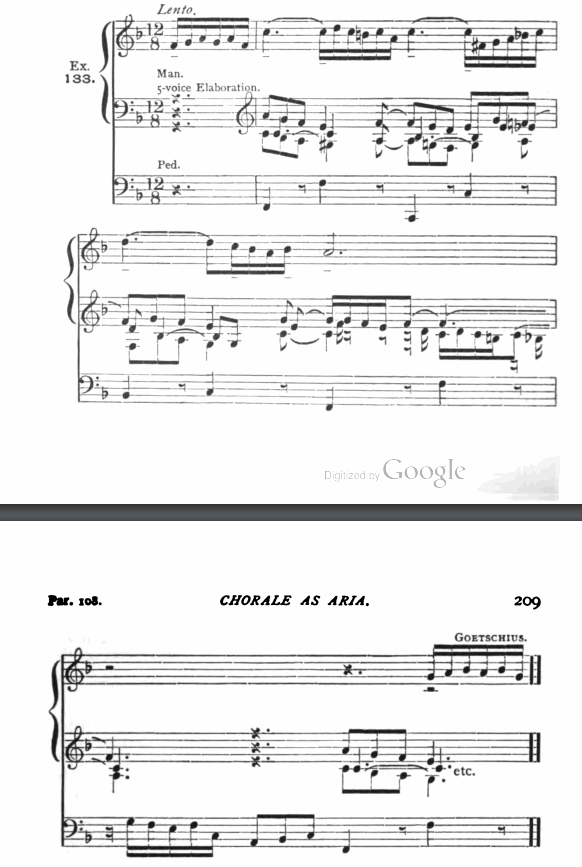
For illustration of the treatment of the chorale:
Ex132
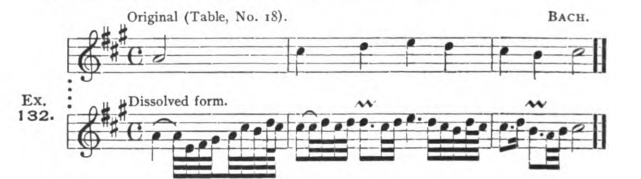
TableNo25

Ex133
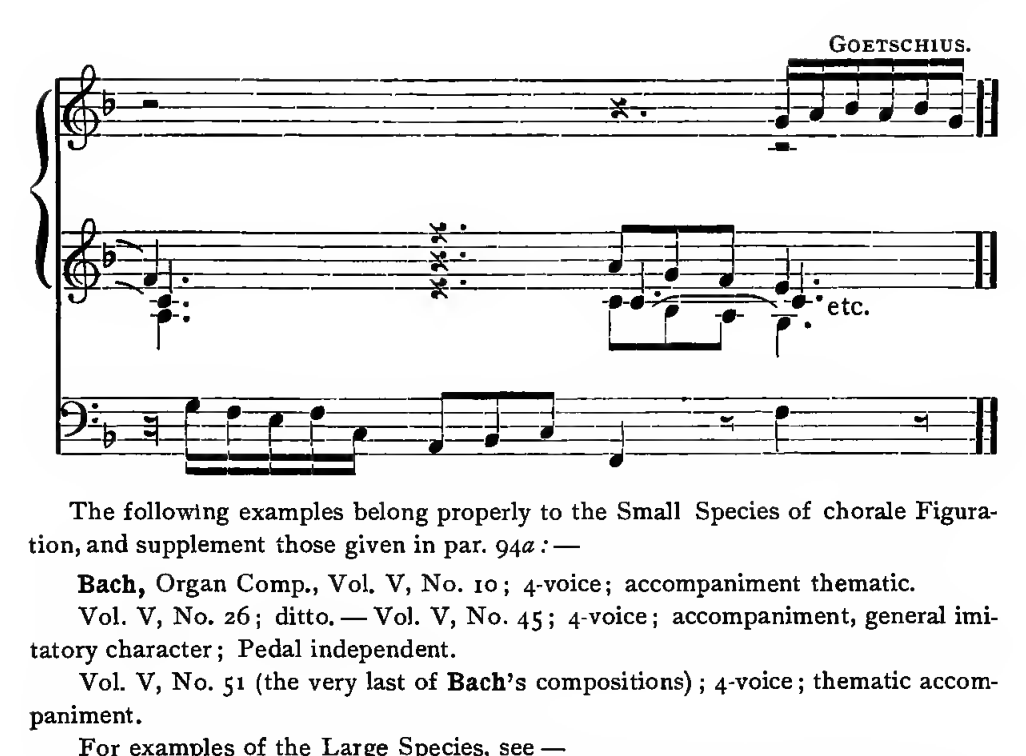
The following examples belong properly to the Small Species of chorale Figuration, and supplement those given in par. 94a:-
Bach, Organ Comp., Vol, V, No. 10; 4-voice; accompaniment thematic.
Vol. V, No. 26; ditto. — Vol. V, No. 45; 4-voice; accompaniment, general imi-
Vol. V, No. 51 (the very last of Bach's compositions); 4-voice; thematic accom-
For examples of the Large Species, see -
Bach, Organ Comp., Vol. VII, No. 49; 4-voice; c. f. in Soprano, profusely embellished; Pedal independent; inner paris imitatory, but not strictly thematic.
Vol. VII, No. 45; 4-voice, c. f. in Soprano, copiously embellished, and extended — each Line similarly —in its course; Pedal independent (running auxiliary part) ; inner voices free.
Vol. VI, No. 9; 4-voice; c. f. in Soprano; inner parts thematic; 3 Motives (meas. I in Tenor, meas. 2 in Alto, end of meas. z in both parts) in close alternation and conjunction; Pedal uses first M. frequently.
Vol. VI, No. 8; 4-voice; c. f. in Tenor, richly embellished and expanded; Pedal independent; thematic upper parts quite elaborate.
Fourth variety: ritornelle with chorale
108. In this variety the Motive (or, more properly, Theme) is much longer than in the foregoing; generally a complete 8-measure Period, or extended Period, or even Double-period. It is frequently a sort of running voice, in nearly or quite uniform rhythm; but sometimes a lyric melody of striking, impressive character. It may be invented entirely free, or (as is more common) may be derived from a Line or two of the c. f., as an elaborate embellishment and radical modification of the latter.
This Theme appears as an introduction (or Prelude), usually with complete perfect cadence; recurs, generally at its full length, as an
Interlude (once or twice, according to the length of the chorale), and again as a Postlude, — hence the term "Ritornelle" During the chorale lines it is present in fragments only.
See Bach, Organ Comp., Vol. VI, No. 2; 3-voice: c. f. in Soprano; Pedal independent. Vol. VI, No. I7; 4-voice; c. f. in Bass; long Theme, in Tenor; upper two parts constantly imitatory. Vol. VI, No. 3; 2-voice, no Pedal; c. f. in Soprano; M. from c. f., treated with great freedom. Vol. VII, No. 44; 3-voice; c. f. in Pedal, as Tenor; quasi running parts, independent rhythms. — Brahms, Choral-Vorspiele, op. 122, No. 4; .. f. in Sopr.; 4-voice; Ped. indep. — No. 7; c. f. in Sopr. and Bass alternately; 3 to 6-voice. — No. I0; c. f. in Ped. as Tenor; 4-voice.
Fifth variety: chorale-fantasia
109. The c. J. may consist of a portion, or portions, of the original chorale, instead of the whole; possibly of one or two characteristic lines only; or even of certain distinctive members of the lines (naturally the very beginning, or ending, of the chorale). These may appear in optional succession and frequency, generally in different parts, and in different keys and registers.
The accompanying voices may be conducted with great freedom; they are generally imitatory, but not necessarily thematic; and are likely to contain many, more or less disguised, allusions to the chorale.
The form is optional, but is most likely to be sectional, or " group," design. A certain progressive structural idea should be embodied, as general outline, and one or more effective climaxes introduced. Review, carefully, par. 85.
See Bach, Organ Comp., Vol. VI, No. 22; 3-voice; c. f. embellished (at times) in alternate voices; accompaniment not thematic; treatment distinctly " Fantasia"- like.
Vol. VI, No. 7; 3-voice; Pedal independent; upper parts imitatory and generally thematic; form sectional, and very clear, with many confirmations; first too lines of chorale in Pedal, at the end.
Vol. VI, No. 15; 2- to 4-voice.
Vol. VI, No. 27; 3-voice; quasi chorale-Invention (par. 110); chorale in Pedal, during final Sections.
Vol. V, No. 34; 4-voice; built upon fragments of chorale; definite Sectionai form; Pedal quasi "basso ostinato" (i.e., consisting in repetitions of the same Figure, generally upon the same scale-steps).
Vol. VII, No. 36 (already cited; quasi long Invention with chorale, but of free "Fantasia" character).
Exercise 32
A. One or two examples of the Chorale as Aria.
B. One or two examples of the Ritornelle with Chorale.
C. One or two examples of the Chorale-Fantasia.
Sixth variety: chorale-invention, or prelude
110. See par. 83c. • In this variety the chorale, as. c. f., does not appear. The whole is an Invention (as chorale-Prelude) of the usual character, based upon a Motive, or Motives, derived from the first Line of the chorale (or from some other characteristic Line).
See Bach, Organ Comp., Vol. VII, No. 40A, and No. 40B; 4-voice; 3 Sections. Vol. VI, No. 27 (already cited, quasi " Fantasia").
Vol. V, page 70, Partita III (also Partita V, same Motive, different treatment; 3-voice).
Vol. V, page 73 (4-voice, chromatic).
Vol. V, page 83 (4-voice).
Vol. V, page 84 (4 to 5-voice, Pedal independent).
Chorale variations
111. A number of different elaborations of the same chorale, in the various methods shown above, may be associated as a set of Variations. The manner in which the Varieties of manipulation are chosen, and the number of variations collected, are subject to no rule; but decided contrast (especially in reference to rhythm and measure) must be obtained; and the interest should be progressively increased, by choosing the more elaborate and effective species for the final numbers.
See Bach, Organ Comp., Vol. V, pages 60-67; 68-75; 76-91. Mendelssohn, Organ Sonata, op. 65, No. 6, movements one to four (up to the Fugue). Brahms, Motet, op. 74, No. z; chorale in first verse, with contrapuntal accomp.; the following 3 verses (II, III, and IV) are elaborations with the c. f: (more or less embel.) in different voices.
Exercise 33
A. One or two examples of the Chorale-Invention.
B. One or more sets of Chorale-Variations.
In conclusion, attention is directed to a scholarly collection of "200 Choral- Vorspiele " by CarL PIUTTI, in which the principal varieties of manipulation are represented.
Division four
The fugue
Introductory
112. The Fugue differs from the Invention chiefly in being a more strict and serious contrapuntal form. Review par. 37. While the Invention is subject only to the general conditions of contrapuntal treatment, the Fugue, on the other hand, involves certain special conditions and limitations.
These special qualities, which distinguish the Fugue, are as follows:
(1) The Subject or Theme of a Fugue is usually more extended, and has a more definite form, than the " Motive";
(2) The Subject is first announced alone, in a Fugue, unattended by auxiliary tones;
(3) During the first Section, or Exposition, the Subject is (as a rule) announced alternately in the Tonic and Dominant keys, i.e., it is imitated alternately in the 5th and 8ve; and
(4) There is, throughout, less freedom of detail, and greater seriousness of character and manipulation.
The fugue-subject
113. The thematic germ of a Fugue is called "Subject" or "Theme."
The former term is used in a specific sense; the term "Theme " as a general designation of the thematic basis.
a. It is, with rare exceptions, definite in form, being either a complete Phrase or (more rarely) Period, and closing as a rule with a distinctly cadential effect. Its length is optional, — from one large measure (Bach, Well-temp. Clav., Vol. I, Fugue 17) up to 6, 8, or even more measures (Bach, Well-temp. Clav., Vol. II, Fugue 15; Organ Comp., Peters compl. ed., Vol. III, Fugues Nos. 3 and 8).
b. Generally it begins either upon the 1st, 3rd, or 5th scale-step of the key; but in any case the Tonic note should appear near (if not at) the beginning. It may begin upon an accented beat, or upon the preceding unaccented beat; but by far the best and most common practice is to begin the Subject with a brief rest, ie., immediately after an accent
It ends, frequently, upon the 3rd scale-step, or upon the Tonic (more rarely upon the Dominant), of the principal key; or upon the Tonic or 3rd step of the Dominant key. Other cadences are possible, but very rare. The final tone falls usually upon an accented beat, and produces a decided cadential impression; but thete are exceptions to this rule, and it is sometimes difficult to determine precisely where the Subject terminates (see Bach, Well-temp. Clav., Vol. I, Fugue 9, — doubtful whether the Subject ends on 3rd beat of second measure, or on 1st beat of third measure). The Subject may contain transient modulations, in its course, but can scarcely end in any other than the principal, or the Dominant, key; possibly in the Relative major, from minor.
c. As Subject of a Fugue, and as complete melodic sentence, it should be distinctly individualized. Its melodic and rhythmic contents must be serious, but characteristic, and pregnant (susceptible of manifold polyphonic manipulation); and its delineation must be distinct and moderately striking, — to the exclusion of vagueness, of a too lyric melodic form, but also of eccentricity. Sequences are seldom absent, in good Subjects; the harmonic basis is clear, natural, and forcible; and there is usually at least one salient rhythmic feature (an effective tie, syncopation, or contrasting figure). The compass of effective Subjects seldom runs beyond an octave. Review par. 38a.
Exercise 34
A. Inspect, minutely, every Fugue-Subject in both volumes of Bach's Well. tempered Clavichord, with reference to each detail given above.
B. Write a large number of original Subjects.
The construction of the " response."
114. As stated above, the Subject or Theme is to appear, during the first Section (the Exposition) of a Fugue, first in the principal key, then in the Dominant key, and so on, alternately in the Tonic and Dominant registers, as far as the number of voices dictates.
The first announcement (tonic) is called the Subject proper; the second announcement (dominant) is called the Response or Answer.
115. In order to place it in the Dominant key, the Subject must be imitated in the perfect 5th above (or perfect 4th below). Hence, the fundamental rule for the construction of the Response is:
To imitate each tone of the Subject in the perfect fifth.
This gives what is known as the " real " Response or Answer. For example:
Ex134
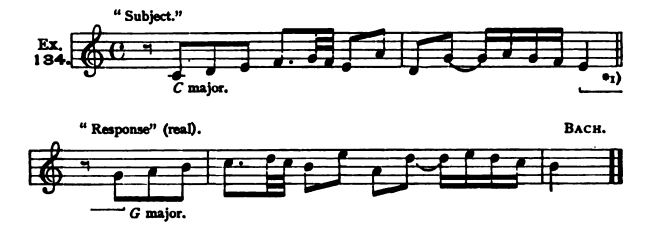
#1) The adjustment is perfect, and no circumstance exists which would necessitate an exception to the fundamental rule.
116. But this strict imitation often gives rise to awkward or abrupt modulation, and a lack of adjustment at the extremes (beginning or end) of the Response. The element invariably involved in such embarrassment is the Dominant. Hence, the first general exception to the fundamental rule is :
That the Dominant element, wherever peculiarly conspicuous in the Subject, is to be imitated in the perfect fourth, instead of 5th.
a. This applies (1) to the Dominant tone at the very beginning; or (2) near the beginning (as zd, 3rd, or 4th tone of the Subject, especially when connected with the Tonic note); (3) to all tones inseparably connected with this initial Dominant (as embellishment, repetitions, and the like); (4) to a strong Dominant chord-impression at, or very near, the beginning; (5) to the cadence in the Dominant key (at the end of the Subject); and (6) to all tones that pertain inseparably to this final Dominant. All such tones should be imitated in the perfect 4th.
This is called the "tonal" Response.
117. a. The Dominant note at the beginning. For illustration:
Ex135
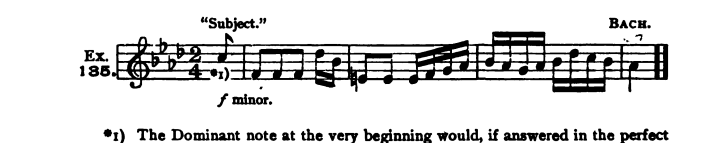
*1) The Dominant note at the very beginning would, if answered in the perfect 5th, transfer the Response abruptly, and bodily, into the Dominant key (c minor).
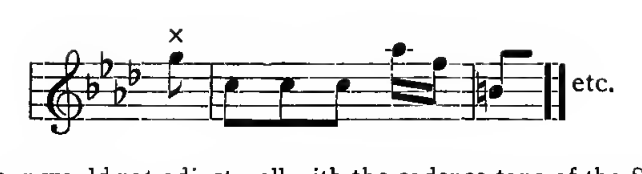
Thus:
The first tone, g, would not adjust well with the cadence tone of the Subject (ab). In a word, this initial g' is the Second-dominant (Dominant of the Dominant) in the key of f minor thus far pursued; and while this comparatively remote tone, or any other, can be reached in time, it is certain to sound abrupt at the very beginning of the Response. Therefore the above Subject is imitated as follows, the first (Dominant) tone in the 4th, and the remainder, as usual, in the 5th:
Ex136
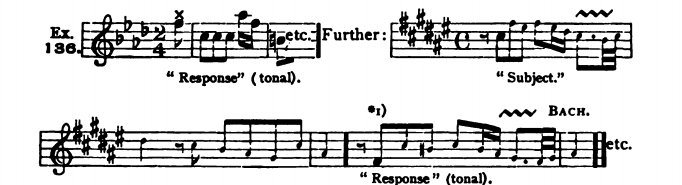
By this means the Response is retained for an instant in the original key, until perfect adjustment, at the beginning, is secured. It is called the "tonal" Response because of this (at least temporary) adherence to the tonality of the Fugue; the Tonic elements | being answered by the Dominant, and the Dominant elements (where salient) by the Tonic (imitation in the 4th).
*I) All large notes indicate the imitation in the 4th; the small notes that in the 5th.
b. The Dominant note near the beginning:
Ex137-1

Ex137-2

This always applies to the Dominant as second note of the Subject, when it follows the Tonic; and, in case the initial Tonic note is embellished, it may be the 3rd or 4th tone of the Subject. Thus:
Ex138-1

Ex138-2

*1) The initial Tonic (f) is simply embellished; therefore the Dominant (as 4th tone, c) is near enough to the beginning to be the second essential tone.
*2) The second tone of the subject (e) is here imitated in the diminished 5th (bb). Similar substitutions of the diminished or augmented 5th (and 4th) for the perfect 5th (and 4th) are quite common, and are due to the very same principle that gives rise to the general exception under discussion (par. 116). See Note to Ex. 136. Here the 6b confirms the principal key, F major. — See also Ex. 146, No. 3.
*3) Same as Note *2).
c. Repetitions or embellishments of the Dominant, at or near the beginning:
Ex139-1

Ex139-2

Ex139-3

Or, adding to this last Theme (Ex. I39-3) various embellishments of the initial Tonic (as in Ex. 138), the results would be:
Ex140
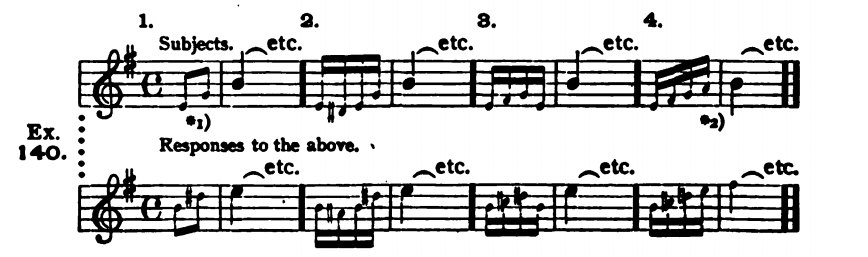
*I) In every case (excepting No. 4) this & is imitated in the augmented 5th , (d♯), because of the principal key. Comp. Ex. 138, Note *2).
*2) No. 4 is a regular (real) Response. The tone a in the Subject changes the whole situation. Partly because the a does not pertain to the initial Tonic, and partly for reasons given in par. 118, the Dominant 6 must be answered in the 5th. See further Ex. 145, No. 6.
d. A cluster of tones at (or very near) the beginning, that constitute a very obvious Dominant chord:
Ex141-1

Ex141-2

See also Ex. 144, No. 3.
e. As declared in par. II6a (3), all tones that pertain inseparably to the Dominant at or near the beginning of the Subject, share with it in the exception to the rule. To this class belong the repetitions and embellishments illustrated in Ex. 139; also a diatonic run from the initial Tonic down to the Dominant; thus :
Ex142

Possibly also the nearly continuous run from Tonic up to Dominant:
Ex143
This comes under the head of Ex. 140; but there is a subtle distinction between it. and Ex. 140, No. 4 (which it, closely resembles), that is left to the student's analysis.
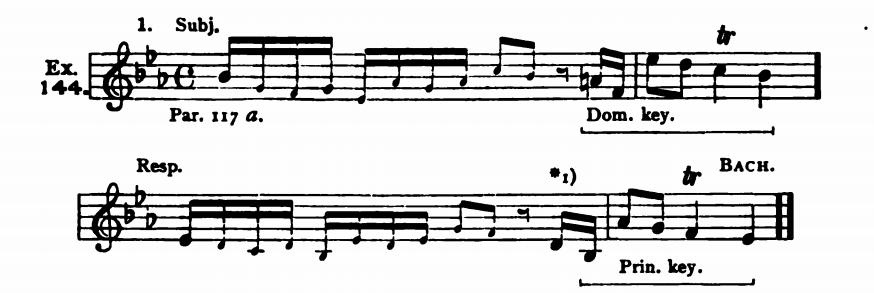
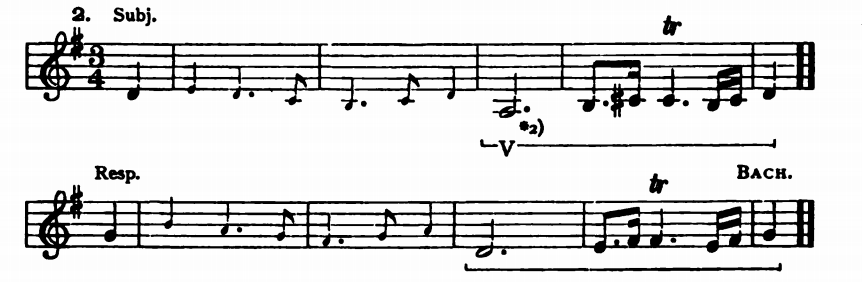
j. Finally, the Dominant key, at the end of the Subject, when introduced by a palpable modulation, is subject to the exception. Thus:
Ex144-1
Ex144-2
Ex144-3
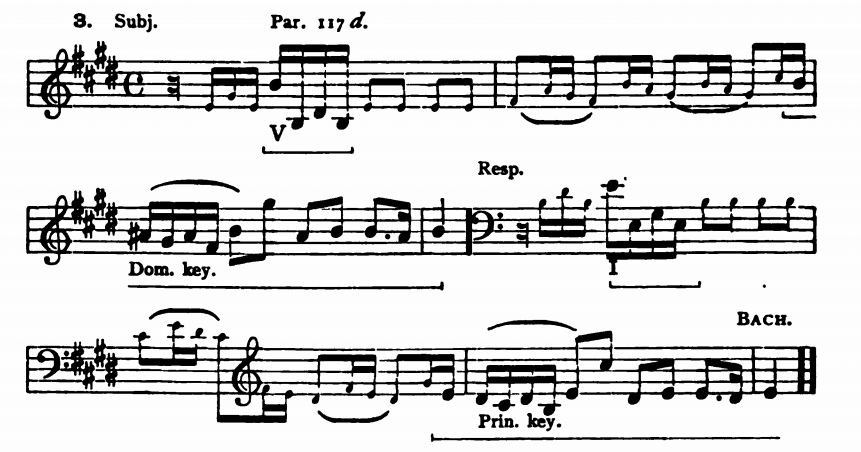
*1) An important question in connection with the final Dominant key is, how far back from the end the imitation in the 4th is to extend. It is best solved according to the principle of par. 117e; — all tones that are inseparable from the final Dominant, as belonging obviously to the total impression of the "Dominant key," are imitated in the 4th. In the above case the tonal imitation begins at the very point where the modulation was made, in the Subject; and, further, at the rest which marks a semicadence.
*2) Here Bach appears to regard the a (3rd measure of Subject) as inseparable from the following modulatory movement into the Dominant key, and therefore begins the imitation in the 4th at that point.
g. The puzzling questions can, in many instances, be determined only by carefully testing the effect, and preserving a good, smooth, modulatory and melodic result. The trouble consists, as stated, simply in deciding which tones . are inseparably connected with the Dominant; and this may depend upon the melodic structure, the modulation, rhythm, or other circumstances bearing upon the characteristic formation of the Subject as a whole. Therefore, the ultimate decision is, here and elsewhere, very often indeed a matter of common-sense judgment, or individual taste.
118. Partly in keeping with this last idea, and partly for general reasons, a third rule must be observed, which constitutes in a sense an exception to the rule of tonal imitation (par. II6), and therefore reverts partially to the fundamental rule, namely:
Under no circumstances shall any characteristic feature of the Theme be violated.
Consequently, neither the real nor the tonal imitation can be insisted upon at any point where they threaten any tone or figure of the Subject that is significant or characteristic. For illustration:
Ex145-1
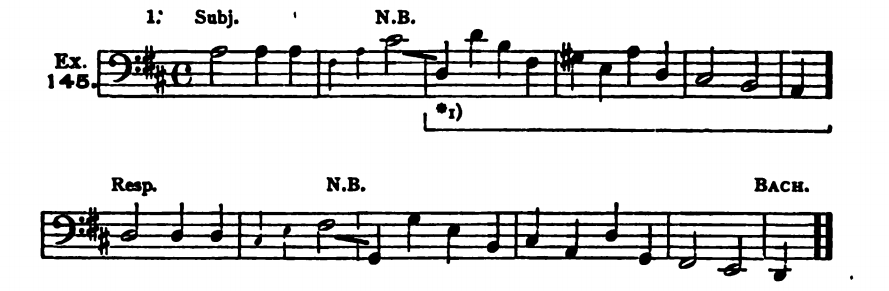
Ex145-2-3
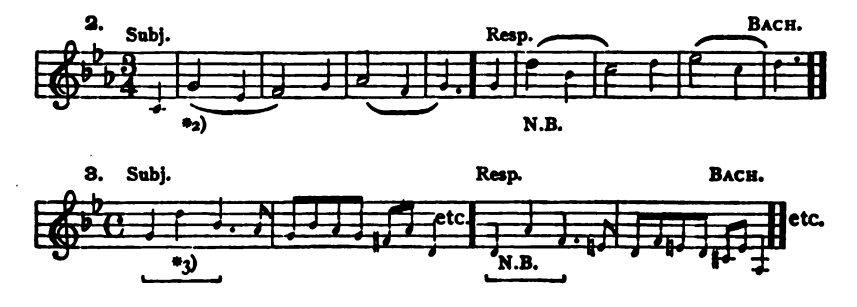
Ex145-4-5
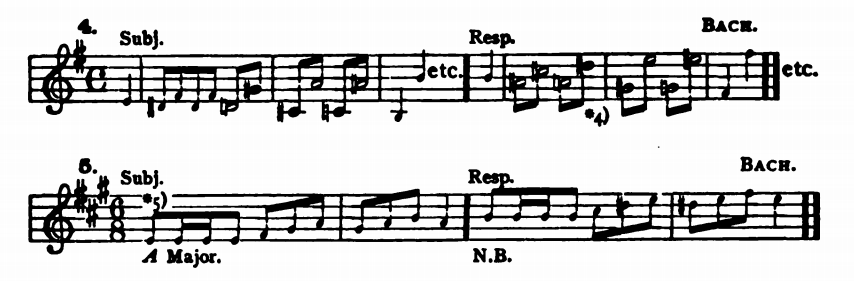
Ex145-6-7
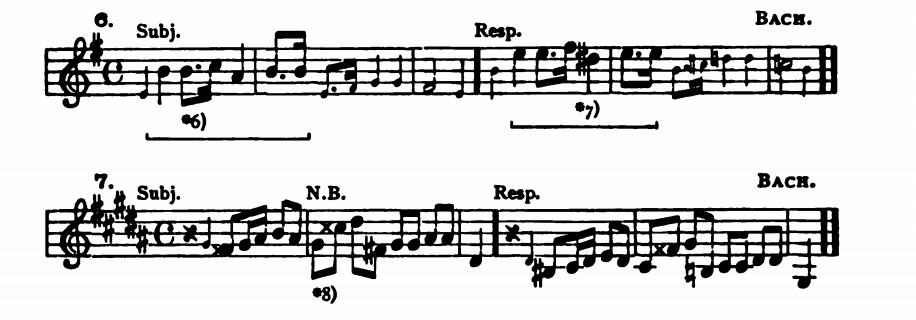
*1) These tones are all harmonically inseparable from the Dominant modulation; and the preceding interval (falling 7th) is so characteristic that it, too, is included in the tonal imitation.
*2) This g is a conspicuous Dominant note, near the beginning; but it is answered in the 5th, because of the sequential formation of the Theme.
*3) Bach evidently regarded this d (Dominant near the beginning) as an essential harmonic factor of his Theme, and imitates it in the 5th to preserve the triadeffect of the first figure.
*4) A remote key, but unavoidable because of the definite chromatic character of the Subject.
*5) Dominant as first tone, —imitated in the 5th, with its repetitions, apparently because of the structure of the whole Theme. Comp. Ex. 149, Note *2).
" *6) To Bach this was a tone-group inseparable from the Dominant (6), and therefore the whole figure reappears in the 4th.
*7) Augmented 4th; see Ex. 138, Note *2).
*8) This peculiar leap of an Augmented 4th is an inviolable trait of the Theme, and therefore it renders the foregoing tones likewise inseparable from the final Dominant key, — back to the second tone of the Subject.
119. The single Dominant note at the end of a Subject is not to be imitated in the 4th (tonal), unless it is strongly suggestive of the Dominant key, or Dominant chord:
Ex146-1-2
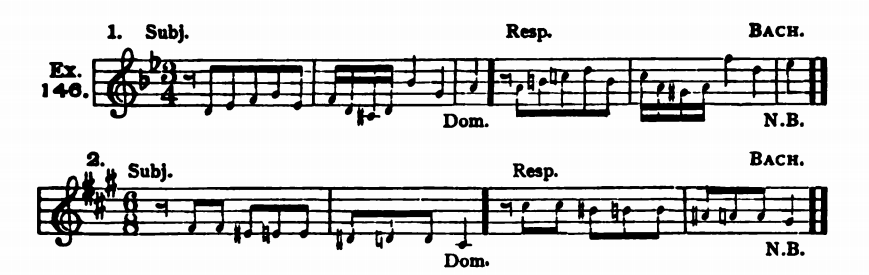
Ex146-3-4
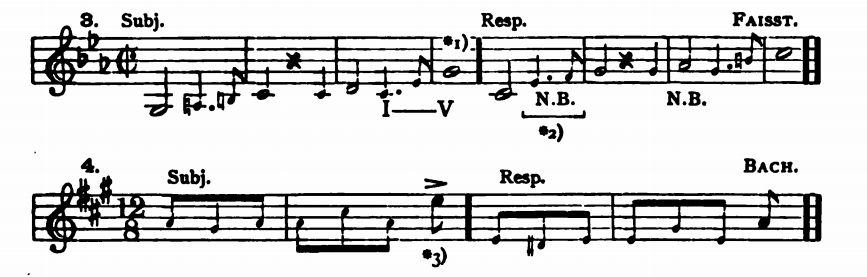
*I) This final Dominant note is more strongly indicative of the Dominant chord than those of the preceding examples, because it occurs at the bar, where a change of harmony (from the foregoing I) is expected. Therefore, it is imitated in the 4th, — although the 5th (d) would have been entirely defensible.
*2) At the points marked N. B. the necessity of using diminished (instead of perfect) 5ths, in order to obtain a sensible and natural total modulatory result, is strikingly illustrated. Comp. Ex. 138, Note *2).
*3) This case is similar to No. 3, being an accent, and therefore suggesting a change of harmony (from I to V). Besides, the whole Theme is so brief, and so nearly all Tonic, that the final Dominant seems near enough to the beginning to demand tonal treatment (par. 1176).
120. a. When the Theme begins with the Dominant note, and also ends in the Dominant key, it may be possible, and necessary, to imitate the initial Dominant in the 5th. Thus:
Ex147
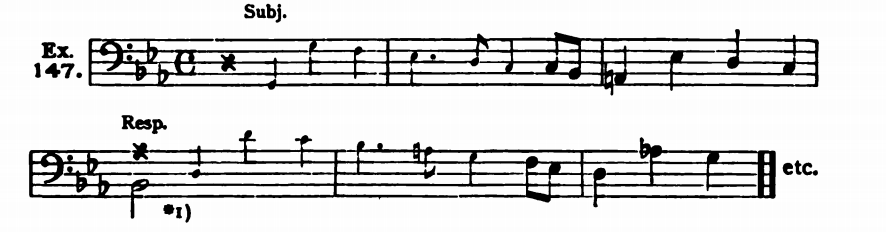
*1) As the Dominant key has already been reached, there is no danger of imper. fect adjuștment, and therefore the " real" imitation is entirely feasible.
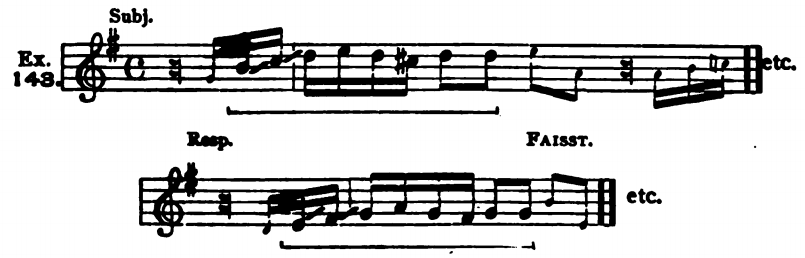
b. Further, when the Dominant effect prevails decidedly through the whole or a great part of the Theme, it may be necessary to imitate it in the 4th throughout. Thus:
Ex148-1
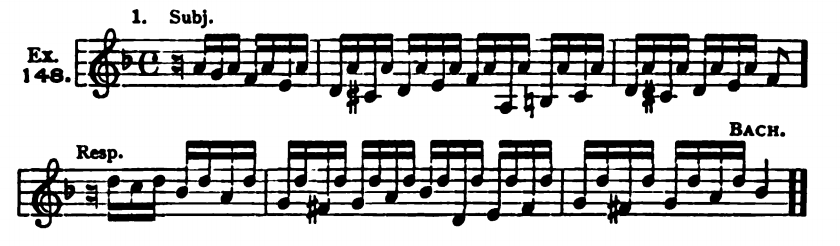
Ex148-2
In both of these cases all that is not actually Dominant appears to be inseparable from the prevailing Dominant effect.
Ex149-1-2
Ex149-3


Possible, and not improbable. Probably the best Response.
Ex149-4-5
Ex149-6
Ex149-7
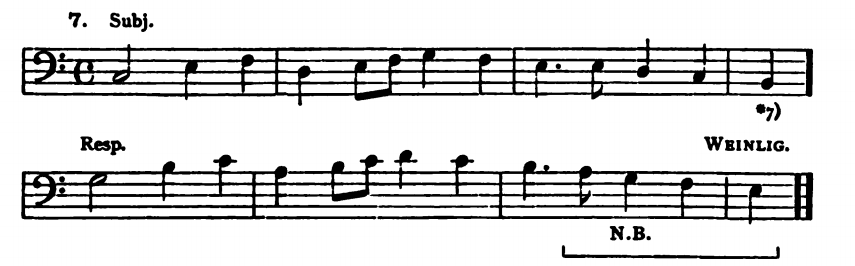
Ex149-8
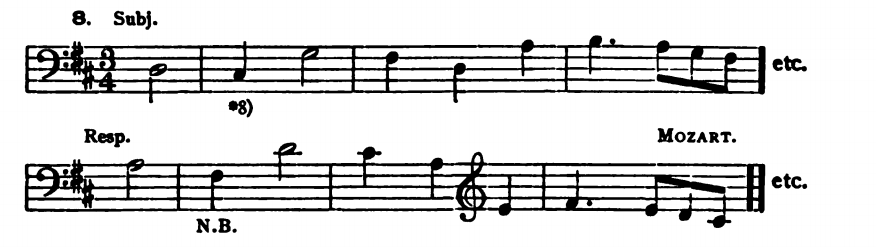
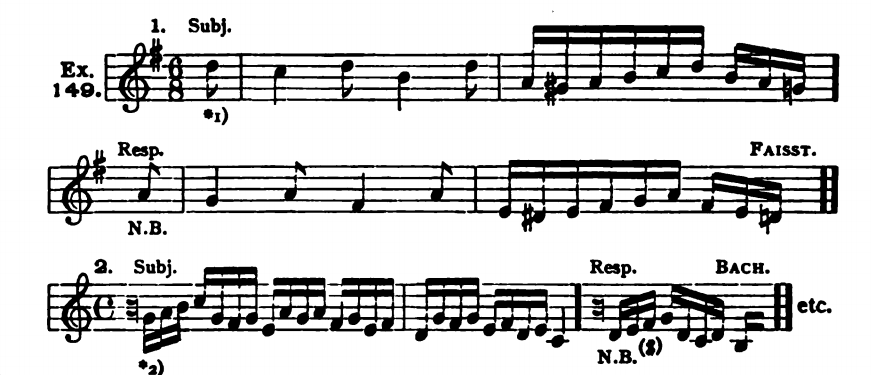
*1) This initial Dominant is answered in the 5th (contrary to par. 116a), because of the characteristic formation of the Theme. Comp. par. 118.
*2) The initial Dominant is here simply one of a series of unimportant passingnotes leading into the Tonic, and is therefore answered in the 5th. Further, Bach chooses fI for the 3rd tone of the Response (instead of the expected f"), in order to preserve for an instant the impression of the original key.
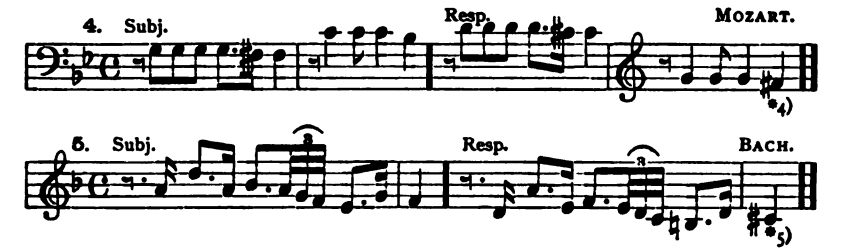
*3) In case Response (c) were to be chosen, this would be 62 in preference to 6b. Otherwise, the latter is more probable.
*4) The final tone is imitated in the augmented 4th, to preserve closer relation to the original key, — probably because the Subject is brief. Compare Ex. 138, Note *2).
*5) Same as Note *4).
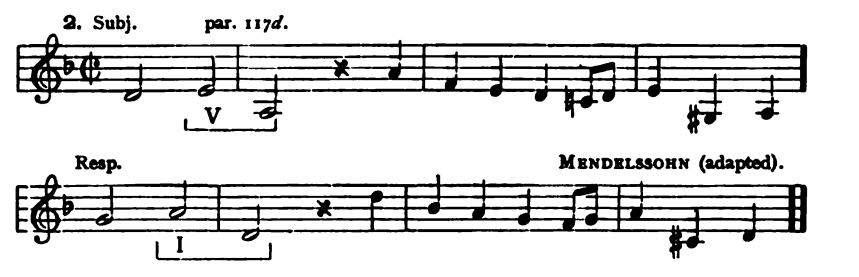
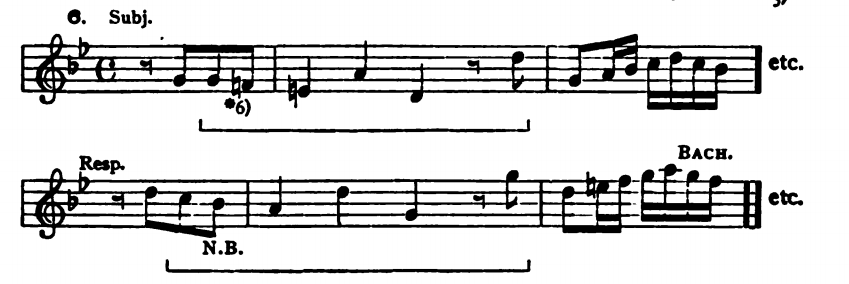
*6) The striking modulation into the Dominant key, so near the beginning, must be answered in the 4th, — similar to par. 117d.
*7) The prominent Leading-tone, when absolutely indicative of the Dominant ' chord (as here), and not merely an embellishing note of the Tonic (as in Ex. 138, No. 1, and tone), is subject to tonal imitation, with all that is inseparable from it. Comp. par. 117d.
*8) Like Note *y).
Exercise 35
A. Analyze all the Responses in the Well-temp. Clavichord of Bach.
B. Write the Responses to all the original Subjects invented in Exercise 34. And invent a number of new Themes (and Answers), with reference to the above
traits.