 Playable Books
Percy Goetschius · section 11 of 23
Chapter VIII.--enlargement of the period-form
Read and hear this section in the playable edition →The processes of extension and development are applied to the period in the same general manner as to the phrase. The results, however, are broader; partly because every operation is performed on a correspondingly larger scale, and partly because the resources of technical manipulation increase, naturally, with the growth of the thematic material.
Among the various methods adopted, there are three, each significant in its own peculiar way, that provide sufficiently exhaustive directions for the student of structural analysis.
ENLARGEMENT BY REPETITION.—The first and simplest method is to increase the length of the period-form by the process of repetition ; repetition of the entire sentence, or of any one—or several—of its component members, in a manner very similar to that already seen in connection with the single phrase (Chap. VI, Ex. 39, etc.), and under the same conditions of Unity and Variety; that is, the repetitions may be nearly or quite literal, or they may have been subjected to such alterations and variations as the skill and fancy of the composer suggested.
An example of complete repetition (that is, the repetition of the entire period), with simple but effective changes, may be found in Beethoven, pianoforte sonata, op. 13, Adagio , measures 1 to 16. Examine it carefully, and observe, among other details, the treatment of the perfect cadence (in the 8th measure). See also, Song Without Words, No. 27, measures 5 to 20.
The repetition of one of the two phrases is exhibited in the following (Mozart, sonata No. 14):—
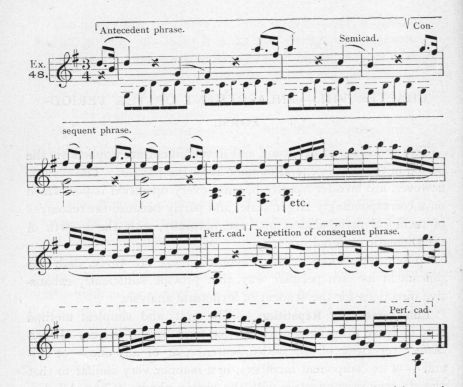
The Antecedent is a regular four-measure phrase, with semicadence (made on the tonic chord, but with 3d as uppermost tone); the Consequent is a six-measure phrase, with perfect cadence, and is repeated, with partial change of register. The whole is a "period with repeated Consequent."
A somewhat elaborate example of extension by detail-repetition is seen in the following (Chopin, Mazurka No. 20, op. 30, No. 3—see the original):
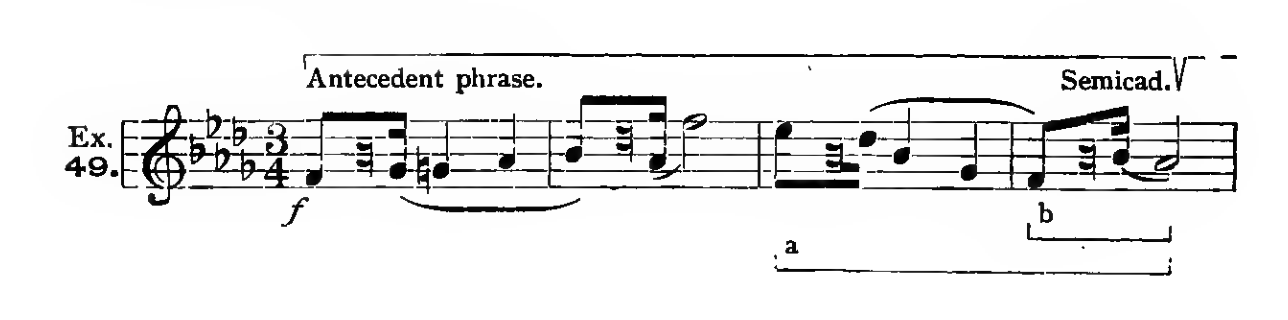
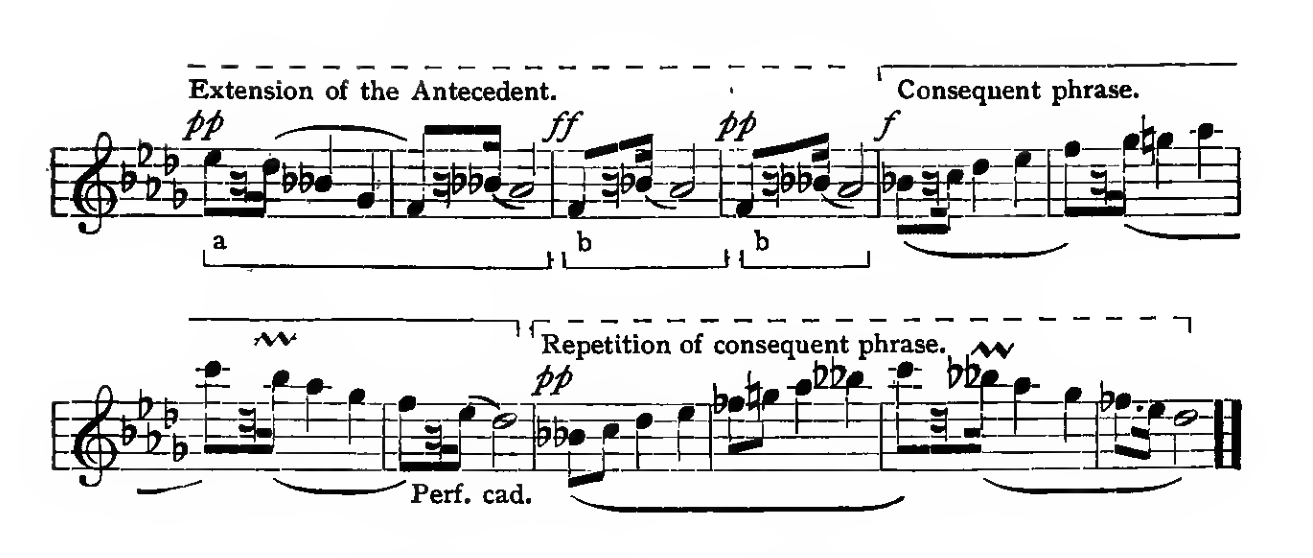
These sixteen measures are the product out of eight measures, by extension; that is, they are reducible to a simple period-form (as may be verified by omitting the passages indicated under dotted lines), and they represent in reality nothing more than its manipulation and development. The original 8-measure period makes a complete musical sentence, and was so devised in the mind of the composer, without the extensions . The method of manipulation is ingenious; observe the variety obtained by the striking dynamic changes from ff to pp ; and, hand in hand with these, the changes from major to minor, and back (as shown by the inflection of b -flat to b -double-flat). These are first applied to members only, of the Antecedent, as indicated by the brackets a and b , and then to the entire Consequent phrase. Observe, also, that in the repeated form of the latter, the rhythm is modified to a smoother form, during two measures. The result here achieved is constant Unity and constant Variety from almost every point of view, admirably counterbalanced.
THE PHRASE-GROUP.—A second method consists in enlarging the period-form to three phrases, by the same process of addition which, as explained in the preceding chapter, transforms the single phrase into the double-phrase or period. In order to preserve the continuity of the three phrases, it is evident that the second phrase must also close with a semicadence,—the perfect cadence being deferred until the last phrase is concluded.
{78}
This form, be it well understood, does not include any of the triple-phrase designs which may result from merely repeating one or the other of the two phrases that make a period, as is shown in Ex. 48. All such phrase-clusters as are reducible to two phrases , because nothing more than simple repetition has been employed in their multiplication, should always be classed among ordinary periods; for two successive phrases, if connected (that is, unless they are purposely broken asunder by a definite perfect cadence at the end of the first phrase) always represent the analogy of Question and Answer.
The enlarged form we are at present considering consists of three different phrases, as a general rule; probably very closely related, or even distinctly resembling one another; but too independent, nevertheless, to constitute actual repetition, and therefore to admit of reduction to two phrases. For this very reason it cannot justly be called "period" at all, but takes the name of "phrase-group." An illustration by diagram will make the distinction clear:—
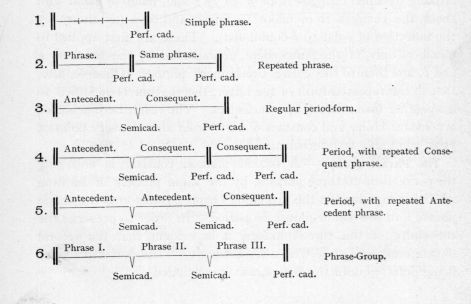
Observe that the classification depends upon the number of phrases,—upon the melodic identity of the phrases,—and upon the quality of the cadences .
No. 1 is illustrated in Ex. 15; No. 2, in Ex. 42 and the first four measures of Ex. 43 (cadence not perfect, it is true, but same phrase-melody and same cadence ); No. 3 is seen in Ex. 44 (phrase-melody similar, but cadences different)—also in Ex. 47; No. 4 is seen in Ex. 48; No. 5 is rare, but an example will be discovered in Lesson 8; No. 6 is illustrated in the following (Grieg, op. 38, No. 2):—
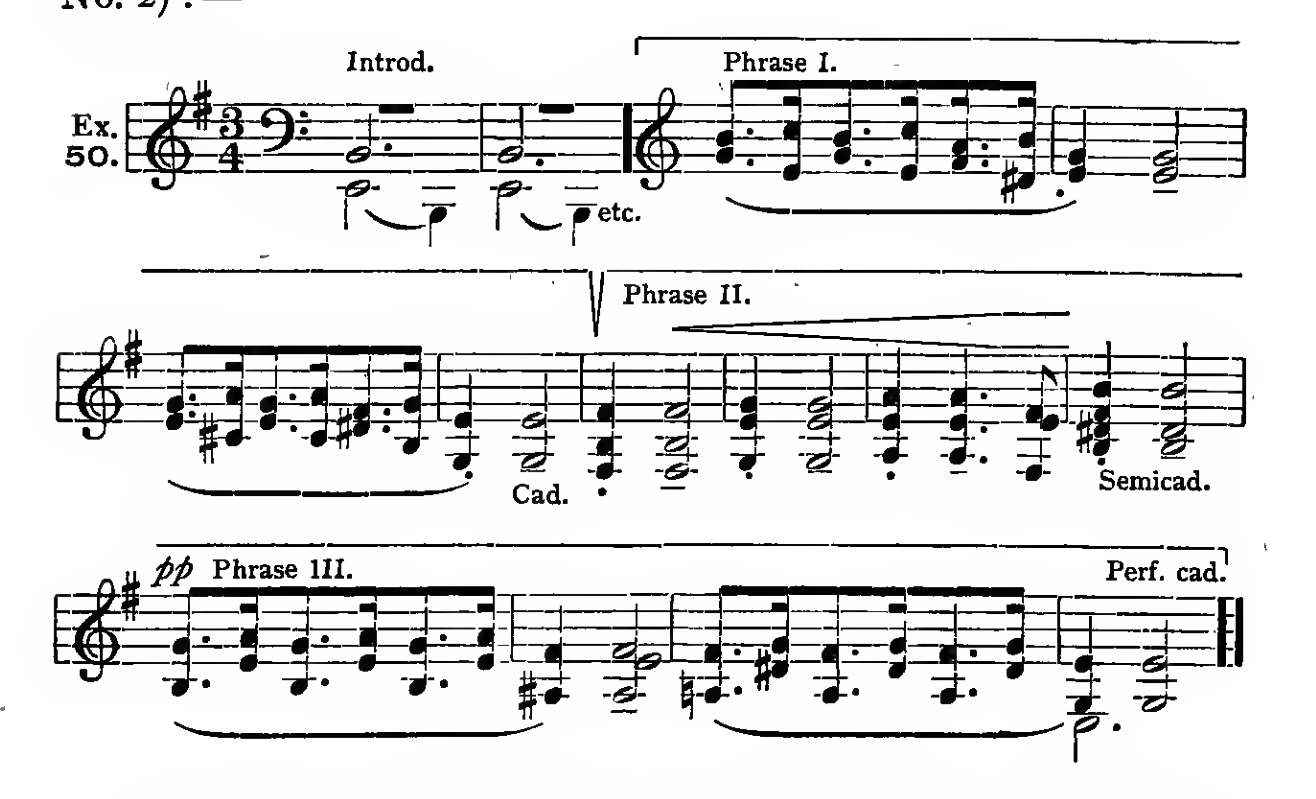
Comparing this sentence with Ex. 48, we discover the following significant difference: There, no more than two phrases were present; the whole sentence was reducible to two phrases. Here (Ex. 50), however, no such reduction is possible; three sufficiently similar—and sufficiently different—phrases are coherently connected, without evidence of mere repetition; it is the result of Addition, and the form is a phrase-group . The first cadence is, strictly speaking, a perfect one; but of that somewhat doubtful rhythmic character, which, in conjunction with other indications, may diminish its conclusive effect, and prevent the decided separation which usually attends the perfect cadence. This is apt to be the case with a perfect cadence so near the beginning (like this one) that the impression of "conclusion" is easily overcome. In a word, there is no doubt of the unbroken connection of these three phrases, despite the unusual weight of the first cadence. See also the first cadence in Ex. 51.
By simply continuing the process of addition (and avoiding a decisive perfect cadence) the phrase-group may be extended to more than three phrases, though this is not common.
THE DOUBLE-PERIOD.—A third method consists in expanding the period into a double-period (precisely as the phrase was lengthened into a double-phrase, or period), by avoiding a perfect cadence at the end of the second phrase , and adding another pair of phrases to balance the first pair. It thus embraces four coherent phrases, with a total length of sixteen measures (when regular and unextended).
An important feature of the double-period is that the second period usually resembles the first one very closely, at least in its first members. That is, the second phrase contrasts with the first; the third corroborates the first ; and the fourth either resembles the second, or contrasts with all three preceding phrases. This is not always—though nearly always—the case.
The double-period in music finds its poetic analogy in almost any stanza of four fairly long lines, that being a design in which we expect unity of meaning throughout, the progressive evolution of one continuous thought, uniformity of metric structure (mostly in alternate lines), the corroboration of rhyme, and, at the same time, some degree and kind of contrast,—as in the following stanza of Tennyson's:
Phrase 1. "The splendor falls on castle walls, Phrase 2. And snowy summits old in story; Phrase 3. The long light shakes across the lakes, Phrase 4. And the wild cataract leaps in glory."
The analogy is not complete; one is not likely to find, anywhere, absolute parallelism between music and poetry; but it is near enough to elucidate the musical purpose and character of the double-period. And it accounts for the very general choice of this form for the hymn-tune.
The following illustrates the double-period, in its most regular and convincing form (Beethoven, pianoforte sonata, op. 49, No. 1):—
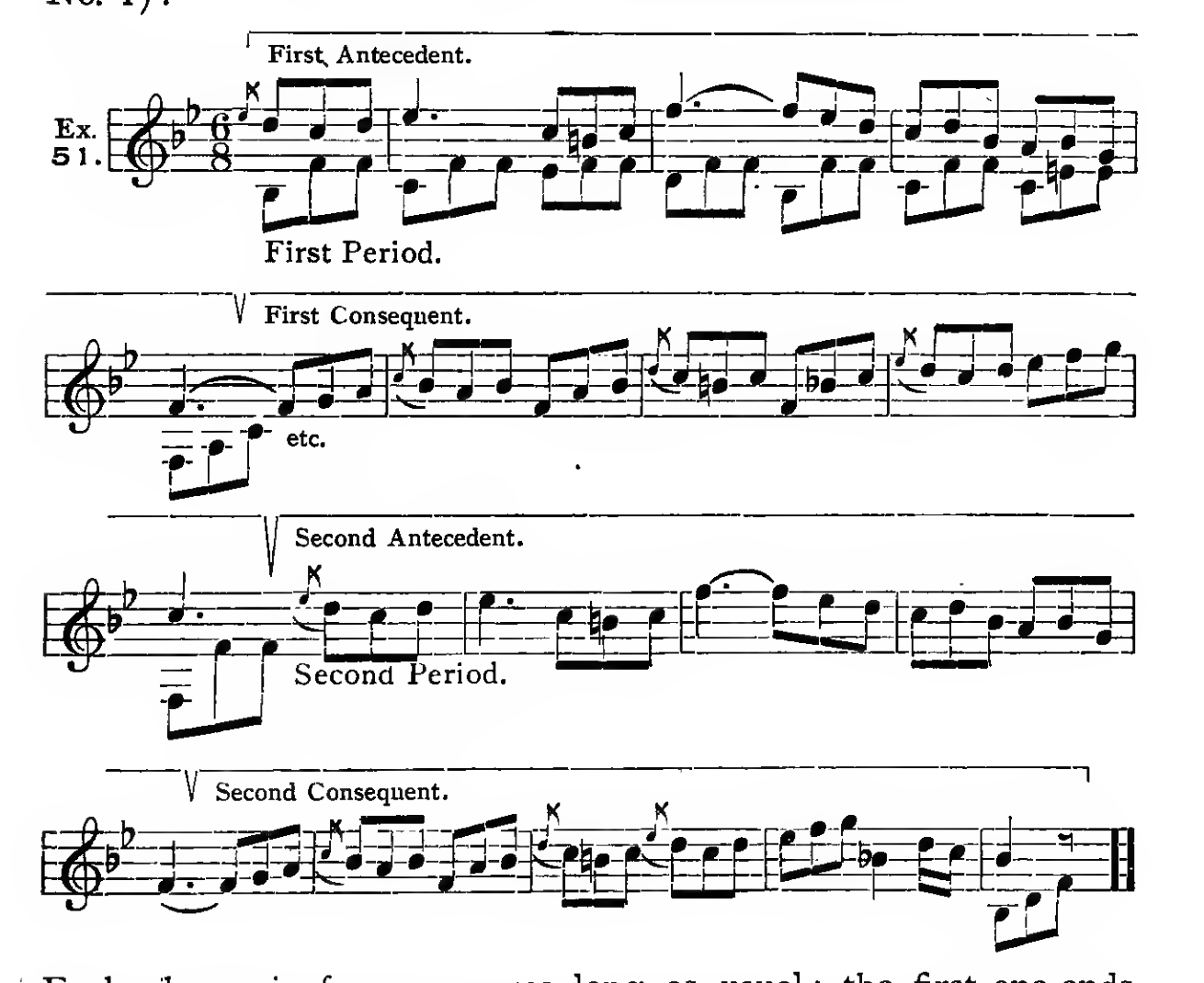
Each phrase is four measures long, as usual; the first one ends (as in Ex. 50) with one of those early, transient perfect cadences that do not break the continuity of the sentence; the second phrase ends with a semicadence,—therefore the sentence remains unbroken; phrase three is exactly like the first, and is therefore an Antecedent, as before; phrase four bears close resemblance to the second one, but differs at the end, on account of the perfect cadence. The evidences of Unity and Variety are easily detected. The main points are, that the second pair of phrases balances the first pair, and that the two periods are connected (not separate periods). See also Ex. 53, first 16 measures.
LESSON 8.—Analyze the following examples. They are not classified; therefore the student must himself determine to which of the above three species of enlargement each belongs:
Mendelssohn, Songs Without Words, No. 29, measures 1-21, (first 4 measures an introductory phrase).
No. 37, first 17 measures.
No. 30, first 15 measures (last phrase irregular).
No. 16, measures 4-9 (small phrases).
No. 33, first 12 measures.
No. 27, first 20 measures (introductory phrase).
No. 3, first 29 measures, to double-bar (introductory phrase).
No. 36, first 27 measures (the similarity between phrase one and phrase three proves the double-period form; the extra phrases are extension by "addition," as in the group form).
No. 6, measures 8-17.
Mozart, pianoforte sonata. No. 13 (Peters edition), first 16 measures.
Sonata No. 2, first 16 measures (last four measures are extension).
Sonata No. 3, last movement, first 16 measures.
Sonata No. 10, second movement, first 16 measures.
Beethoven, pianoforte sonatas; op. 49, No. 2, first 12 measures.
Op. 10, No. 3, first 16 measures.
Op. 10, No. 2, first 12 measures.
Op. 26, first 16 measures.
Op. 31, No. 2, last movement, first 31 measures (extension by repetition).
Schumann, op. 68, Nos. 16, 20, 33, first 16 measures of each; No. 13, first 10 measures; No. 15, first 16 measures.