Playable Books
W. S. B. Mathews · section 7 of 24
The Start
Read and hear this section in the playable edition →To a beginner absolutely new to the keyboard and staff, take plenty of time upon this first exercise. Teach first the position of the hand upon the keys; then the names of the keys under the five fingers; and then the staff places corresponding; each hand by itself. At first omit the counting; but come back later and do

it. The accent after the bar is very slight. The touches must be made with the hammer action of the fingers, but at first without raising them at all high from the keys; a half inch pre - paratory to making the tone is sufficient.
In No.2 the rhythmic principle becomes more important. Begin by teaching the positions and staff places as before, if necessary; then learn the first two measures, by playing it three times through in succession, counting the time; next the 3rd and 4th measures in the same way; then mm.5 and 6. By this time the

pupil should have observed that the melody in the first two measures forms a pattern, which is repeated in the later measures, mm.7 and 8 being the conclusion of the whole. An idea thus repeated in pattern sequence is called a “motive”; because it is the moving idea which led the composer to write the piece.
In No.3 there is also a motive which is several times repeated; find out how many and whether exactly repeated or with slight differences. Teach the quarter note, the pulse note. Also the table of the whole note, half notes and quarter notes: how many of each

equal the next larger. The curved line under the notes in the first measure is called a Slur; it indicates connection between the tones, but it does not imply any disconnection from the next tone.
In No.4, the idea consists of two measures, as indicated by the slurs. The leading motive (m.1) occurs with one ending in m.2 and with a different ending in m.4. One ending implies “to be continued;”

the other closes the idea. Which seems to you the closing idea? Positions, finger action, and note values the same as previously.
In No.5 a more pleasing melody occurs. It consists of four phrases, each of two measures. The first is like a subject,something to talk about; the second mm.3,4, is like a predicate, that which we say about the subject. The third phrase, mm. 5,6, is a-

gain the subject; the final answer is the closing phrase, mm.7,8. In m.4 and m.8 the last half is silent; the half-rest takes its place. The rest is a sign of rhythmic silence. The playing will be better if the hands are exercised separately before playing together.
In No.6, the principal motive is that of the first measure. This figure occurs unchanged twice, mm. 1 and 5; it occurs changed twice in mm. 2 and 6. The second phrase, mm. 3,4, makes an incomplete predicate; in mm. 7, 8, the predicate is complete. The difference lies in arriving at last at the tonic or key-tone.

Further exercise upon the five-finger positions already employed.

Further development of fluency in the five-finger position. For this purpose each figure (the design of four tones) should be memorized and repeated several times; then two designs in succession, several times over. In short, make exercises of it.

See caution in regard to securing finger action, in the Introduction to this work.

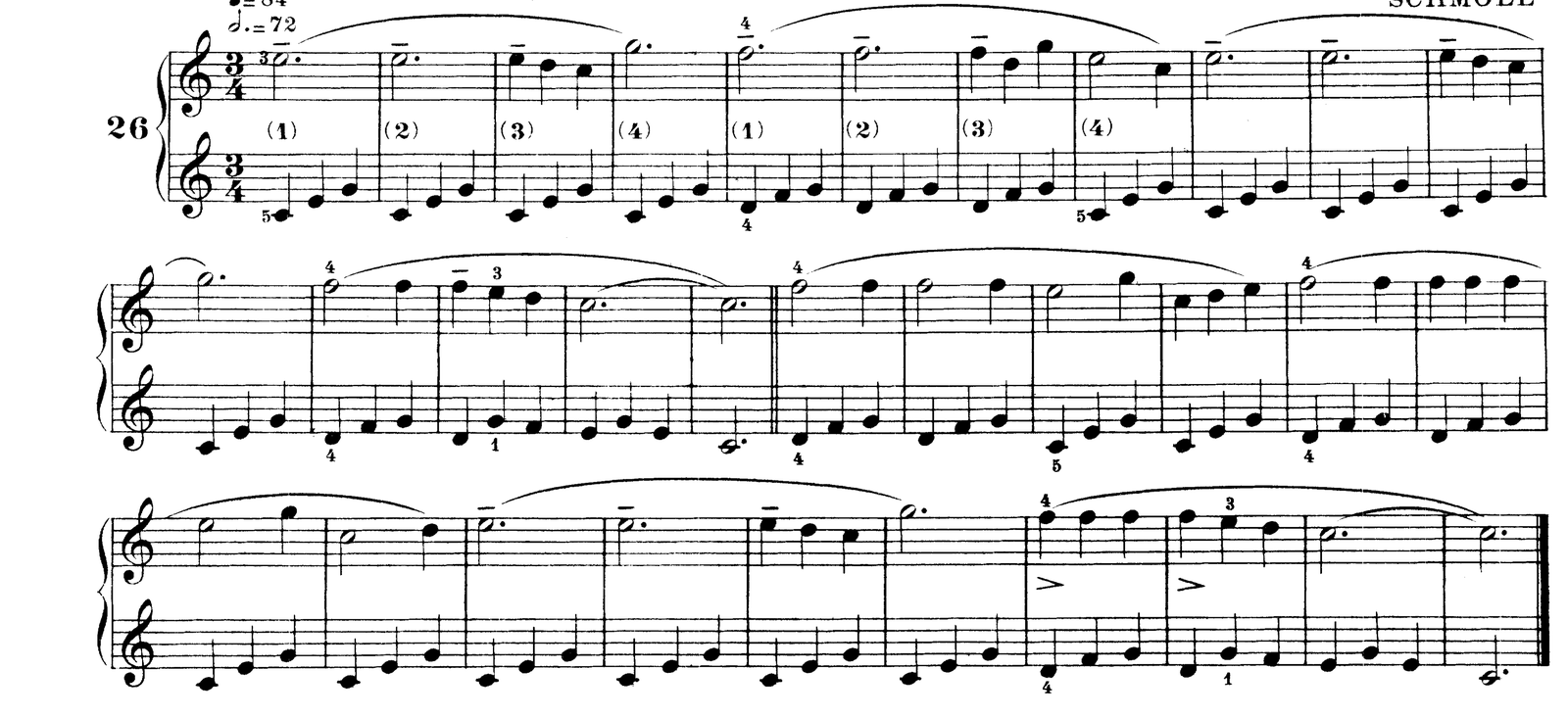
This melody is constructed upon a systematic plan; see if you study it out. Try also to secure the expression marked; i.e., the tone is supposed to get stronger as the angle widens, and to get softer as the angle approaches a point.

Here we have a three-pulse measure, each pulse represented by a quarter note, half note for two pulses, and dotted half for three pulses. Triple measure gives rise to very pleasing rhythms which are more floating and elastic than those based upon 2 or 4. It is the rhythm of many fascinating dances, of which the waltz is perhaps the greatest favorite.

In No.12 the motive consists of two measures, as the ear will perceive when the tones are played. This figure occurs twice only. Mm. 5 and 6 are again a single motive or idea, and the idea is repeated a degree lower in mm. 7,8, and again in mm. 9,10. Then;the ending or closing motive, mm. 11, 12. In the second figure(mm. 5, 6

etc.) the last tone of one measure is repeated to begin the next. The Editor prefers a slight hand touch for the repeating tone and not to insist upon a pure finger touch, which is very difficult in this place and would never be used by a good player.
In No.13 the melody of the right hand begins to be different from that of the left, but as yet merely repeating the same tone. The repeated tones are best played with a very slight hand motion, but the second tone must be carefully connected to the next ensuing.

The repeated tones are all played by a hand touch but the finger legato is preserved between the last tone and the new one which follows That is, the three C’s in m. 1 are played with a hand movement, but the last is held legato to the D beginning m. 2. So also the D in m.2 is connected legato to its successor E, and so on.

If the left hand part is begun with the second measure and compared with that of the right, beginning in m.1,it will be seen that the left hand plays precisely the same melody, one measure later, until the close is arbitrarily reached in m. 8.

The same principle of construction prevails in No.16. The right hand idea (mm.1 and 2) is precisely repeated by the left,one measure later, and so on all the way through. This manner of constructing a second voice like the first at a later moment is called “Imitation” or “Canonic Imitation”and is in constant use in the higher kinds of music. It conduces to independence of hands.

In No.17 the right hand is active and plays the melody; the left hand merely puts in a few tones for accompaniment. These long tones should be produced in such a way as to sing through their required duration, and not to be lost to the ear just after they have been sounded. The ear should watch this.

In No.18 the left hand has melody in an active way, while the right plays long tones. These should be made to sing as long as required.

In No.19 the activity of the hands interchanges, upon a principle of “give and take.” Whichever hand has the moving voice should play a little more forcibly.

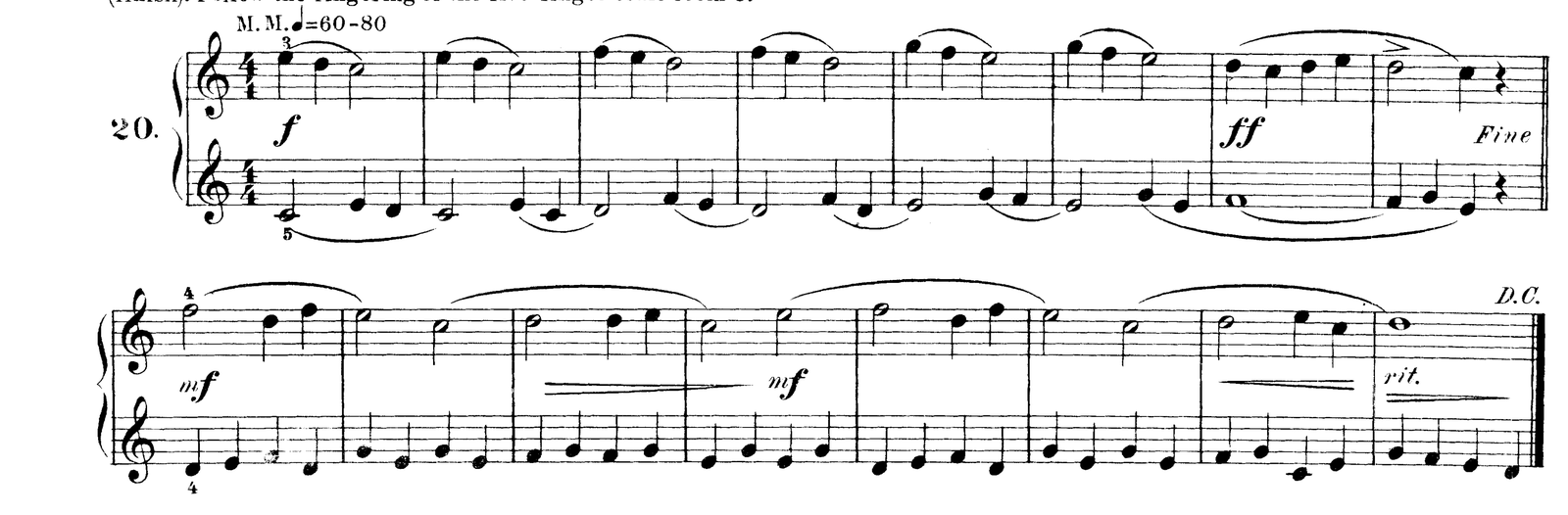
The idea here is that of two bell-ringers who answer each other as they play upon the chimes. The tones need to be rather bright and vibrating, like clear bells. The initials D.C. at the end of the piece mean that the first part is to be played again, closing at the word “Fine” (finish). Follow the fingering of the five-finger scale from C.
In No.21 the two hands are more independent and each has its own individuality.

In No.22 we arrive at “half-pulse motion” for the first time. The easiest manner of forming an idea of this new effect will be to play the five-finger scale up and back in half notes,counting two to each; then in quarter notes, counting one to each; and finally in eighth notes just twice as fast, counting the pulses at the same rate as before.The half pulse motion is light and

spry. The eighth note differs from the quarter in having what is called a“flag” at the end of the stem; this flag may be independent and for one note only, as we see very often in songs; or several notes may be connected together by the “flags”, as here in various ways.

It was Plato,who many years ago remarked that when we had no words to music, it was very difficult to make out what it really meant. There are people today who hold this opinion still, although to a musician the music tells its story as directly and as fully as words can. In this case we have the melody while an
The First Violet of Spring


older player gives the accompaniment. The pricipal player or another may sing the words also,and in this way bring out the idea in all its perfection. The idea is to play the melody in such a way as to“almost speak the words,” as people. say.
The long tones in the right hand are to be sustained softly but with a somewhat full quality of tone.
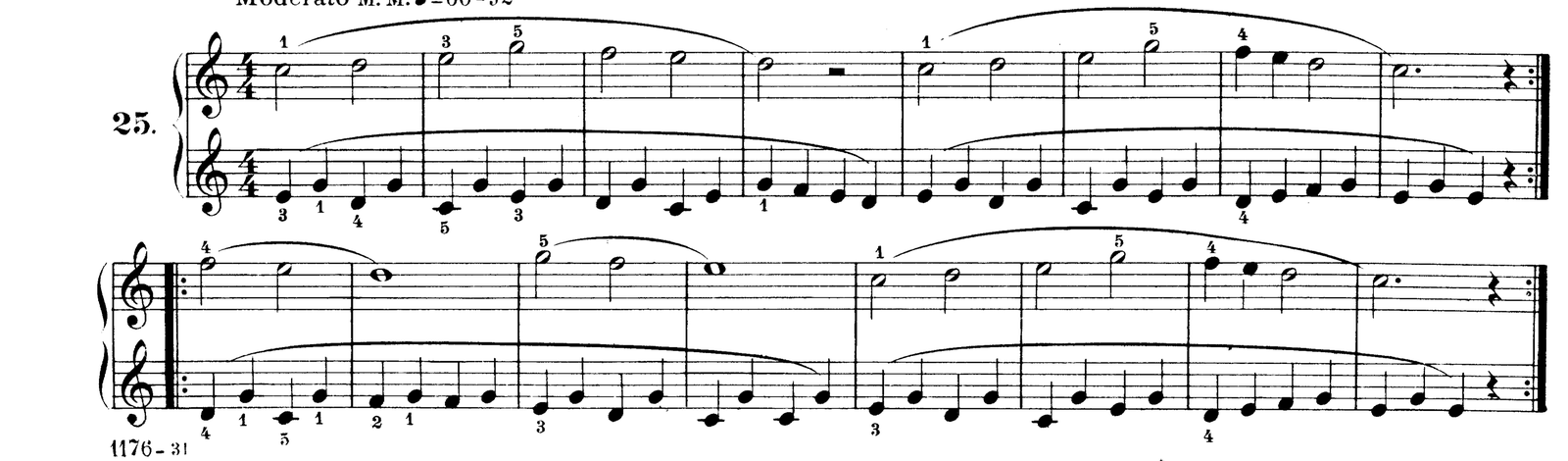
A charming piece for exhibition purposes. The repeated notes of the melody with slight arm motion. To get the proper elasticity and swing of the movement, after learning it carefully, then change the counting to Two, one to each measure, or to Four. This change gives the mental grouping upon which the proper rhythm depends.
Poco Allegro M.M. d= 60-92 A Study in Fluency
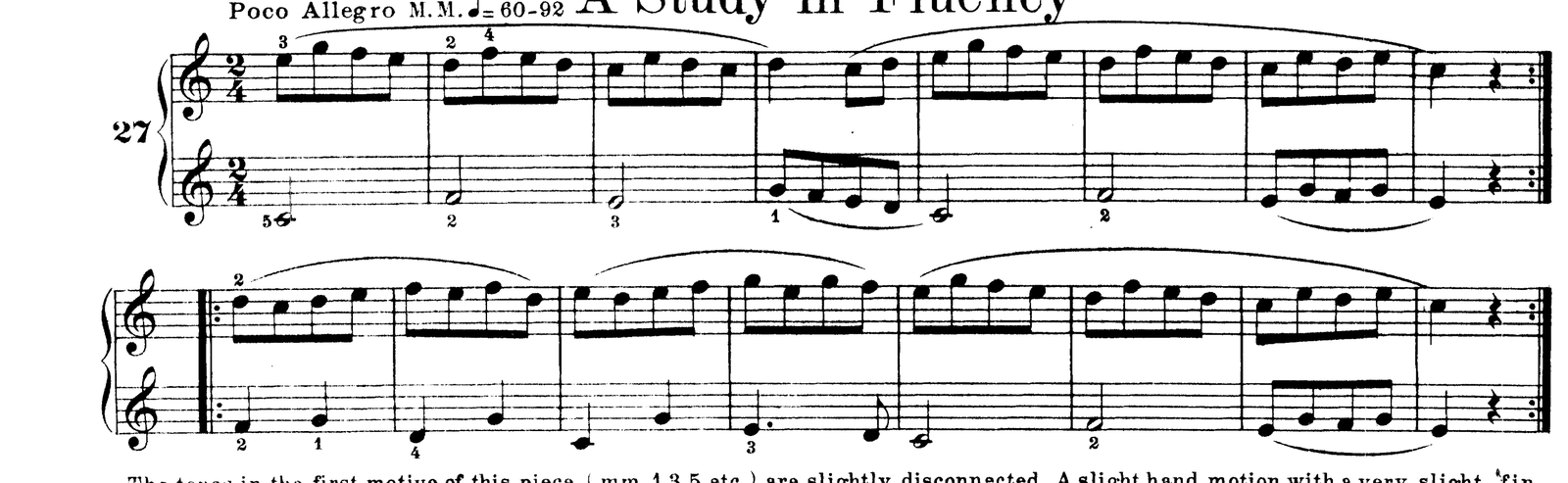
The tones in the first motive of this piece, ( mm. 1,3,5 etc.) are slightly disconnected. A slight hand motion with a very slight 'finger staccato will be sufficient.
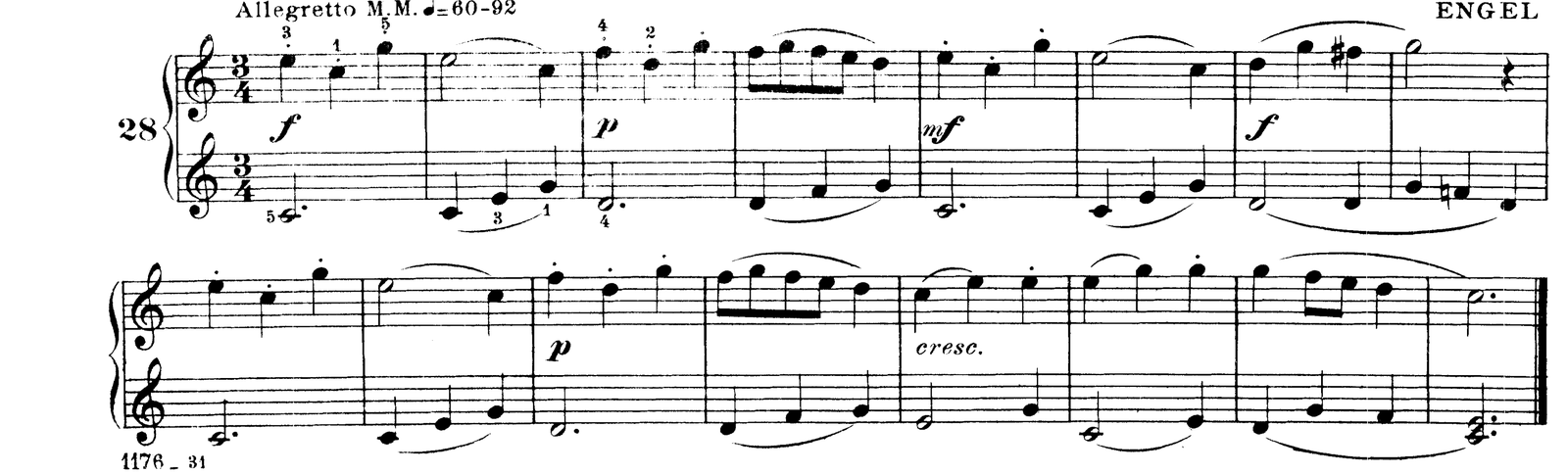
A domestic scene in which pleasant things are said on both sides. The hands carry on a kind of dialogue. The moving voice is to sound out distinctly.
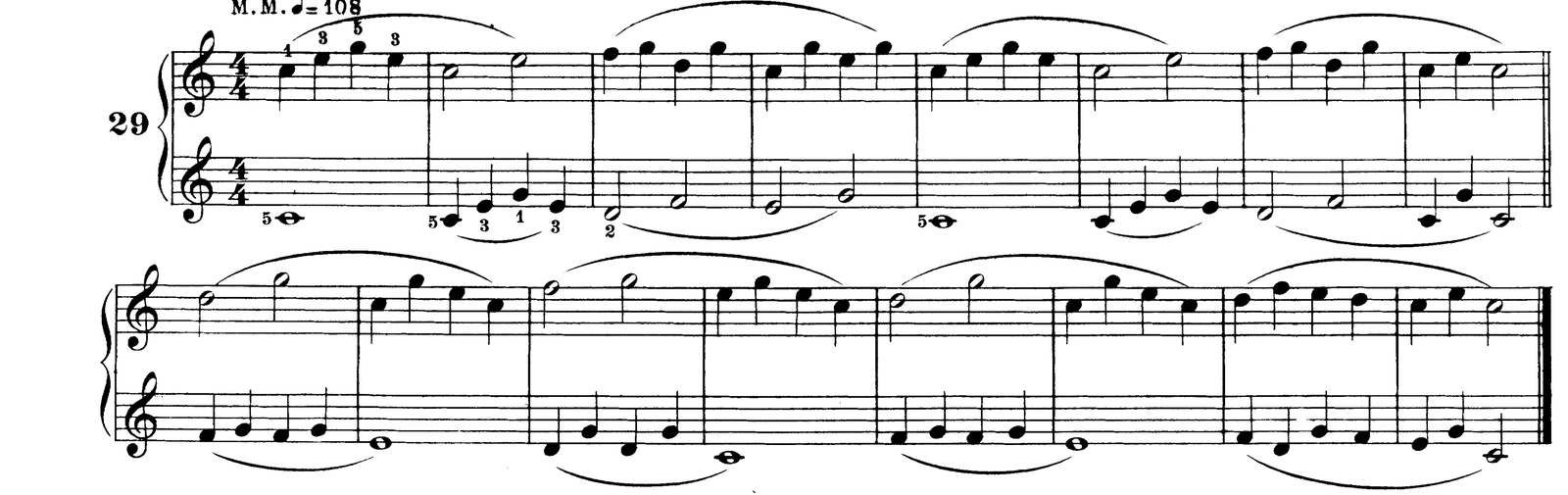
A melody written in the shortest variety of measure, a two-pulse measure. We count two and accent upon “one.” When the accents fall so near they are made less prominent; otherwise they break up the flow of the thought. The quarter note is the unit, and the eighths are half pulses, as before.
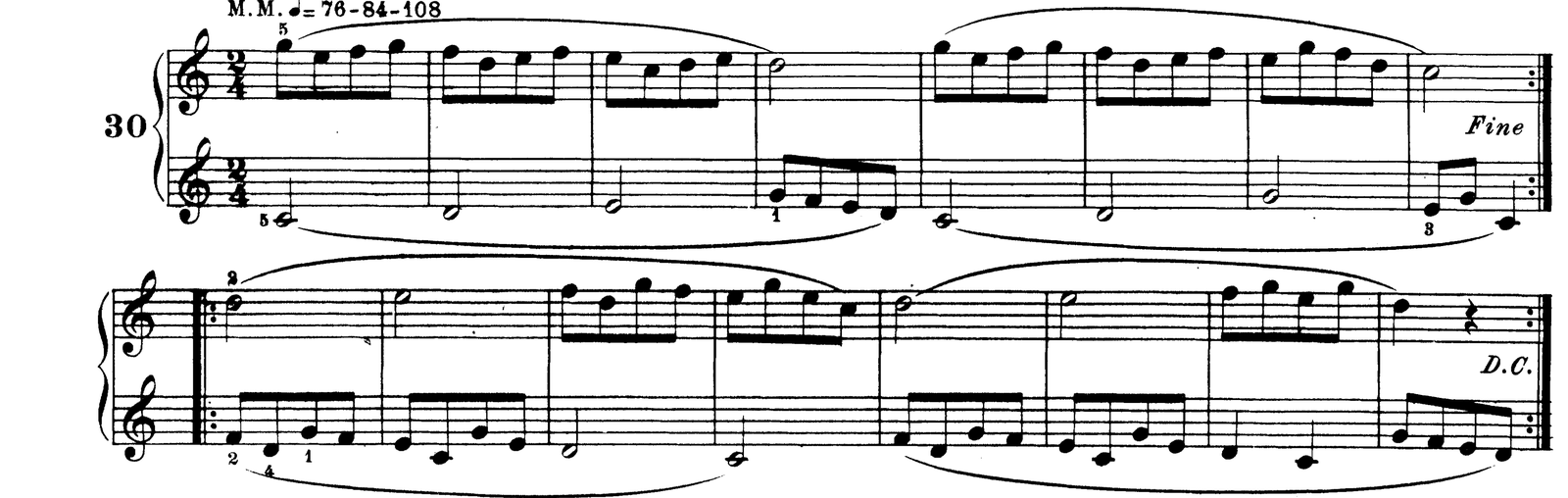
Additional practice upon positions already somewhat familiar. Take the occasion to improve the tone-quality of the left hand melody by making it speak out like a right hand. Especially must this be the case where the two hands answer each other responsively as in mm. 9 to 14. In m. 8 we have a “Whole Rest,” a rest equal to a whole note.
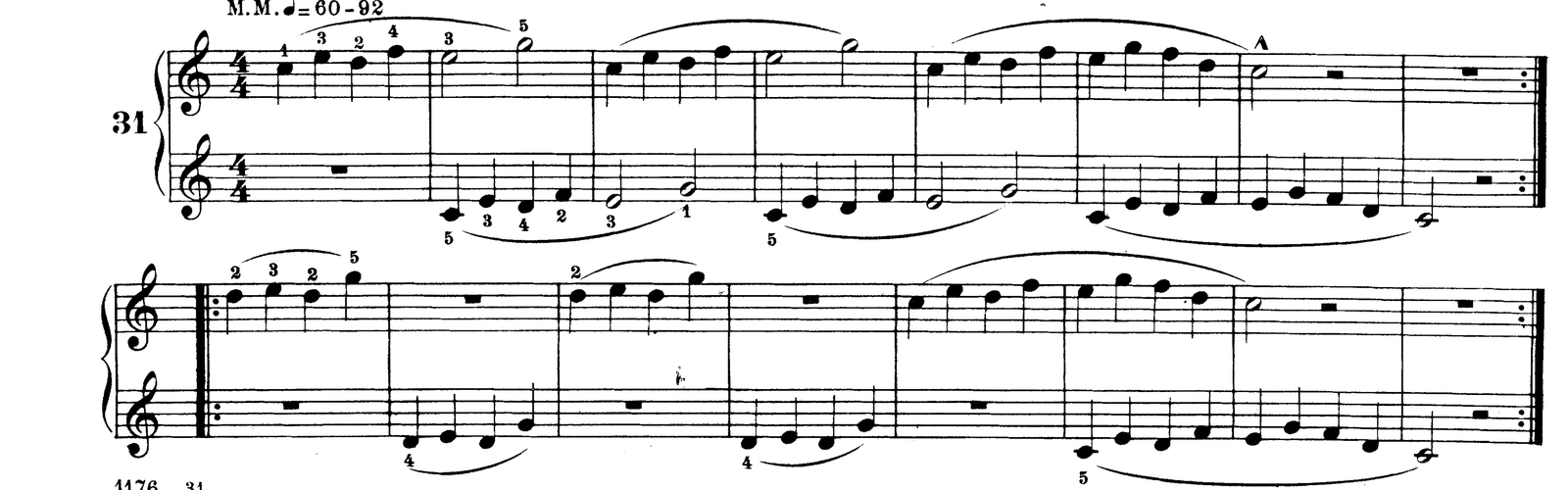
At this point the F Clef is introduced, as required for writing bass voices. The staff with F Clef is employed whenever the left half of the keyboard is to be used. It places F, next below middle C, on the 4th line. Teach the Clef line F, then the three C’s. Then exercise the pupil in calling the names of the notes of the scale here written.

Better begin this exercise by playing the left hand part from its own notes. After finding out which note begins, then go on to play the exercise in correct time, rather slowly, as an exercise in reading the bass notes. Later, both hands together.

The bass tones softly but sustained; the right hand tones distinct and expressive without being at all heavy.

Further exercise in reading from the bass staff.

Exercise for reading from the bass staff. Begin with the left hand alone. Then add the right hand. Try and make the increase of tone indicated by the diverging lines, and the diminish of tone, signified by the converging lines.

To be read at sight, both hands together.

Further exercises for independence of the hands. The long tones should be sounded just enough more forcibly than the short tones to prolong them during their intended duration.

The melody singingly, but not loud; the moving voice (the eighths) not so strong but evenly and connectedly.

An exercise looking towards velocity.
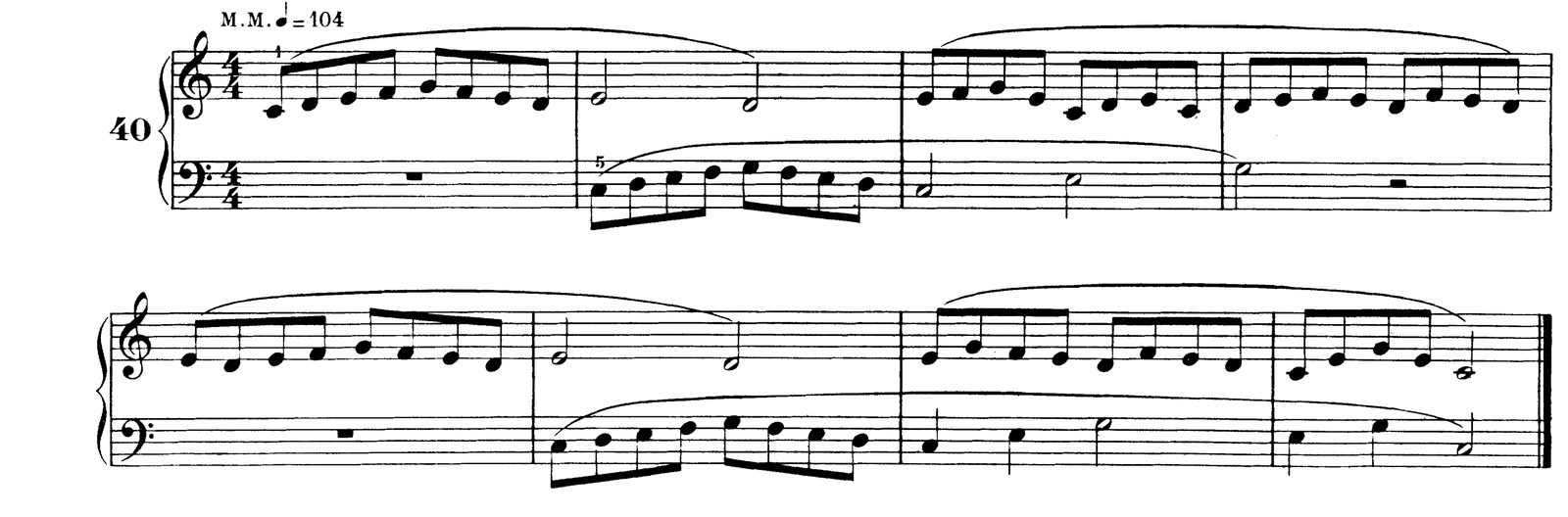
A practical exercise in the tie. The long tone ( the half with an eighth note tied to it) should be heard singing quite through its time in such a way that the next tone grows out of the tied tone. Be quite sure to hold down the key its full value, and connect the next tone(legato)to the tied tone.
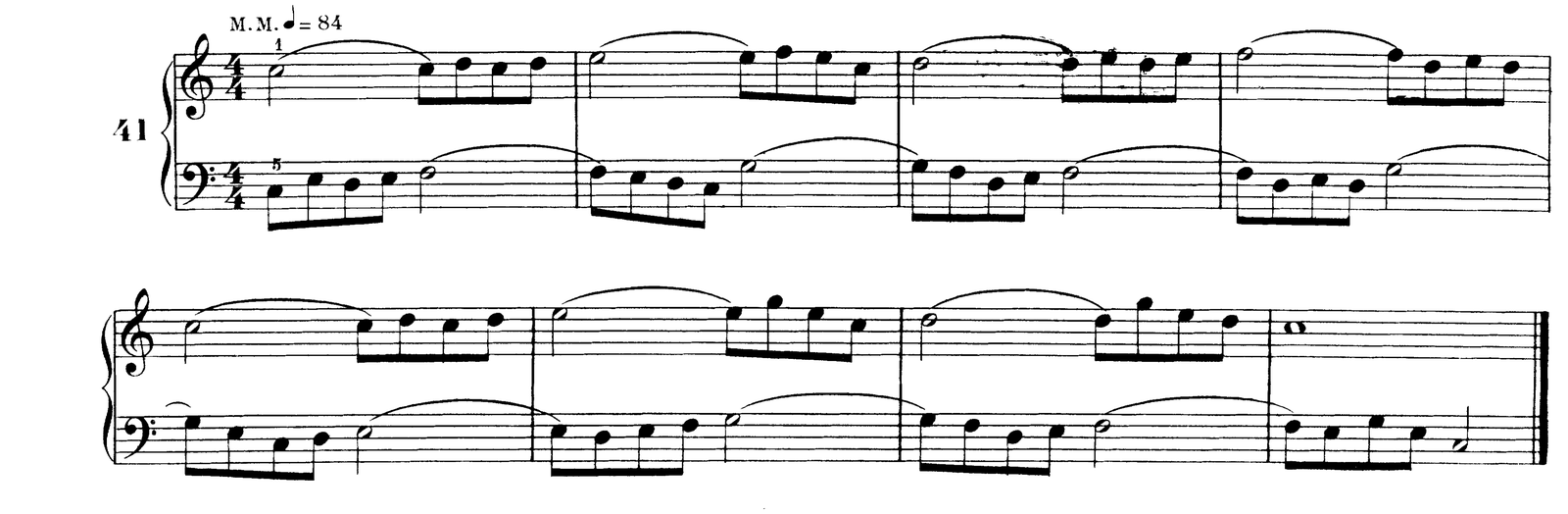
Five finger scales in changing positions. The trick is to be ready in the new position at the moment when the hand should begin its melody upon this position. Hence move the hand as soon as it is through with its old position.
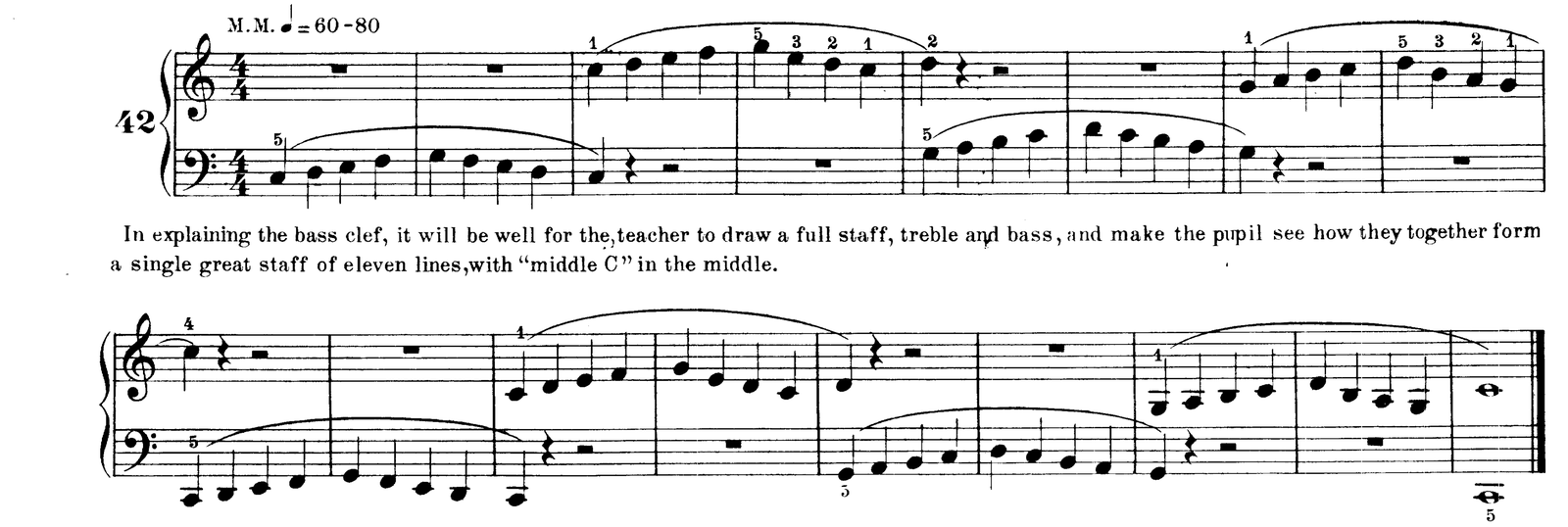
In explaining the bass clef, it will be well for the teacher to draw a full staff, treble and bass, and make the pupil see how they together form a single great staff of eleven lines,with “middle C” in the middle.
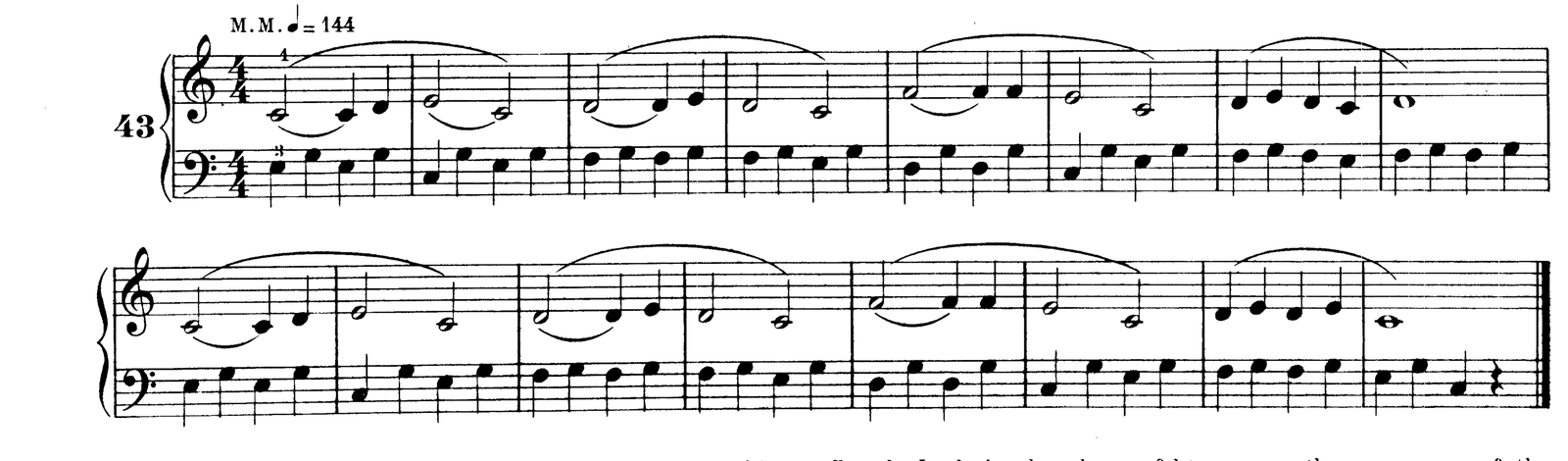
A pleasing melody, in which many tied notes occur, with steady motion of quarter notes in the bass.Observe that it is quite the same whether the three-pulse tone here represented by a half note spliced out with a tied quarter, is written in this way or simply as a dotted half. The tie is here used to lead to care in the reading.
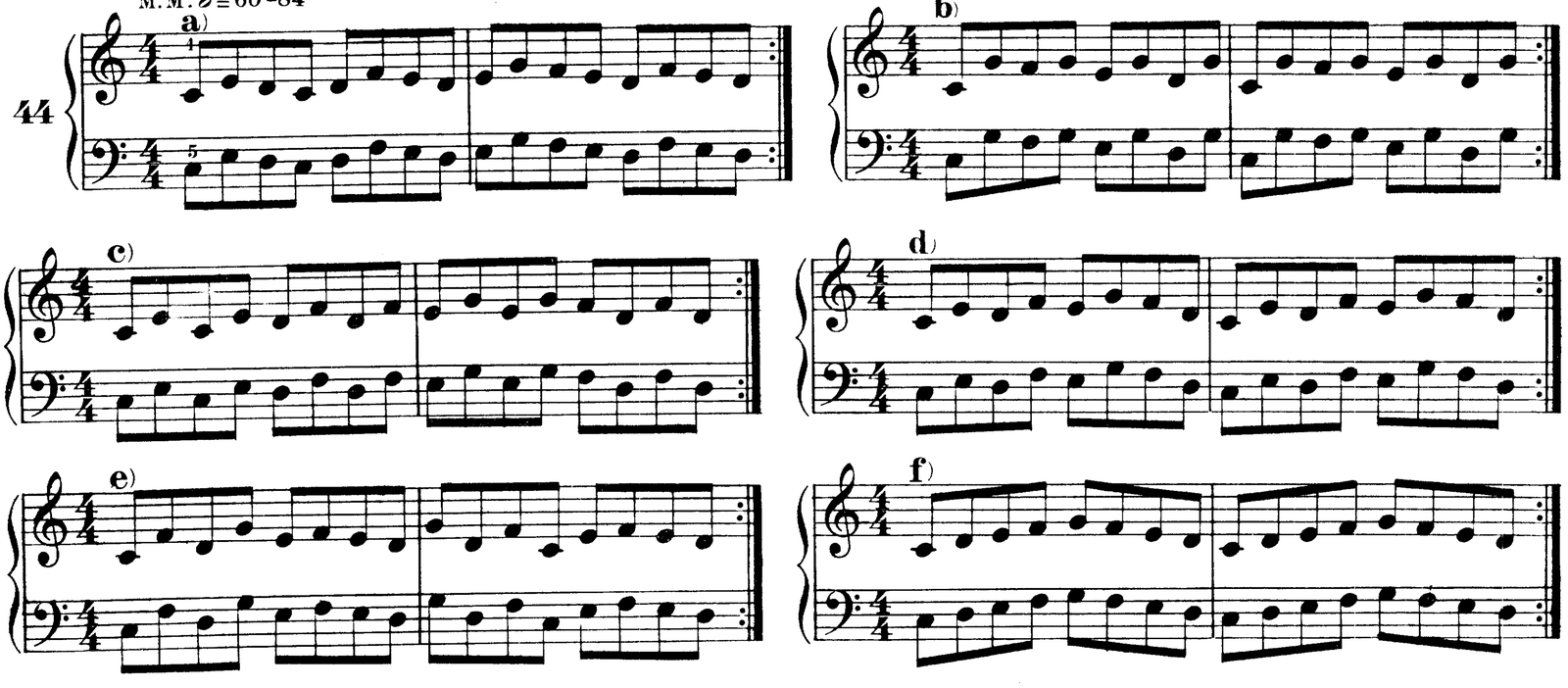
Five finger exercises, each one to be played many times, until it goes fluently. In playing these be careful to preserve the proper pose of the hand, the fingers curved and especially the nail joints not collapsing, or falling in.
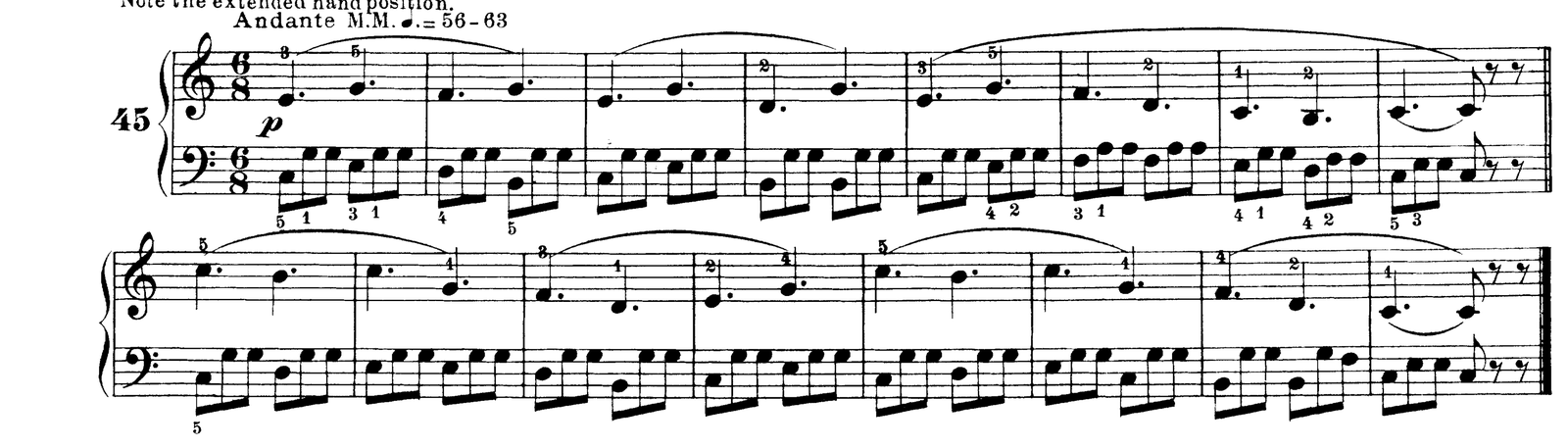
This melody should be played in a quiet manner and brought out with a singing tone, the accompaniment subordinated throughout. Note the extended hand position.
This piece is a little more difficult than the ones before, owing to the extensions and contractions of hand to gain new positions, where the melody leads. It will be observed that where a melody tone is repeated, a different finger plays the second tone. All pianists make this change in rapid playing, because it makes the repetitions surer. (See mm. 4, 6, etc.)
Tempo di Valse MM = 72-92
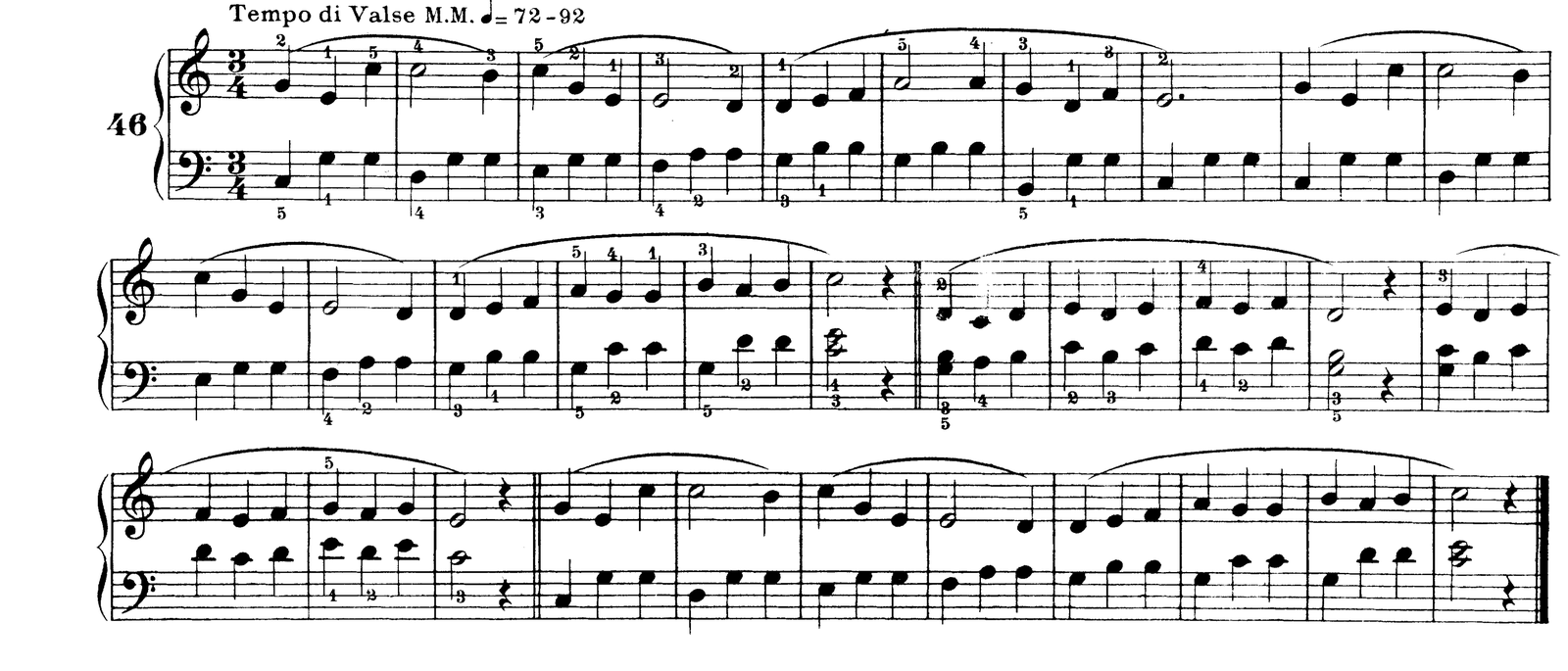
The right hand must be ready for the octave extension in m. 4, and deliver the high G with a firm and telling touch, and yet connect it with the lower G. The natural on F in m. 8 is not really necessary, but is useful to a good player. At a) a melody of
Allo ma non troppo MM 72-92
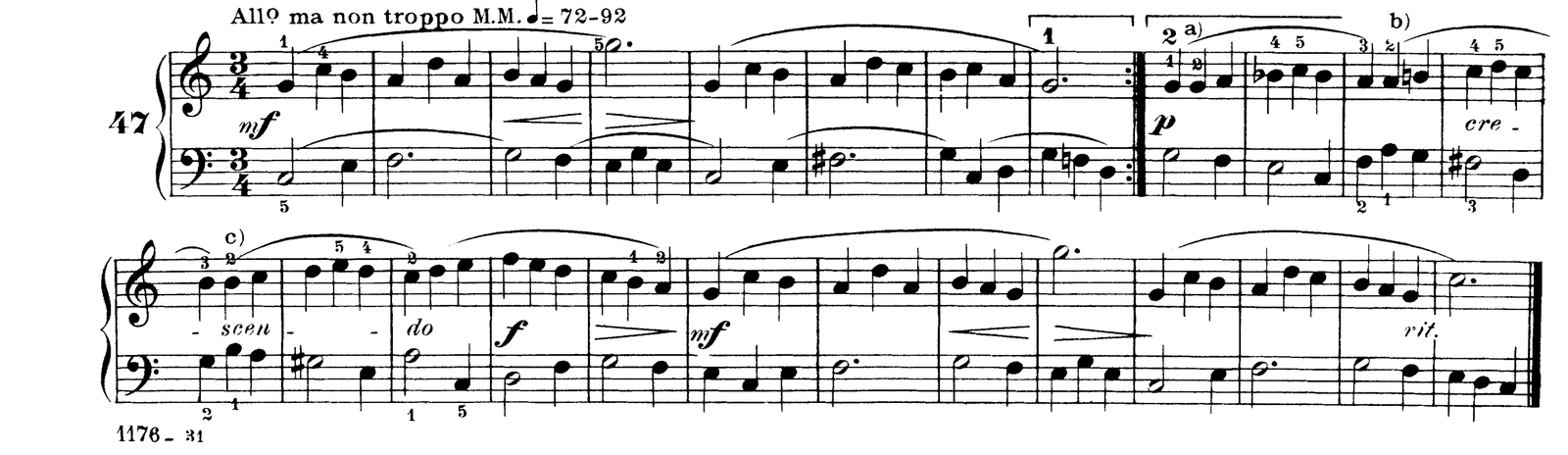
two measures occurs in the key of F; at b) this same melody occurs one degree higher in G; and at c) it occurs again in A minor. Play it a little more forcibly each time. At the end let the left hand retard.
A jolly little march movement. It is to be played sturdily, with strong accentuation of the melody. The left hand part may be treated as a study in chord playing. It must not be played too heavily.
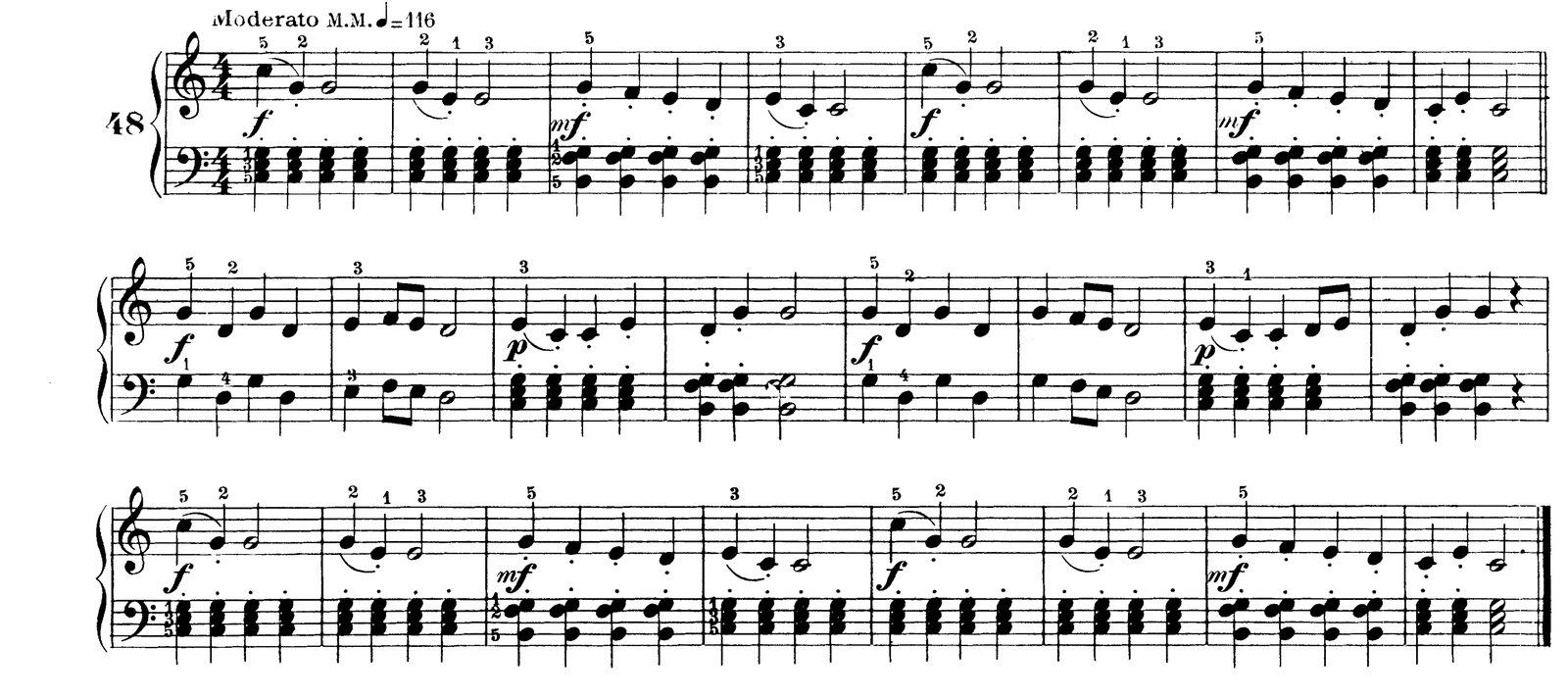
In this beautiful piece of evening music, the pupil has the melody to play, which he should try to make as smooth and as song-like as possible. The other player supplies the pleasing accompaniment, which adds so much to the effect of the whole.
"SHADES OF EVENING GATHER ROUND US"