W. S. B. Mathews · section 13 of 24
Study in Broken Chords Read and hear this section in the playable edition →
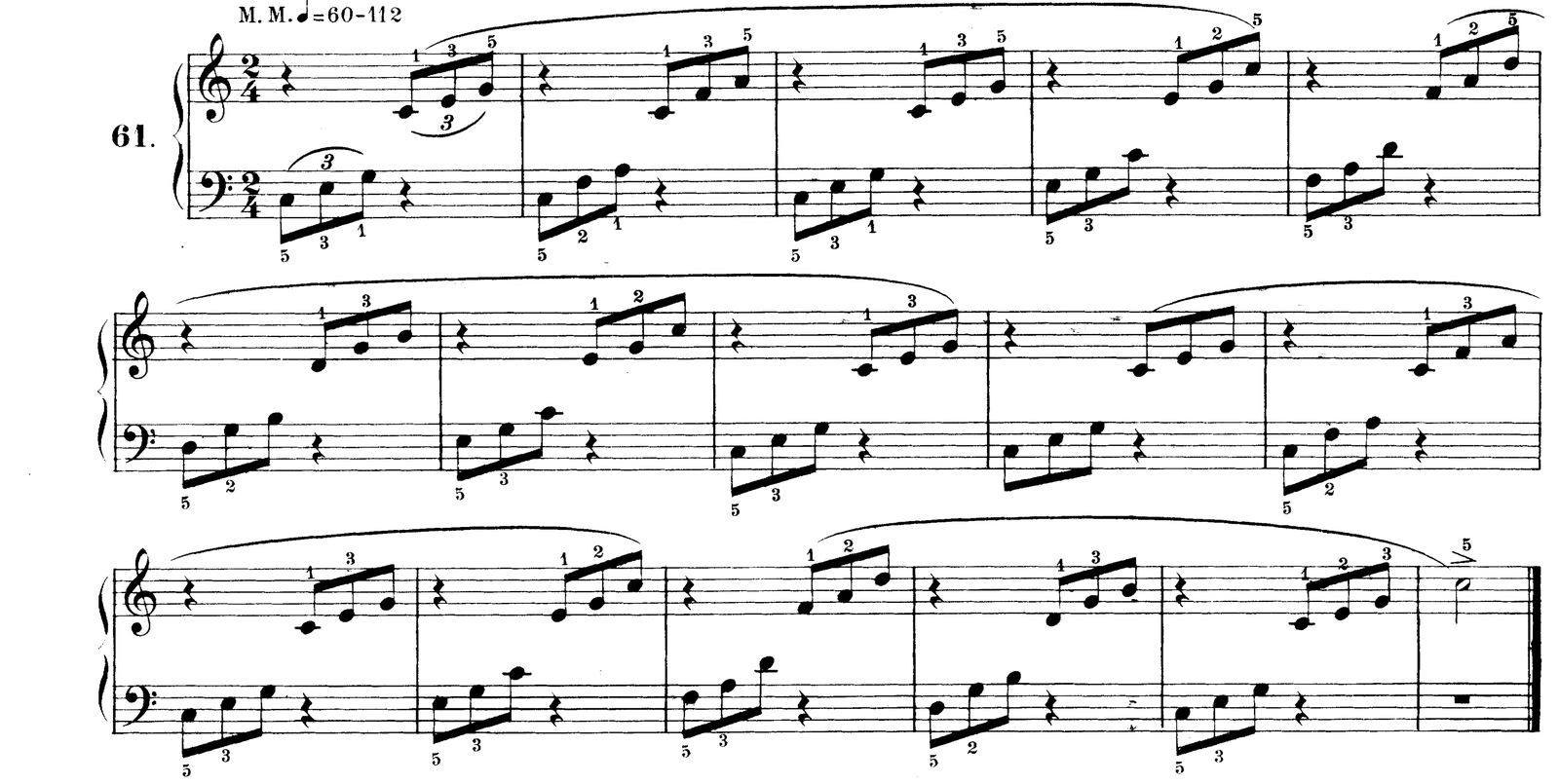
To be practiced in the following different ways: (a) Right hand playing the chords, all the notes together, the chords following at the rate of one a second. (b) Right hand playing the broken chords as written, but not delaying for the other hand; (c) Left hand playing its chords; (d) Left hand playing the broken chords, but not de-
Fig. 83 · Play this example in the reader ▶ laying between chords; (e) Both hands together playing the chords all together, six notes in one solid chord in each measure; (f) Finally, play as written. The object of these different methods of practice is to give the hands a better facility in these forms which occupy so large a place in all music in the key of C.
← Minuet of the Graces All sections First Piece of the Star Performer → More Playable Books Fux, Gradus ad Parnassum Learn how independent voices work together, one species at a time. Goetschius, Exercises in Elementary Counterpoint Build independent melodies through graded exercises, with 471 recorded examples. Goetschius, Counterpoint Applied Study imitation, canon, and fugue with 393 recorded examples. Kitson, Counterpoint for Beginners Strict counterpoint in two and three parts, species by species, with every example playable. Prout, Analysis of J. S. Bach’s Forty-Eight Fugues Follow Prout through all 48 fugues of the Well-Tempered Clavier, every example playable. Rameau, Treatise on Harmony Explore the foundations of harmony, composition, and accompaniment. Rimsky-Korsakov, Practical Manual of Harmony The classic harmony course, newly translated from the 1910 French edition, with all 640 examples playable. Tchaikovsky, Guide to the Practical Study of Harmony Tchaikovsky’s Moscow Conservatory harmony course, with playable examples. Fenaroli, Partimenti Six books of partimenti, with playable basses, contrapuntal exercises, and bilingual rules. Reger, Supplement to the Theory of Modulation Explore Reger’s modulation method with 100 analyses and 102 playable examples. Cutter, Harmonic Analysis Learn to name every chord and non-harmonic tone in real music, from Bach to Wagner, with the passages playable. Schoenberg, Theory of Harmony Read all 22 chapters, with the original German beside a new English translation. Rimsky-Korsakov, Principles of Orchestration Discover instrumental colors through scores and orchestral recordings. Forsyth, Orchestration A witty, thorough guide to every orchestral instrument, with the original pages. Forsyth, Choral Orchestration A whole Te Deum orchestrated bar by bar, with Forsyth’s reasons, the full score and the vocal score playable. Berlioz, Treatise on Instrumentation Berlioz’s treatise on the orchestra, revised by Richard Strauss, with the original pages. McKay, Creative Orchestration Ranges, transpositions, texture and balance, taught through projects, with the supplied examples played by orchestral samples. Sanganeria, Arrival Build jazz lines that land, with 30 original playable examples. Bona, Complete Method for Rhythmical Articulation Practice rhythm through 120 graded studies, with playable notation and original scans. Hanon, The Virtuoso-Pianist Practise all 60 exercises with playable notation, original scans and supplied Mutopia playback. ← All Playable Books  Playable Books