 Playable Books
George Frederick McKay · section 22 of 111
The Violin
Read and hear this section in the playable edition →Of all the instruments the violin is the most flexible in articulation, the most passionate in utterance, the most versatile in motion potentialities. It can be used either for melody or accompaniment. The player can shift easily from register to register and can execute the most subtle musical designs, either in staccato or legato. The violin responds readily to demands for dynamic change.
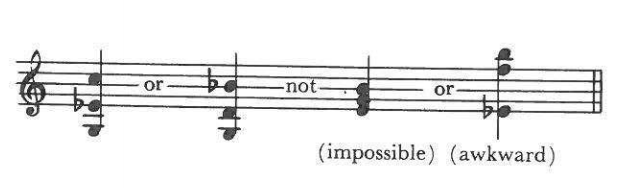
Special effects possible on the violin are: (a) the pizzicato (the most delicate and pointed staccato sound) which is made by plucking the string — the pizzicato can be delicate or rough, depending upon the way it is produced; (b) the trill; (c) the tremolo (for illustrations see pp. 10-11; (d) chords, which can be played by either strumming the strings or bowing — chords are not possible unless each tone of the chord is produced by a different string and unless the finger positions are practicable;
(e) harmonics, which are produced by stopping the string at a point one-half or one-quarter of its length and then drawing the bow,
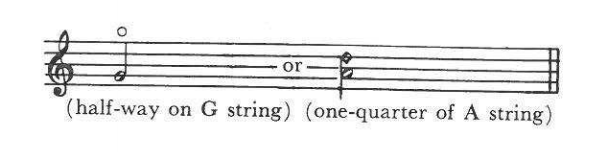
which produces a flute-like tone — harmonics cannot be played in rapid succession and, because of extreme delicacy, must be
more sustained than staccato; (f) the special sound of each individual string, which can be exploited by indicating that the player is to execute a passage entirely on one given string.
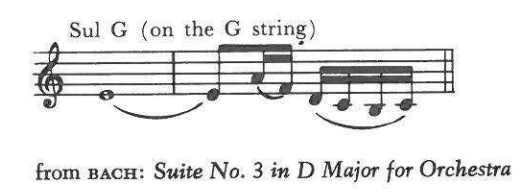
The string tone has a special pliability and a potentiality for softness and gentleness that makes it particularly suited for use as general background. The woodwinds, brass and percussion have a more insistent vividness and force of impact. Because of this difference in tonal character, the ear can tolerate the string tone for longer periods of continuous use.
When writing for the violin, give the player time to make the change from pizzicato to bowed sound, or vice versa. In legato passages two bows per measure are generally required to ensure that the player will have enough bow for a full, free tone. Be reasonable in asking for rapid and continuous leaps from high to low register (across the strings). Be inventive enough with the bowing (mixing staccato and legato) to avoid a monotony of articulation.
To hear the essence of violinistic effectiveness, listen to recordings of the principal violin concertos played by famous artists and also to the string quartets of the classic masters (such as Beethoven, Haydn and Mozart), as well as those of Bartók.