Playable Books
George Frederick McKay · section 37 of 111
Polyphonic texture
Read and hear this section in the playable edition →To aid theoretical understanding it is important to point out, again, that the organizing power of the several textures comes from their ability to create types of unity. The primitively simple line unity of the monophonic texture and the concentrated vertical simultaneity of the chordal texture are easy to observe and acknowledge as sources of unity. The source of unity of the polyphonic texture is perhaps less immediately apparent.
Polyphonic means "many-voiced" when it is literally translated, but in musical terminology it has come to imply a similarity of pace and motion in the "many voices." The unity of the polyphonic texture could be compared to that of dramatic action upon a stage onto which twins, brothers, or other recognizably similar characters enter at different times and by different doors.
In polyphonic texture the unity results from the several lines which are nearly similar but which enter and leave the musical fabric constantly, to create an overlapping action of several simultaneously continuing voices. The clarity results from the fusion of the several voices into a single impression. There is a dominating similarity of design presented by the overlapping action, which draws attention to motival or linear characteristics shared by all voices as they enter anew.
Nothing sounds more warmly sonorous and firmly clear than good polyphony. However, before examples are written for performance, the essential values of polyphonic texture must be clearly understood. Three or four strongly melodic lines sounding simultaneously are not necessarily polyphonic. Unless there is enough open space (sculptured silence) in each of the parts, unless the voices enter and leave the musical fabric by turn, and unless beats other than the first beat of the measure are highlighted as points of entry, the effect will be only partially successful as polyphony.
Every outstanding composer, from Bach to Webern, has used the polyphonic texture in orchestration. It is timeless and absolutely basic. It can contain any reasonable number of authentic voices, but the composer will learn early that a structure made up of only two or three strong lines can have amazing interest and clarity when projected by orchestral sound.
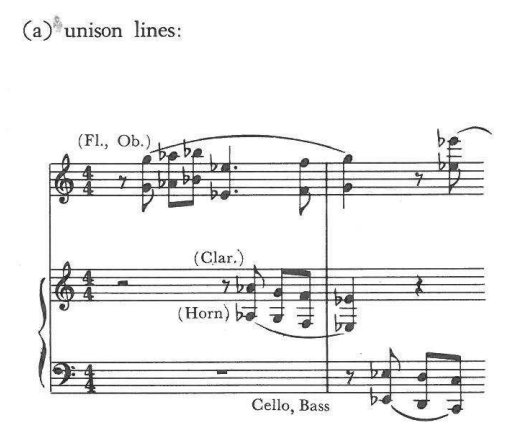
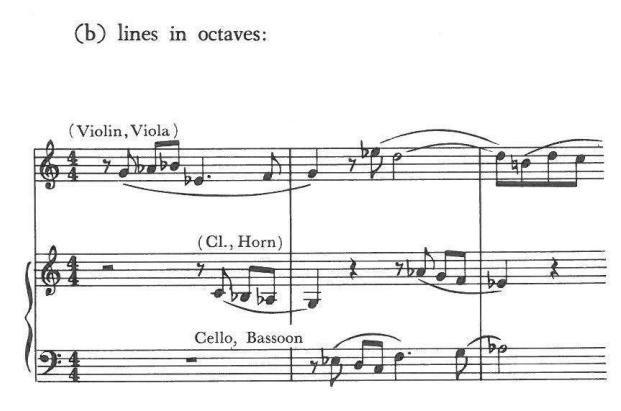
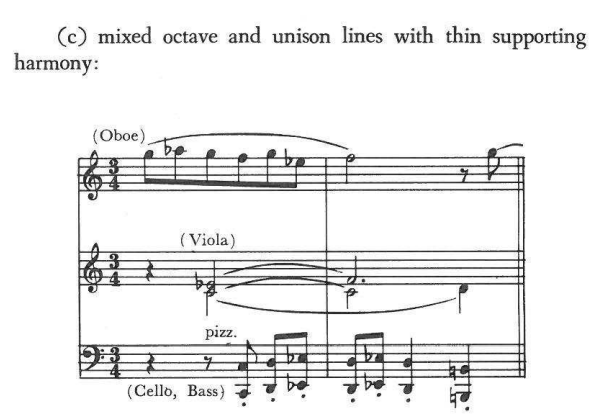
Polyphonic lines may be in unison or octaves, and choice will be determined by the amount of power desired. For variety, some lines may be in unison while others are doubled in octaves. Choice of timbre is an entirely personal matter, but variety is of great importance. Too continuous use of timbre of any one kind may result in monotony. On the other hand, a too frequent change of timbre may result in a rather "scrappy" sound.
Sometimes a too prolonged use of pure polyphony can become tiring because of lack of harmonic effect. To counter this, composers sometimes supplement the sound with a small amount of supporting harmony, motivally insignificant and usually limited to two or three voices.
Study the three examples on the next pages.
The amount of harmonic support given will depend upon personal taste and the dramatic or climactic need of the music. Although harmonic support adds warmth and substance, it also endangers the effectiveness of the polyphonic texture, the main glory of which is clean, clear linear design.