 Playable Books
George Frederick McKay · section 39 of 111
Homophonic texture
Read and hear this section in the playable edition →In each of the textures previously explained (monophonic, chordal and polyphonic), the unity of action resulted from similarities of line, rhythm and motion.
from KODÁLY: Concerto for Orchestra (Copyright 1942, Revised Edition 1958 — reprinted by permission of Boosey & Hawkes, Inc.) — PLATE III. POLYPHONIC TEXTURE [Plate withheld from the public edition: the excerpt is still in copyright.]
The clarity of the homophonic texture results from differentiation of the instrumental action into three functional elements: (a) melody, (b) accompanimental rhythmic design, and (c) sustaining chord. The more positively these elements are differentiated, the clearer the resulting orchestration will be.
It is this combination of differing action in the homophonic texture that dominates page after page of the orchestration of Rimsky-Korsakov and also the many illustrative examples in his treatise on orchestration. Observe the contrast of roles in this example, from his Scheherazade:
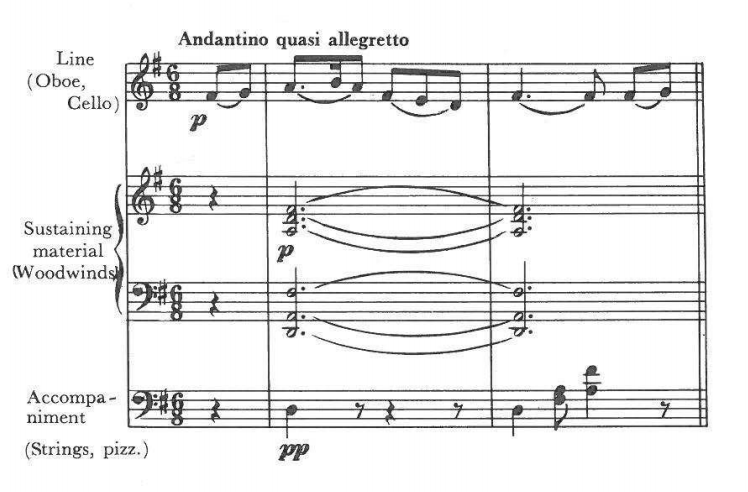
Although this balance of roles has been associated with much commonplace Romantic Period music, it is misleading to suppose that all homophonic music is necessarily dull. The homophonic texture represents, in fact, the most complete and subtle of all orchestral balances, and it has been constantly used with marvelous elaboration and ramification in the orchestration of imaginative composers such as Debussy, Ravel, Prokofiev and others.
It has been a fundamental resource through all style periods and, in various manifestations, has been used more than any other orchestral texture.
If balanced by significant melody and adequate harmony, the rhythmic accompanimental material is free to expand into expression and design of great interest. This potentiality for freshness and inventiveness in the accompanimental material is a constant challenge to ingenuity and motor sensibility.
The homophonic texture is not really as old-fashioned as is sometimes implied by those who reject it in favor of more "contemporary" types. Since the homophonic clarity results from a more developed and subtle perception (an understanding of the value of contrast), it represents a mental advance toward structural awareness. Homophonic texture will therefore remain as a major factor in all future music.
To maintain a balance of textures, a composer might well alternate homophonic texture with the other more primitively simple (monophonic, chordal and polyphonic) types.
In writing for performance, a few variants in the application of the homophonic texture should be kept in mind.
For example, an accompanimental pattern sometimes combines both the motion and sustaining factors into one compound design.
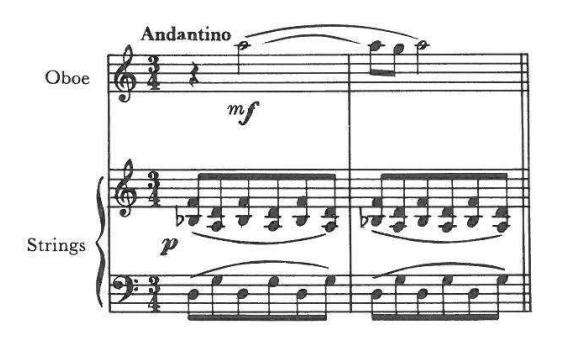
Sometimes the melody may be expanded into a harmonized line. Such reinforced melody is still a sufficient line in terms of the definition of homophonic texture (contrast of line, sustaining material, and accompanimental pattern). Study the three versions of a line given in this example:
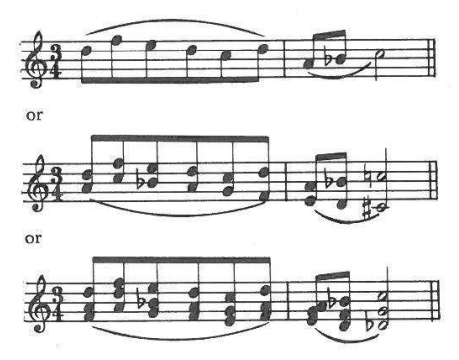
The more harmonic the line becomes, the less harmonic the accompanimental pattern will need to be.
Sometimes a homophonic texture will include what is commonly called a counter-melody. As it relates to the main melody, it is roughly contrapuntal and by itself is melodically incomplete. It must merge into the melodic action without drawing too much attention to itself — as shown on page 58.