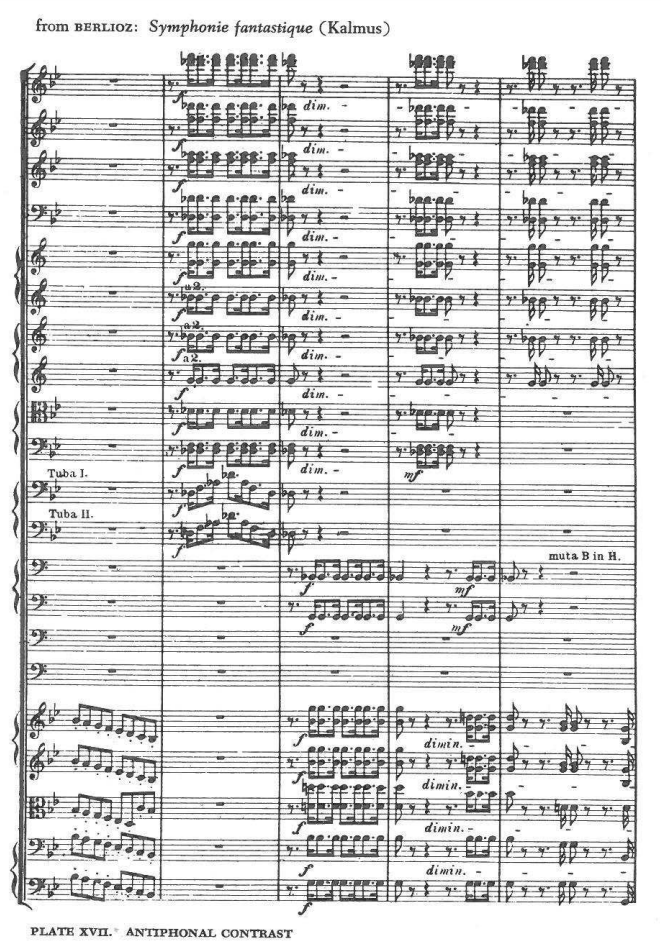
Music may be defined as "sound in motion, within a span of time." There is a whole realm of meaning and poetic feeling in musical motion which stimulates a kinaesthetic (motor) response. When an instrument is set into meaningful motion, an aura of attractiveness arises. A sudden flurry captures the attention, and any characterfully active design or live and continuous rhythmic pattern mysteriously magnifies the allure of a timbre.
The possibilities of instrumental motion are as rich and varied as are those of harmony or melody. These two facets have been carefully analyzed, but the processes and values of instrumental motion have remained largely untouched by practical analysis. Surely, here is an important theoretical frontier!
Although liveness of instrumental action was an important part of primitive music, its use diminished until Rimsky-Korsakov and others in the late Nineteenth and early Twentieth Centuries brought about a revival of interest in kinaesthetic values.
It is a special emphasis upon new frontiers in idiomatic invention that distinguishes modern from classic orchestration. Stravinsky is especially noteworthy for modern-day instrumental invention; Debussy and Rimsky-Korsakov were also very gifted in their motor sensibilities. Study some of the scores by these masters to analyze techniques of instrumental motion: such as La Mer and Ibéria by Debussy, Scheherazade by Rimsky-Korsakov and Petrouchka, Le Sacre du printemps and L'Histoire du soldat by Stravinsky.
 Playable Books