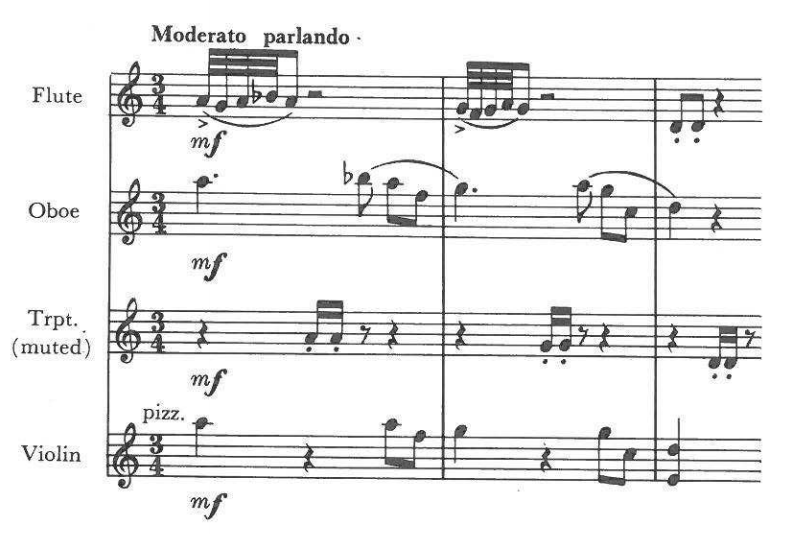
If differing versions of a melody are played at the same time, or if a rhythm is diversified by the playing of one or more variants simultaneously, a special kind of tonal attractiveness is created. This attractiveness springs from a certain motor enrichment, a subtle complexity of seemingly simultaneous yet partially alternated activity.
This heterophonic type of interest was common to primitive music and has become more and more a characteristic of Twentieth-Century orchestration. In the works of Debussy, Stravinsky, Martinu and others there is a subtle and glamorous quality to the motion that seems to come from elaborate design. In trying to equal this the novice composer will often write a page with too many unrelated patterns of activity and motion. The elaboration in the music of the master composers is usually unified by the central force of principal rhythmic motives which have been expanded by simultaneous heterophonic variants.
To illustrate this procedure, a principal rhythmic motive is shown first in its elemental form, and then expanded into heterophonically elaborate complexity (opposite page).
Note that in the latter example the essentially rhythmic character of the principal motive has been retained in the variants to produce an over-all unity of rhythm. Although the second version is greatly diversified, it has the impact of a single unified action.
 Playable Books