 Playable Books
George Frederick McKay · section 73 of 111
Contrasted articulation
Read and hear this section in the playable edition →The drier percussion instruments like snare drum and wood block are stringent in their attack, and supply a harshness and vigor that is akin to dissonance. The plectrum (plucked) instruments (pizzicato strings, guitar, etc.) are pointed and immediate in articulation and supply a vigor of attack second only to the drier percussions. The strings when bowed produce a moderately stringent attack and can effect either staccato or legato with little effort. The brasses are instruments of sustained tone,
but have some degree of articulative vigor. The bell-toned percussion instruments (glockenspiel, celesta, etc.) have a lesser degree of articulative vigor because of the softening effect of the harmonic (consonant) impression that they make. The woodwinds, especially the flutes, have the softest and gentlest articulation.
There are, therefore, six degrees of articulative intensity, ranging from harsh and vigorous to soft and gentle.
This scale of intensities leads to a formula for tonal interest:
The most striking blends of articulative types will result from combinations of the most extreme opposites.
Next in interest will be combinations of relatively opposite types. Least interesting will be combinations of the most nearly similar in articulative intensity.
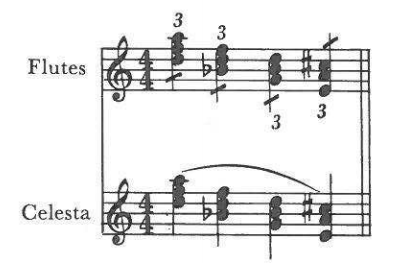
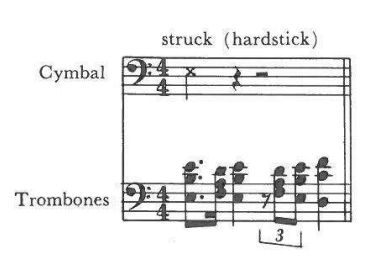
Two examples of contrasted articulation are shown on page 136. Flutes (blown) are mixed with celesta (percussive), and trombones (blown) are mixed with cymbals (struck). Both of these examples illustrate combination of articulative types.
It is in the music of the Orient that the most imaginative articulative resources can be found, particularly in the use of percussion instruments. Fascinating examples of mixture of articulative intensity may be heard in the Louisville recording And the Fallen Petals, by Chou Wen-Chung. In this work, by blending harsh percussive sounds with those of the blown instru-
ments, the composer has added an exciting dissonance to harmonies which, by themselves, are relatively consonant. Another good example of articulative mixture is the Louisville recording Concerto No. 7, by Hovhaness, which brings in the bell sounds in an original way. “The Festival at Bagdad” from Rimsky-Korsakov’s Scheherazade, and The Fountains of Rome by Respighi are also notable — the former for its vigorous combination of articulative types, and the latter for certain delectable blends (flute and harp, for instance).