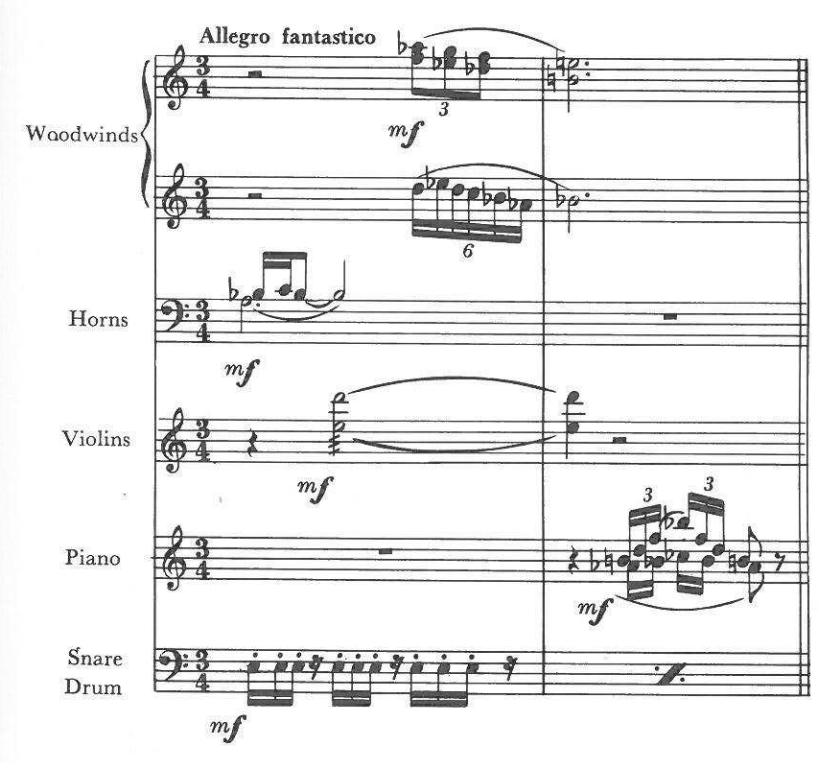
Pointillism is a technique borrowed from the “Impressionistic” style of painting and transferred to music by Debussy and others. In such a painting, when seen from a distance, points of design seem to merge into a single impression; separated primary colors form an impression of a subtle blend.
To approximate this in music, a series of fragmentary designs must be sounded in clear timbres and in differing registers. Entrances should be heard only briefly and in rapid order. These splashes or points of sound are separated in space and time, but in the mind of the listener, they merge into an impression of blended tonal beauty. Analyze the use of this technique in
from BLACHER: Studie im Pianissimo (With authorization of Bote & Bock, Berlin/Wiesbaden, Germany) — PLATE XXV. OVERLAPPING [Plate withheld from the public edition: the excerpt is still in copyright.]
La Mer and Ibéria by Debussy. Successful pointillism demands a special clearness of timbre. Too much sustained sound should be avoided, but sometimes a very thin background of sustained motion may be added. This will give an underlying unity which will balance a certain “scrappiness” inherent in pointillism. This supplementary thread of motion must be subtle and delicate. A bit of overlapping in the pointillistic entrances helps give continuity to the sound, but is not essential. Observe these two “pointillistic” measures:
 Playable Books