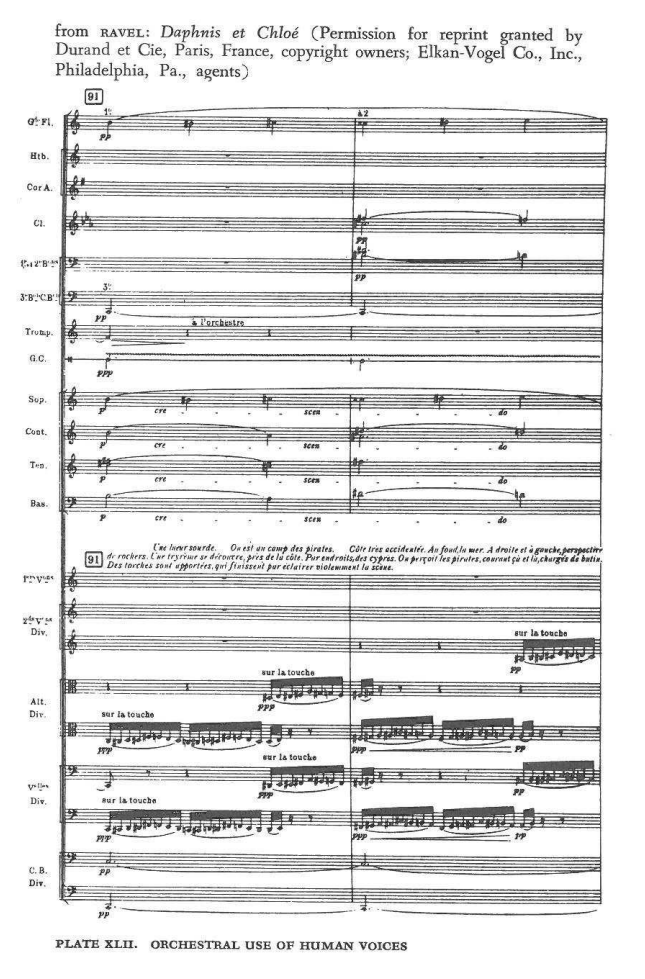
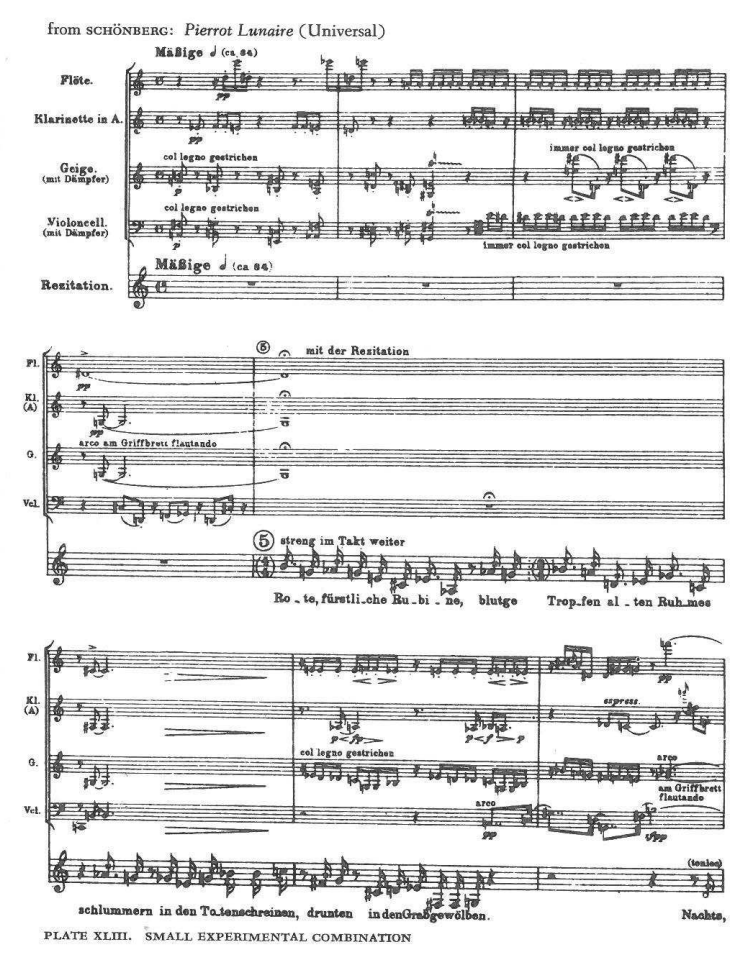
In his Three Nocturnes, Debussy adds a choir of feminine voices to the instruments of the orchestra. In the movement “Sirènes” they sing harmonically as though they were a choir of instruments but use only syllables such as “ah,” “la,” etc. Holst in The Planets (“Neptune”) makes similar harmonic use of human voices. Vaughan Williams uses the human voice as a solo instrument in the Pastoral Symphony and uses choral sound instrumentally in Flos Campi.
from VARÈSE: Deserts (By permission of G. Ricordi & Co., copyright owner) — PLATE XLI. INSTRUCTIONS FOR THE USE OF ELECTRONICALLY PRODUCED SOUNDS [Plate withheld from the public edition: the excerpt is still in copyright.]
Theoretical analysis of the characteristics of vocal timbre might lead to the conclusion that voices are not really suitable as orchestral ingredients, if judged by what they add to the concept of “total mixture.” Nevertheless, there are interesting frontiers in the possibilities for combining orchestral and vocal timbres.
 Playable Books