 Playable Books
Jean-Philippe Rameau · section 6 of 109
Chapter three
Read and hear this section in the playable edition →On the Origin of Consonances and Their Relations
* Sound is to sound as string is to string. Now every string contains within itself all strings shorter than it, but not those that are longer. Consequently, in sound likewise, all high sounds are contained in the low sound, but not, conversely, all low sounds in the high one. It is therefore evident that the higher term must be sought by dividing the lower. This division must be arithmetical, that is, into equal parts, and so forth. Let A B, then, be
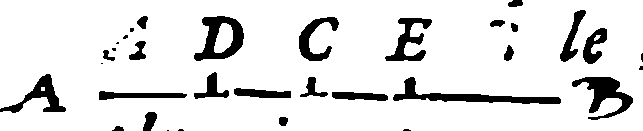
the lowest term. If I wish to find its higher term in order to form the first of all consonances, I divide it into two—this being the first of all numbers—as you see done at point C. A C and A B then stand apart by the first consonance, called the octave or diapason. If I wish to obtain the other consonances immediately following the first, I divide A B into three equal parts. This produces not merely one higher term, but two: A D and A E. From these arise two consonances of the same kind, namely a twelfth and a fifth. I may also divide the line A B into 4, 5, or 6 parts, but no further, because the capacity of the ears does not extend beyond this, and so forth.
* Descartes, Compendium of Music, p. 60.
To make this proposition clearer, we shall take seven strings whose divisions will be indicated by numbers. We suppose them all tuned in unison, without concerning ourselves with any other equality. We shall then place the numbers in their natural order beside each string, as in the following demonstration. Each number indicates the division into equal parts of its corresponding string. We need only observe that, since the number 7 cannot produce any agreeable interval—as is evident to connoisseurs—we substitute 8 for it. After 7, this is the first number that doubles one of the numbers contained in the senary; it forms the triple octave with 1. This does not increase the quantity of numbers proposed, since 6 and 8 give the same interval as 3 and 4, every number always representing the number of which it is double.
Demonstration
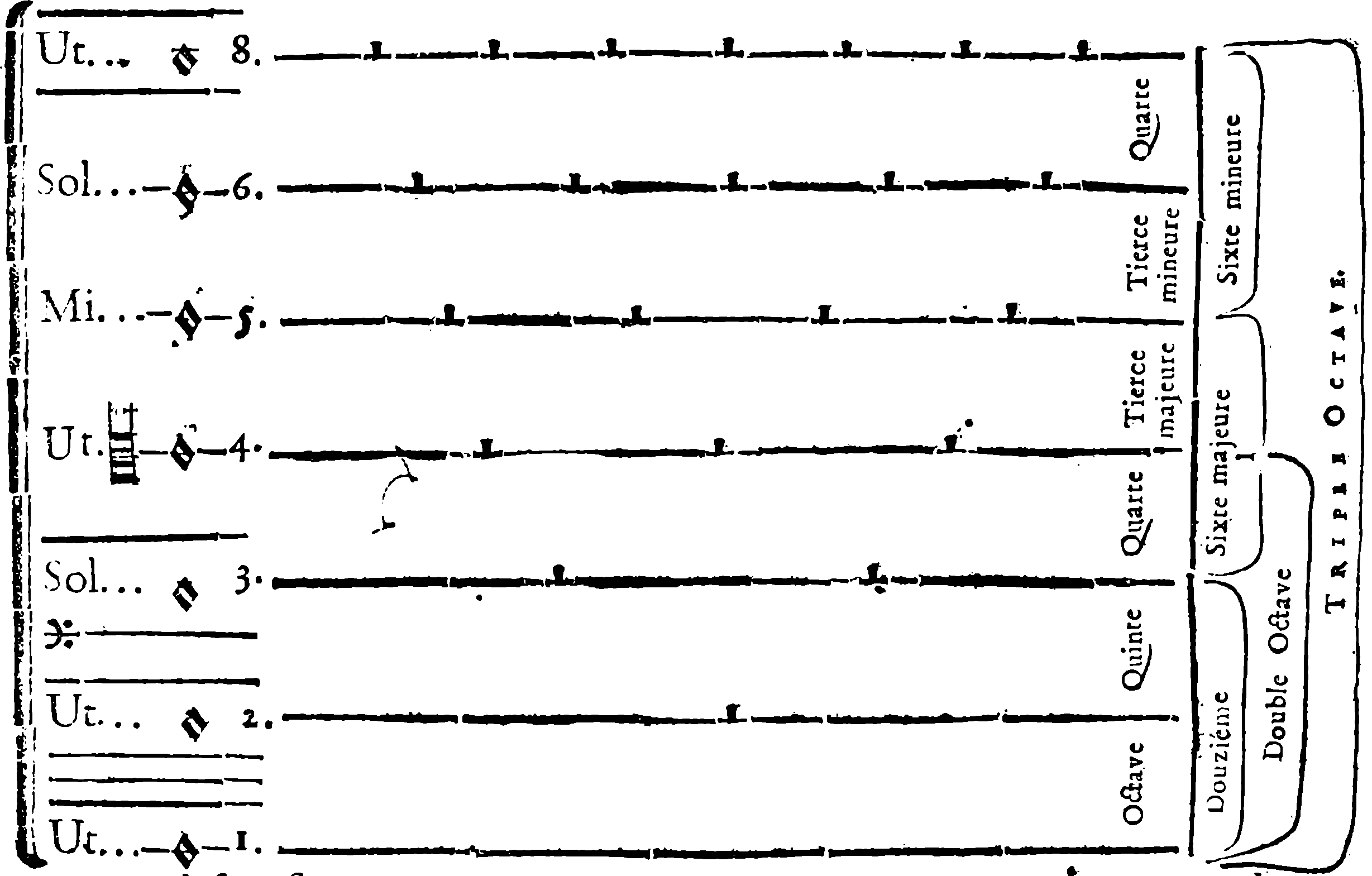
First, remember that the numbers everywhere indicate divisions of unity, just as they indicate divisions of the whole string corresponding to 1.
The order of the origin and perfection of these consonances is determined by the order of the numbers. Thus the octave between 1 and 2, which is generated first, is more perfect than the fifth between 2 and 3. Next comes the fourth between 3 and 4, and so forth, always following the natural progression of the numbers and admitting the sixths only last.
The names of the notes should make it apparent that string 1, its octave 2, and its double and triple octaves 4 and 8 produce, so to speak, only one and the same sound. Moreover, arranging these notes according to the order of the numbers and the divisions of the string gives the most perfect harmony imaginable, as anyone is free to test. As for the properties particular to each sound or consonance, we shall set them out in separate articles, to give a more distinct idea of them.
Article one
On the Principle of Harmony, or the Fundamental Sound
We must first suppose that the whole string corresponding to 1 produces a certain sound. We must examine this sound’s properties by relating them to those of this single string, or even to those of unity, which is the principle of all numbers.
1. The different divisions marked on all the strings equal to the first, and determined by the quantity expressed by each corresponding number, clearly prove that every part of these strings comes from the first string, since these parts are contained in that first and single string. Thus the sounds produced by the divided strings are generated from the first sound, which is consequently their principle and foundation.
2. The different distances between this fundamental sound and those it has generated through its division form different intervals. The fundamental sound is consequently the principle of these intervals.
3. Finally, the union of these different intervals forms different consonances. Their harmony cannot be perfect unless the first sound prevails beneath them as their base and foundation, as the demonstration shows. Thus this first sound is also the principle of these consonances and of the harmony they form.
In the following articles, we shall see which sounds correspond most closely with this principle, and the use it makes of them.
Article two
On the Unison
Strictly speaking, a unison is only a single sound, which may be produced by several voices or instruments, as may be seen in the seven strings of the preceding demonstration before they are divided. Hence it is said that the unison is not a consonance, because it lacks the condition necessary to make one: a difference between sounds in low and high pitch. Rather, the unison has the same relation to consonances that unity has to numbers.
Article three
On the Octave
The proportion of a whole to its half, or of a half to its whole, is so natural that it is understood at once. This should incline us in favor of the octave, whose ratio is 1 to 2. Unity is the principle of numbers, and 2 is the first number; the terms “principle” and “first” are closely related, and their application here is entirely apt. In practice, too, the octave is distinguished only by the name “replica.” Every replica is then identified with its principle, as the note names in the preceding demonstration show. It is regarded less as a chord than as a supplement to chords, which leads some to compare it with zero. Male and female voices naturally sing the octave while believing that they are singing the unison, or the same sound. On flutes, this octave depends only on the strength of the breath. If one takes a viol whose strings are long enough for their vibrations to be distinguished, one will observe that, when a string is made to sound with some force, strings an octave lower or higher will vibrate of themselves. With the fifth, however, only the higher sound vibrates, not the lower. This proves that the principle of the octave is identified with both sounds that form it, whereas the principle of the fifth, and consequently of all other intervals, resides solely in the low, fundamental sound. * Descartes was mistaken here because of the false evidence he drew from a lute concerning the octave.
Moreover, the octave sets the bounds of all intervals. Everything generated by division of the principle, after being compared with that principle, may equally be compared with its octave. This double comparison produces no diversity in harmony other than that arising from the different positions of two terms, such as 2, 3 or 3, 2: what geometry calls an inverted ratio or comparison. In harmony, this inverted comparison is nothing other than the transposition of a sound from low to high. If 2 denotes the low sound when it comes first, it will consequently denote the high sound when it comes last. We must therefore mark this transposition by the number representing its octave, writing 3, 4 instead of 3, 2. This should show us that a number multiplied geometrically always represents, so to speak, the same sound, or gives the replica of the sound represented by its root. The preceding demonstration proves this when the multiplication begins with 2, the first number generated by dividing unity. Unity yields to this number the privilege of generating all the rest in its place, without nevertheless losing any of its force: whatever agrees with 2 agrees equally with 1. The octave, double octave, triple octave, and further octaves if desired are fundamentally only the same interval, distinguished merely by the name “double” or “replica.” The same holds for the fifth and twelfth, and so forth. The ratio 1, 2 is multiplied as far as necessary only to find intermediate numbers that can agree with each of its terms. Thus, for example, 3 lies between 2 and 4; 5, 6, 7 lie between 4 and 8; and this continues increasingly to infinity. The ratios 2, 4 and 4, 8 are the same as 1 to 2.
From the correspondence between intervals arising when numbers are compared indifferently with 1 or 2, though always above 1 and above 2, we may judge that these same numbers, compared above 1 and below 2, will form intervals whose relations are almost equal. More importantly, since this inverted comparison comes only from transposing a sound into its octave, or a number into its double, we must judge that the relation of sounds so transposed can change only through a difference of proportion that causes almost no difference to the ear. The proportion 2 to 4 has nearly the same effect as 2 to 2, as all we have said, together with experience, sufficiently proves. This has led to granting the octave the same force as its principal, fundamental sound. “The octave,” says Zarlino,* “is the mother, source, and origin of all intervals; the division of its two terms generates all harmonious chords.” Although this is true in a certain sense, it is always the division of the single fundamental sound that generates all other sounds, and consequently all intervals and chords. To uphold Zarlino’s opinion, we must therefore add that the fundamental sound uses its octave as a second term to which all intervals generated by its division must correspond, making clearer that it is their beginning and end. The octave has no properties except those communicated to it by the fundamental sound that generates it. Or, more precisely, it is always the same sound transposed into its octave or replica—or multiplied, if one wishes—in order to determine, on every side, intervals particular to each sound it has generated. This does not alter the properties allotted to those generated sounds in the first comparison that had to be made with the fundamental sound. A sound that formed a perfect consonance with the fundamental forms one equally with its octave. A sound that formed an imperfect consonance or a dissonance on one side forms the same on the other. A sound that had to ascend or descend on one side ascends and descends on the other. In short, whatever agrees on one side also agrees on the other, and nothing is altered in any way, with this exception: the perfection belonging to chords formed from the principal consonances, where the fundamental occupies its natural position as the lowest sound, is indeed changed when that fundamental moves into its octave. This introduces variety by changing the order in which those same consonances stand in relation to one another. One may test this in the preceding demonstration. Its present arrangement of all the consonances gives very great satisfaction. That satisfaction diminishes, though without offending the ear, if sounds 1 and 2 are removed, and then if sounds 1, 2, 3, 4 are removed. The effect is even more perceptible in the course of a piece of music.
* Descartes, p. 59.
From all these observations we may conclude that any sound is always implied in its octave. * Descartes partly agrees when he says that no sound is ever heard without its octave above seeming, in some manner, to strike the ears. He might perhaps have added the octave below, had he not been mistaken in his proof drawn from a lute, as we have said, or had he taken account of Aristotle’s opinion. In his 24th and 43rd Problems, according to Desermes,* Aristotle says that if the nete string, which forms the upper sound of the octave, is plucked, the hypate string, which forms the lower sound, will also be heard, because the fading end of the high sound is the beginning of the low sound, which resembles an echo or image of the high one. Perhaps no musician fails to use the expression “such a sound, such a note, or such an interval is implied,” sometimes adding “in the bass.” In this case the expression often comes before an understanding of its force in the person who uses it. Harmonic ratios offer us only the perfect chord. We therefore cannot admit the sixth and sixth–fourth chords derived from it without supposing that the fundamental sound of that perfect chord is implied in its octave; otherwise, every principle must be destroyed. Beyond all this, experience shows us that a chord composed of the third and fifth is always perfect and complete without the octave. This leads us to think that the octave is implied, since it is generated first. If that octave is then placed above the third and fifth, with which it now forms a sixth and fourth, we nevertheless hear a chord that is still good, although the fundamental sound is no longer present. Thus the fundamental is transposed or implied in its octave. This is why the latter chord is less perfect than the former, although composed of the same sounds. These various expressions—“the principle is inverted,” “it is identified with its octave,” “transposed into its octave,” or “implied in its octave”—therefore amount to the same thing. The high sound of the octave must not be regarded as a principle different from the one that immediately generates it, but as representing that principle and forming a whole with it, in which all sounds, intervals, and chords must begin and end. We must nevertheless remember that all the properties of this octave, of sounds in general, of intervals, and of chords depend absolutely on this single fundamental principle, represented by the whole string or by unity.
* Zarlino, Terza parte, chapter 3, fol. 174.
* Descartes, p. 61.
* Desermes, p. 41.
Article four
On the Fifth and the Fourth
The sounds forming the fifth and fourth are contained in the divisions of the whole string and are consequently generated by the fundamental sound. With regard to intervals, however, only the octave and fifth are generated immediately by the fundamental in this case. The fourth is merely a consequence of the octave: it arises only from the difference between that octave and the fifth. Accordingly, it is not mentioned in the original chords, whose entire force is attributed solely to the fifth. Even the octave is not recalled there, although it originated before the fifth and the fifth consequently cannot exist without it. If the octave is not recalled in these chords, it is apparently because it is implied. Otherwise the fourth could never be admitted, since it cannot subsist without the octave.
Here we must attend closely to the inversion of comparison discussed in the preceding article. This inversion is the key to all the variety of which harmony is capable; knowing it is enough to overcome the greatest difficulties. That knowledge consists only in distinguishing the intervals that may arise from comparing an intermediate number in turn with each term of the octave. Thus, if we take 3, the arithmetic mean of the octave 2, 4, and compare it with each term, it gives the fifth with 2 on one side and the fourth with 4 on the other. The only difference between these intervals is that the one resulting from comparison with the low, fundamental sound of the octave must undoubtedly be more perfect than the one resulting from comparison with its high sound. The further difference in proportion need not detain us, since it arises only from the difference between octave and unison. It is as though we compared 3 with 2, and again with 2, which would produce no difference. Thus the close relation between the octave’s two sounds—barely distinguishable from unison and seeming to be one—leads us to judge that 2, 4 has nearly the same effect on the ear as 2, 2. It must likewise lead us to regard as almost equal two intervals differing only in one of these terms, 2 or 4. We give preference only to the interval in which the fundamental occupies its natural position, since that interval comes directly from it. This led to using arithmetic proportion in this case. It is very simple: it consists only in finding the mean of two given numbers, as we found 3 between 2 and 4. It also led those who followed the order of multiplications to invent a new proportion, called harmonic, which is merely an inversion of the former, as we shall see in the next chapter. Each of these proportions, applied to its own object, therefore gives the fifth in relation to the octave’s low sound and the fourth in relation to its high sound. Apply either proportion to the object of the other, and it gives the fourth on the low side and the fifth on the high side. This inversion reveals itself increasingly as one seeks to penetrate the secrets of harmony. For example, begin with numbers, whose natural progression is to increase: in harmony, that progression must decrease. If arithmetic proportion favors us on one side, the proportion called harmonic produces the same effect on the other. To conform to the first proportion, we must suppose that the numbers express divisions of unity; to conform to the second, we must reverse the order of numerical progression. To conform to the natural progression of numbers—still supposing they express divisions of unity—we must divide a given string; to conform to the reversed progression, we must multiply that string. All sounds arising from division lie above, as they should; those arising from multiplication lie below, contrary to the natural order. Harmonic proportion nevertheless remedies this. Finally, if the octave has the entire relation we have observed—and we cannot deny it without overturning what reason and experience offer on this subject—its division first gives us the fifth as the first interval of its kind, since it is such only in relation to the octave’s low, fundamental sound. It then gives the fourth as the “shadow,” in Descartes’s expression,* of that fifth. This comes solely from reversing the two sounds that first formed the fifth, by transposing the octave’s low sound into its high sound. This final inversion is the principal subject of this work.
* Descartes, p. 69.
Article five
On Thirds and Sixths
The sounds forming thirds and sixths are all contained in the divisions of the whole string and are consequently generated by the fundamental sound. With regard to intervals, however, only the octave, fifth, and major third are here generated immediately by the fundamental sound. The minor third and the sixths are merely consequences of the fifth and octave: they arise only from the difference between the major third and fifth, and between the two thirds and the octave. This deserves some reflection, particularly concerning the minor third.
Since all intervals are generated from the octave, where all begin and end, the minor third must be included in it—not indirectly, as we find it here between the major third and fifth, but in direct relation to the fundamental sound or its octave. Otherwise the minor third could never change its position: it would be confined to the middle of chords and could never occupy their extremities. This would be entirely contrary to experience and to the properties attributed here to arithmetic and harmonic proportions. According to our system, the first divides the fifth with a major third below and a minor third above; the second, conversely, divides it with a minor third below and a major third above. This new kind of inversion in the order of thirds clearly proves that all harmony’s variety is founded chiefly on inversion.
To be further convinced, one need only observe the agreeable effect produced by all the consonances of the preceding demonstration in their given order, and the properties belonging to each. First, the octave appears so united with the principle from which it originates that it becomes inseparable from it. It is therefore not mentioned in all that follows, because it is implied. Next, the fundamental sound appropriates the fifth to form all chords, immediately determining their construction by its union with the third. The fifth is then composed of a major third and a minor third, so it is impossible for both thirds to relate to their principle at the same time. Yet if one appears to be generated immediately from that principle, we must grant the other the same privilege. Their major–minor difference does not change the kind of interval: each remains a third. Moreover, the fifth cannot set the bounds of intervals; that quality belongs only to the octave. Everything between the principle and its fifth therefore remains dependent on the octave, which is inseparable from that principle, as we have proved thus far. Besides, since one interval can be judged by another only with the octave’s assistance, we must set aside the fifth and major third when judging the minor third. The octave of the minor third’s low, fundamental sound will then be implied and will enjoy the same privileges assigned to it in the origin of all intervals. Thus the fifth between 2 and 3, generated immediately from the fundamental sound of the octave 2, 4, produces the fourth between 3 and 4 through inversion—or, equivalently, by transposing the fundamental 2 into its octave 4. Likewise, the major third between 4 and 5, generated immediately from the fundamental of the octave 4, 8, produces through inversion a minor sixth between 5 and 8. Similarly, the minor third between 5 and 6, generated immediately from the fundamental of the octave 5, 10, produces through inversion a major sixth between 6 and 10, or between 3 and 5. There is therefore no difference here between the immediate origin of the fifth and that of the two thirds, nor between the mediate origin of the fourth and that of the two sixths. One might still object that the minor third’s principle appears different from that of the major third, fifth, or octave, since 5 is not a multiple of 2—taking 2 here as unity. We should therefore point out that the minor third’s ratio is placed between 5 and 6 only to avoid fractions while following the natural order of numbers, which prescribes a corresponding order for string divisions. The same proportion could express this ratio between 1 and 1 1/5; unity would then be its principle. The next article makes this apparent.
We must conclude from all that has been said that there are only three primary consonances: the fifth and the two thirds. Together they compose the chord called natural or perfect. From them arise three secondary consonances: the fourth and the two sixths. These compose two new chords, which are nevertheless inversions of the first. We set aside the octave, which must be implied in each of these chords, and for which “consonance” is less fitting than “equisonance,” the name bestowed upon it by most of the best authors.
* After observing in his Harmonic Demonstrations that sixths are inversions of thirds, Zarlino says in his Institutions that they are composed of a fourth and a third. This causes his first proposition to be lost from view.
* Descartes was equally mistaken about the origin of the minor third and of the sixths when he said, “The minor third is generated from the major, as the fourth is from the fifth,” and so forth; further down, “The major sixth proceeds from the major third,” and so forth; and further still, “The minor sixth is derived from the minor third as the major sixth is from the major third, and thus borrows its properties and nature,” and so forth. The fourth is generated from the fifth only through the force of the octave, just as the minor sixth is generated from the major third and the major sixth from the minor third, without the minor third sharing that same origin. Thus all these conclusions of Descartes are false, except concerning the properties of sixths, which he confused with their origin. The property they share with thirds attaches only to the major or minor kind to which each third and sixth must belong. Following the properties of the major or minor kind is therefore very different from proceeding or deriving from it. Nevertheless, these faults are pardonable in an author who only touched upon the subject, and who otherwise makes it quite clear that, had he devoted himself to it, he would have pursued it further than another.
If we have given each third equal force in relation to the fundamental sound, this does not mean that the position determined for each by the natural division of the fifth is not the most suitable, especially when one seeks a deeper understanding. We shall see throughout that the high position suits the major third less well than the minor.
* Zarlino, Ragion. 2°, definition x, fols. 83 and 84. Terza parte, chapters 20 and 21, fols. 192 and 193.
* Descartes, p. 71.
Article six
Summary of This Chapter, in Which the Properties of the Preceding Demonstration Are Contained in a Single String
Since a part of each string in the preceding demonstration is sufficient to prove all that we have said, we shall mark that part on a single string, with the number determining its division into equal parts. We shall take the part extending from the number to the end of the string toward the right.
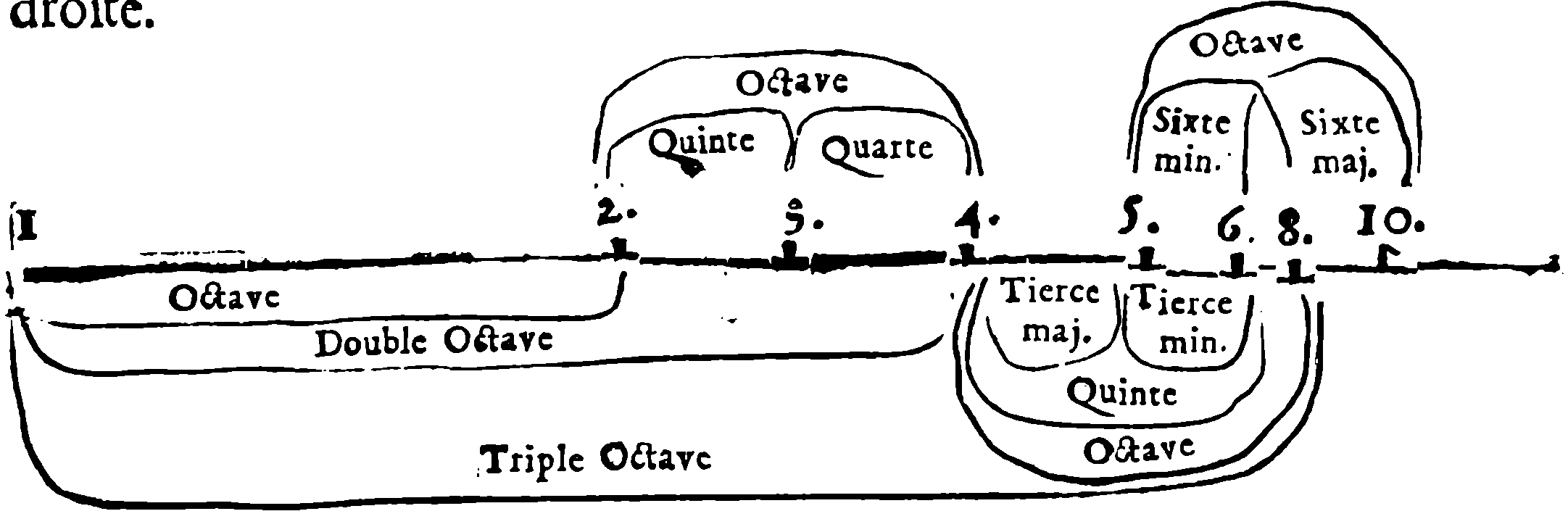
Here we need attend only to the octaves 2, 4; 4, 8; and 5, 10, comparing the numbers lying between each pair with each of that octave’s terms in turn. We shall find that the primary interval is always contained in the comparison of the intermediate number with the number representing the octave’s low, fundamental sound. The inversion of that primary interval is contained in the comparison of the same intermediate number with the number representing the octave’s high sound. For example, in the octave 2, 4, the fifth 2, 3 is the principle of the fourth 3, 4. In the octave 4, 8, the major third 4, 5 is the principle of the minor sixth 5, 8. Finally, in the octave 5, 10, the minor third 5, 6 is the principle of the major sixth 6, 10. All this comes only from transposing the fundamental sounds 2, 4, and 5 into their octaves 4, 8, and 10.
To make this clearer still, take the lengths resulting from the same division, but extending to the left from the number to the end of the string. Each length may then be compared with the whole string, which is its principle, and with its octave 2, which serves as its limiting term. Thus 3 gives the fifth with 1 and the fourth with 2; 5 gives the major third with 1 and the minor sixth with 2; and 6 gives the minor third with 1 and the major sixth with 2. As we see, unity is here the immediate principle of the fifth and both thirds. The fourth and both sixths arise from these by transposing unity into its octave 2. We should therefore no longer be surprised if unity is represented by 2, 4, 5, or any other number, since this is done only to avoid fractions.
Demonstration
On the Relations of Consonances in the Lengths Taken Toward the Left
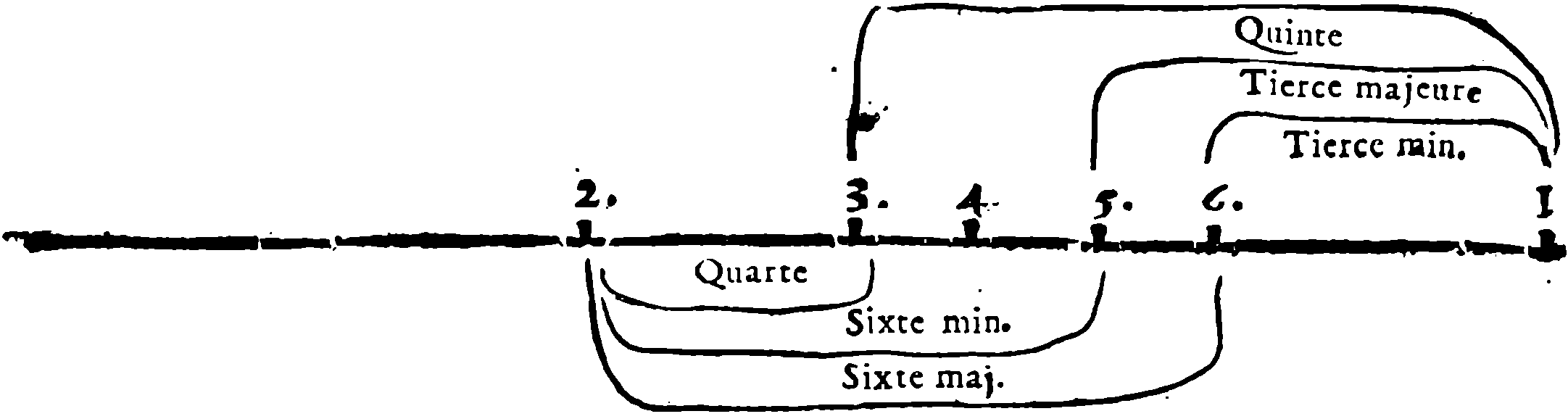
In Chapter XI, we shall explain how to find the ratios of consonances compared in this way.
Most theorists have considered the inversion we have just observed between consonances merely as the simple difference between one interval and another. Yet the difference between a consonance and the octave must be distinguished from the difference between two consonances. Since the octave represents the principle, nothing can agree with one of its terms without also agreeing with the other, as Descartes says.* In finding the difference between two consonances, however, we consider only the principal sound of that octave; the high sound counts for nothing. Accordingly, we shall observe that primary consonances and those arising from their inversion can always be taken on our string toward the right, the more natural side, because their difference comes only from the difference between the octave’s two terms. The difference between two successive consonances, however, can be taken only toward the left, as we shall see in Chapter V. This is because they were generated only from the principal sound, to which we must return to discover their difference, since it is their origin.
* Descartes, p. 64.
If we consider how to find the ratios of intervals generated by transposing the octave’s two sounds, or of intervals arising from the distance between one interval and another without including the octave, we shall see that an inverted interval is obtained simply by doubling the smaller term of a given ratio or halving the larger, which amounts to the same thing. For example, the minor third 5, 6 gives the major sixth by doubling 5 or halving 6. To obtain the interval that forms the difference between two others, however, we must resort to a rule of subtraction. As further proof of the octave’s great perfection, we see that it can be formed from a unison by dividing or multiplying one term of that unison, whose ratio is 2 to 2. Divide or double either term and we obtain the octave, which remains an octave whether on the low side or the high side.