 Playable Books
Jean-Philippe Rameau · section 8 of 109
Chapter five
Read and hear this section in the playable edition →On the Origin of Dissonances and Their Relationships
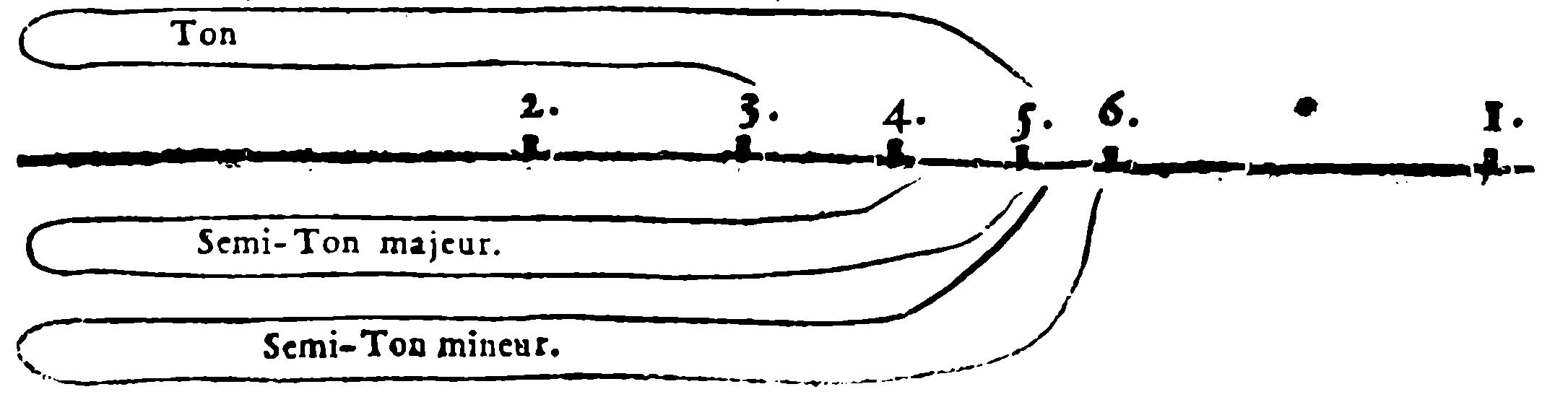
Dissonances* can be derived from the same divisions of the string that gave us consonances, by comparing the lengths remaining to the left of each number. This will also reveal the difference between two consecutive consonances. For example, the lengths taken to the left of 3 and 4 give the whole tone, which is the difference between the fifth and the fourth; those of 4 and 5 give the major semitone, which is the difference between the fourth and the major third; and those of 5 and 6 give the minor semitone, which is the difference between the major and minor thirds. These whole tones and semitones form the successive steps of the natural voice, from which melody originates. Thus we begin to see that melody is merely a consequence of harmony.
* See the Alphabetical Table.

The ratios of these dissonances can be learned through a rule of subtraction: place one above the other the ratios of two consecutive consonances whose difference is sought, thus:
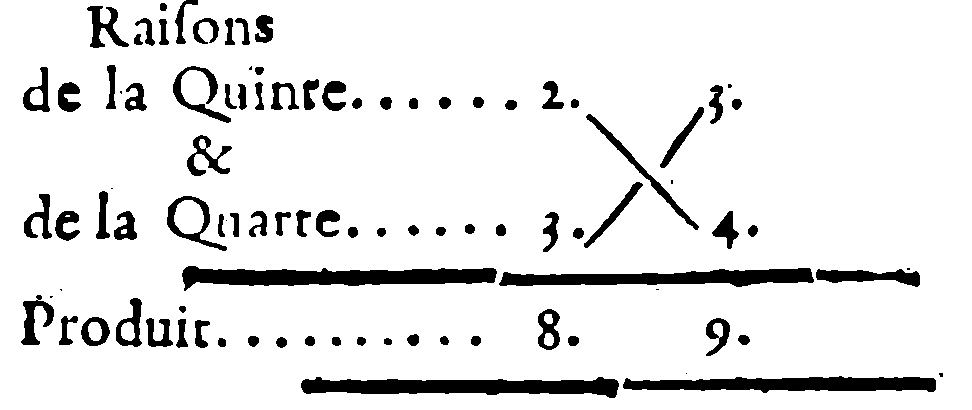
This cross X means that the antecedent of one ratio must be multiplied by the consequent of the other. Thus 2 times 4 gives 8, and 3 times 3 gives 9; the product 8, 9 gives us the ratio of the whole tone. We can do the same with the fourth and major third, and so forth. If we seek the difference between the fifth and the major sixth, we find that it is a whole tone whose ratio is 9 to 10. This obliges us to distinguish two kinds of whole tone, calling the first major and this one minor.
The following system has been established on these observations.
Perfect diatonic system
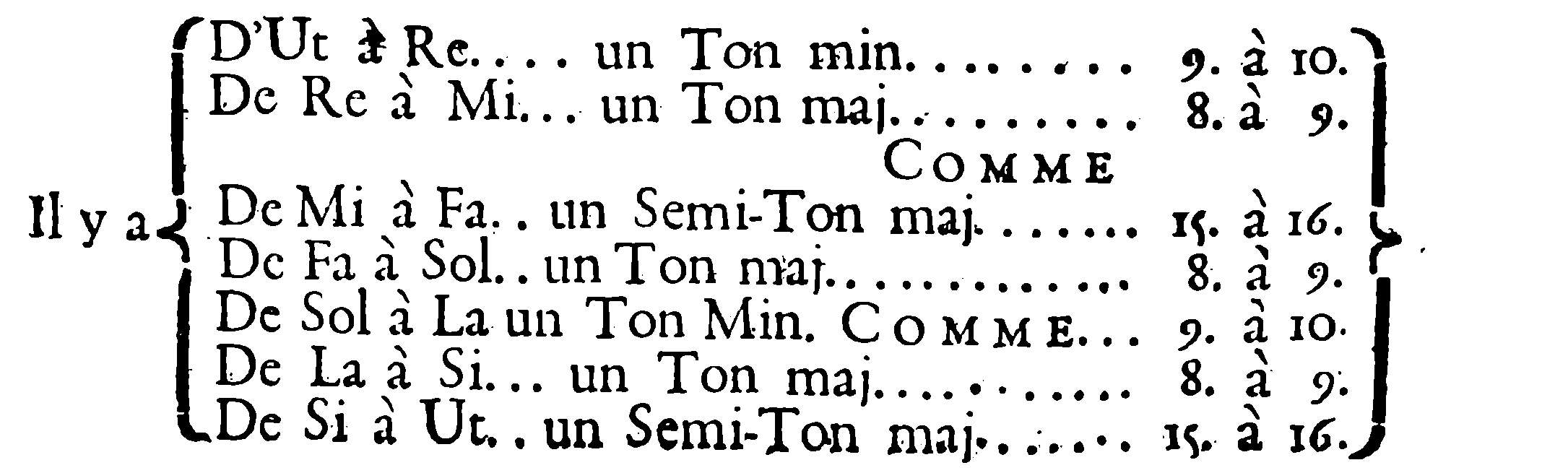
Some harmonic dissonances could be derived from the preceding system; but their true origin should rather be drawn from squaring a primary consonance, or from adding two primary consonances, as the following demonstration proves.
DEMONSTRATION OF THE ORIGIN of Dissonances
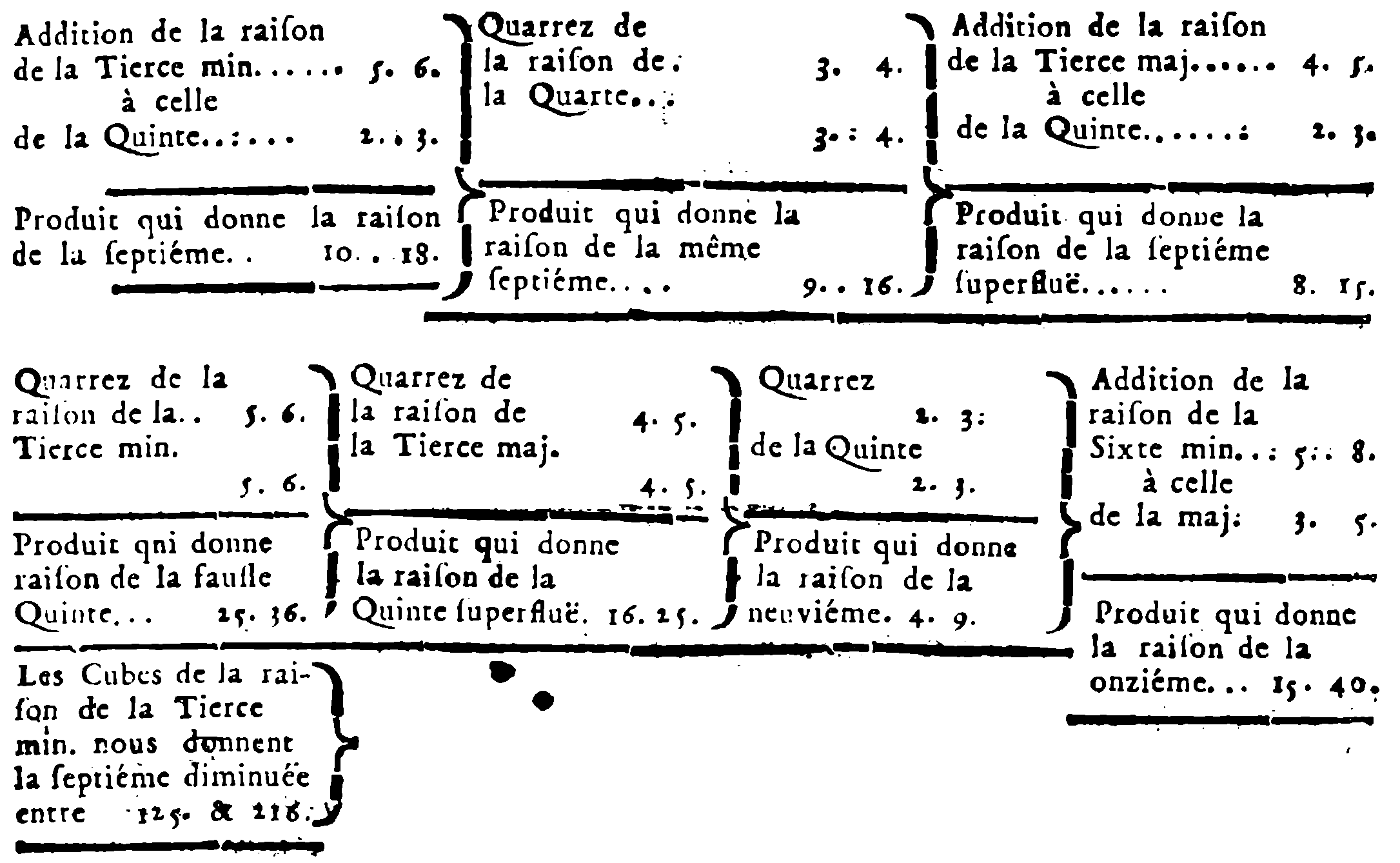
The other dissonances arise by inversion of these: for example, the second arises from the seventh, the tritone from the diminished fifth, and the augmented second from the diminished seventh. The dissonances that arise from augmented ones, such as the diminished second and diminished fourth, have no place in harmony, because augmented dissonances are admitted only by supposition. They can occur only with the ninth or eleventh, whose intervals exceed the octave and consequently cannot be inverted. This is explained more fully in Book II, Chapters X and XI.
Although we said that harmonic dissonances could be formed only from primary consonances, we have nevertheless formed some from the fourth and the sixths. But the eleventh given by the sixths does not have the privilege of the others, namely, of furnishing a new interval by inversion; moreover, it can be regarded as a doubled fourth. As for the seventh given by squaring the fourth, it could have been omitted, since it is the same as that given by adding a minor third to the fifth. We nevertheless thought it appropriate to include it among the others to draw attention to the two different ratios of this same seventh. What happens to this seventh can happen to every interval except the octave and the augmented seventh. This arises from the difference between the major and minor whole tones dispersed through the diatonic system, a difference of one comma, whose ratio is 80 to 81. Although the ear is insensitive to this difference, especially in intervals suited to harmony and melody, it is nevertheless appropriate to explain it with regard to the different notes of the system that can be used to form any given interval. For example, if we take the fourth from C to F or from D to G, we find two different ratios. These arise solely because one contains two major whole tones, while the other contains only one major and one minor whole tone.
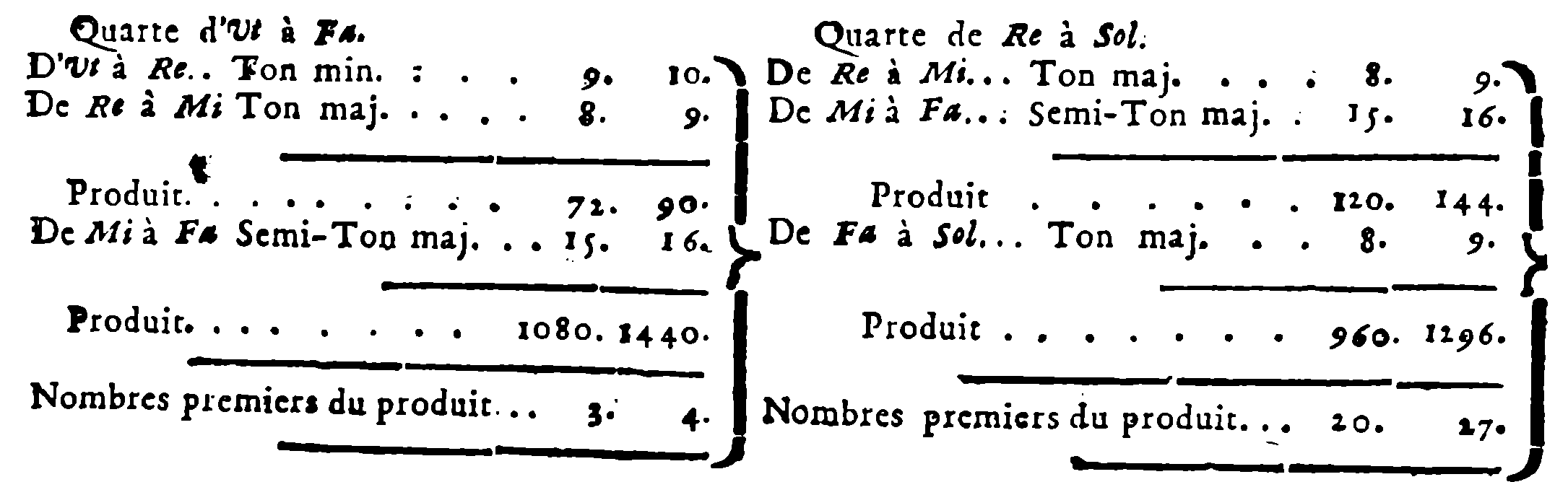
To spare the calculation of the two different ratios of every interval, we shall give a catalogue of them.
NATURAL AND ALTERED RATIOS of All Intervals
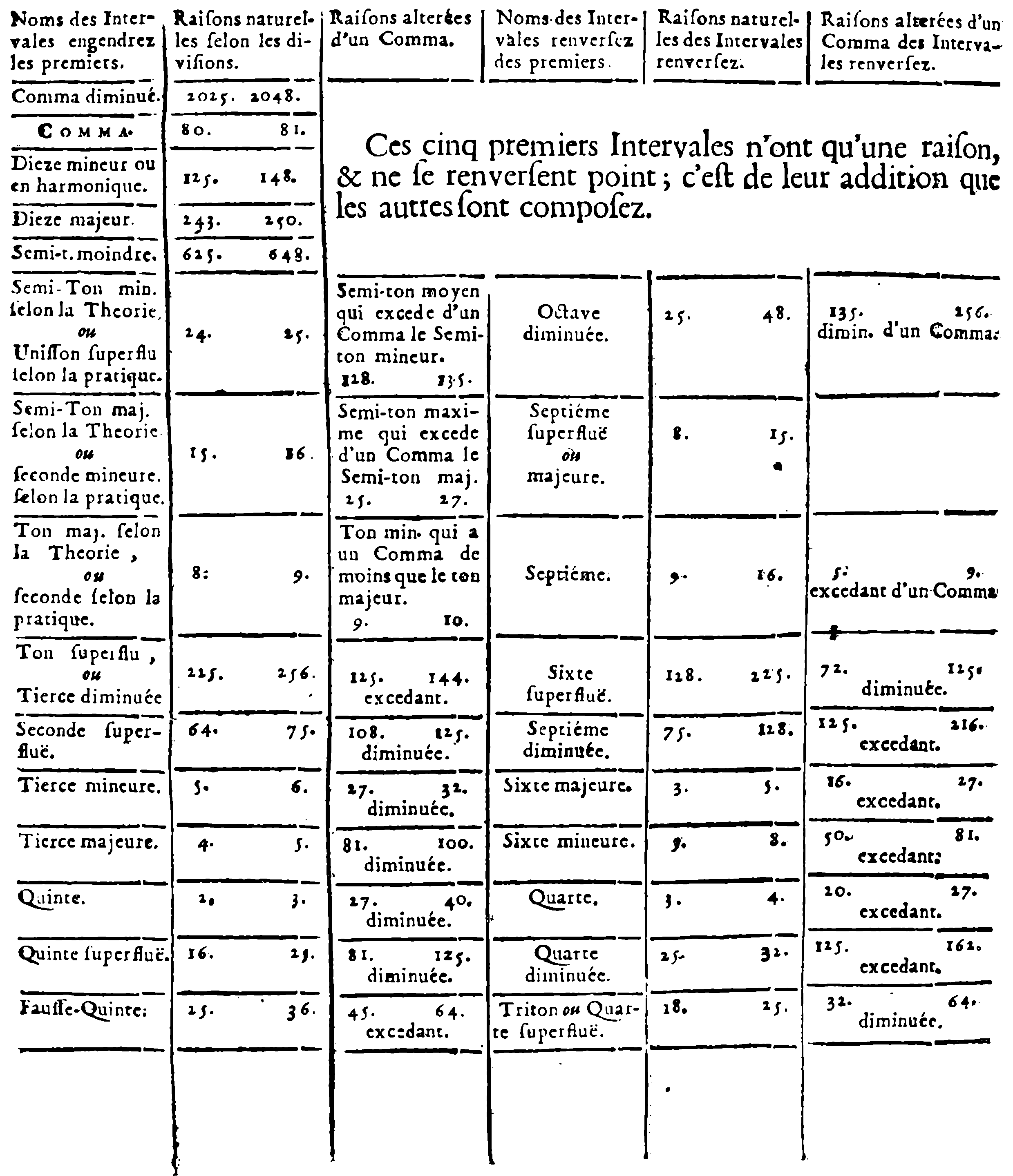
All these ratios can help us find for ourselves those of any interval whatsoever. Larger intervals are formed by multiplying the smaller ones, and smaller ones by subtracting the larger. For example:
The minor diesis is formed by multiplying the ratios of the two commas.
The major diesis is formed by multiplying the ratio of the minor diesis by that of 15552 to 15625; the latter ratio gives us only a very small part of a comma.
Lesser semitone: from the ratios of the minor diesis and comma.
Minor semitone: from the ratios of the major diesis and comma.
Medium semitone: from the ratios of the minor semitone and comma.
Major semitone: from the ratios of the minor semitone and minor diesis.
Maximum semitone: from the ratios of the major semitone and comma.
Minor whole tone: from the ratios of the major and minor semitones.
Major whole tone: from the ratios of the minor whole tone and comma.
This method allows us to learn how many commas compose the whole tone. We can carry this multiplication as far as the octave.
Conversely, the comma is formed by the difference between the major and minor whole tones.
The minor semitone is formed by the difference between all intervals distinguished as major and minor, perfect, augmented, and diminished.
Example
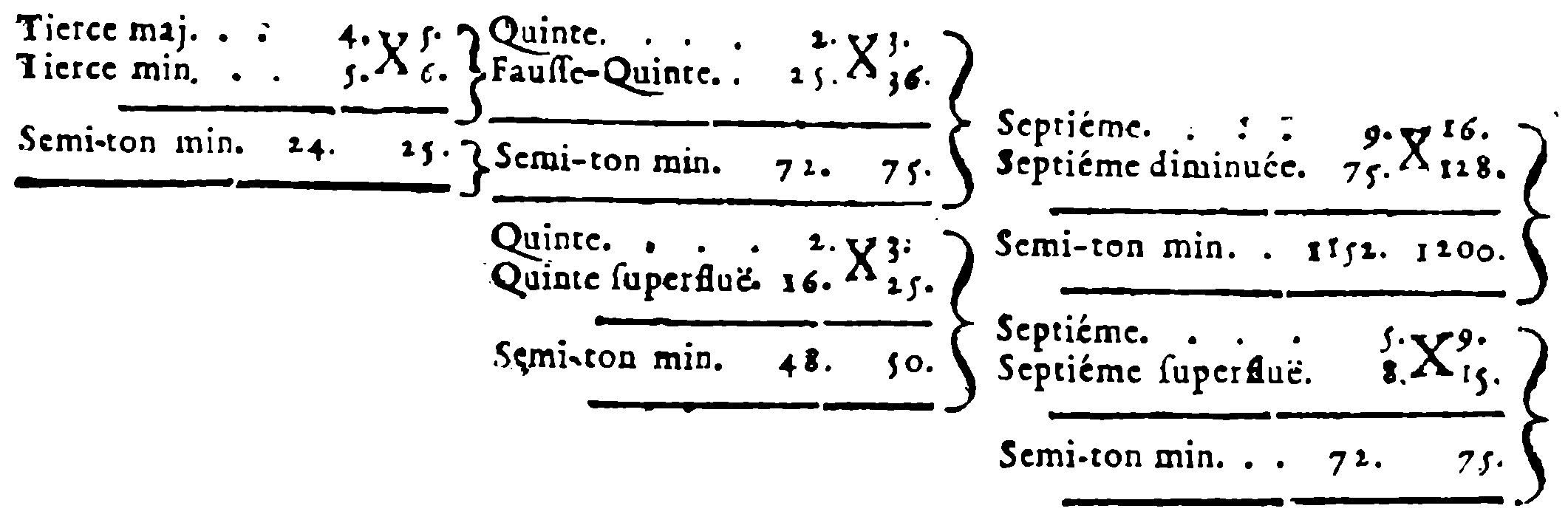
The medium semitone or the major diesis can also constitute the difference between these intervals, according to the ratios employed.
Since most of these semitones are absolutely necessary in tuning organs and other instruments of this kind, they have led to the establishment of the following chromatic system.
Chromatic system ]
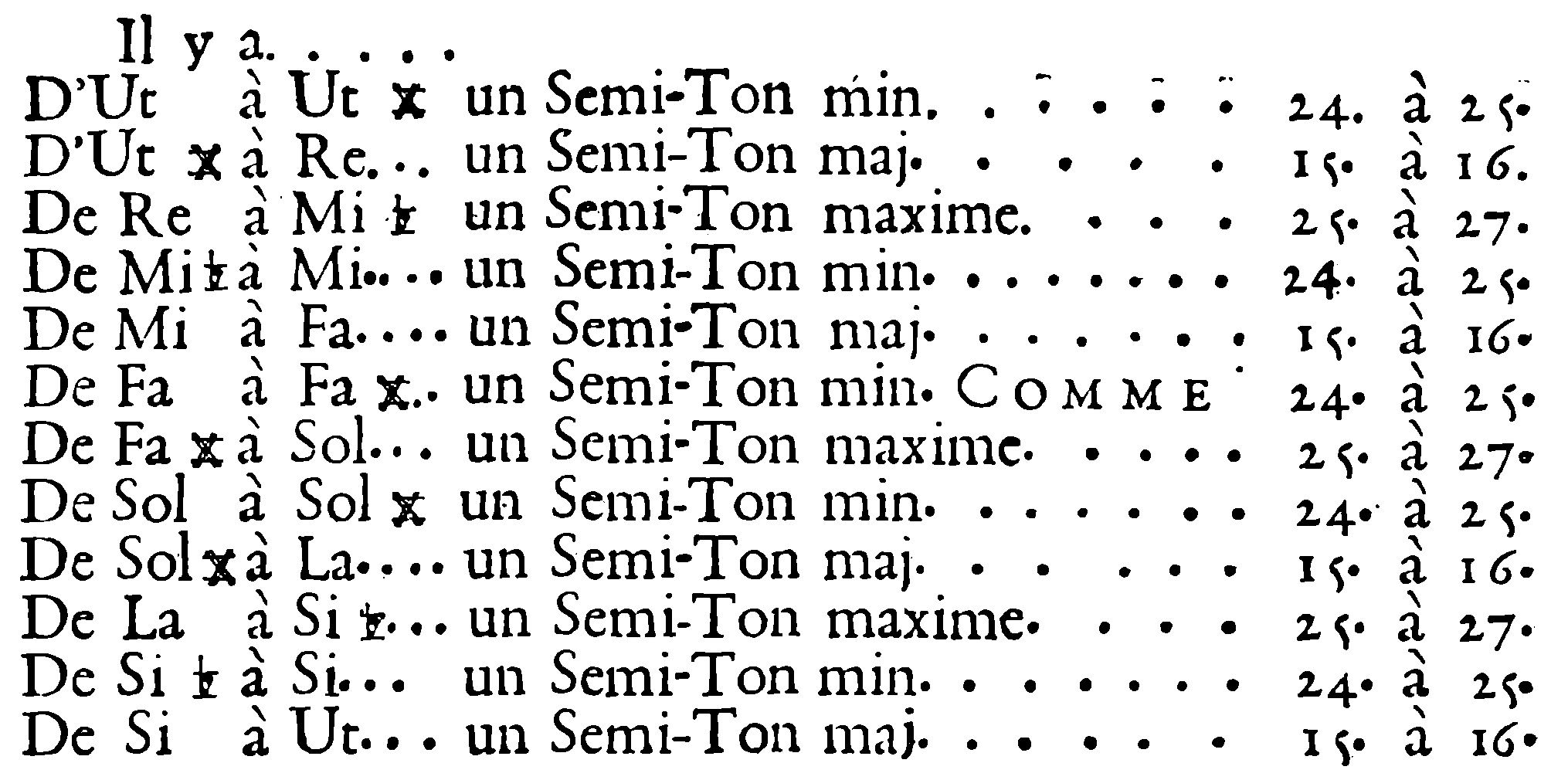
It will be easy to find in the system the two different ratios of each interval taken on different notes. From this we can judge the freedom we have to use either ratio indifferently, according to the notes from which we wish to form an interval.
The explanation we have just given of the formation of each interval can reveal the exact relationship between this system and the preceding diatonic one.