 Playable Books
Jean-Philippe Rameau · section 28 of 109
CHAPTER FOURTEEN. Observations on the Progression of Thirds and Sixths
Read and hear this section in the playable edition →Thirds partake of both consonance and dissonance: they are consonant in themselves, and dissonances arise from them. The major and minor whole tones are formed by dividing the major third, and the seventh by adding a minor third to either perfect chord. Inverting the seventh produces the whole tone, just as inverting the whole tone produces the seventh, from which we derive every harmonic dissonance. Thus we do not fix the progression of thirds or of the sixths representing them when no more perfect consonance follows, because everything then depends upon them. But as soon as the octave or fifth must follow immediately, these latter consonances, from which the others originate, govern their progression. The octave, being most perfect, requires the major third before it, since that too has something more perfect than the minor. The minor third is reserved to precede the fifth, which is less perfect than the octave. The major third then ascends to the octave and the minor descends to the fifth according to their natural properties. As Zarlino rightly observed, this progression is determined by the nearest semitone, which supplies all the ornament of harmony and melody. As for sixths, we already know that the major follows the major third's properties, and the minor the minor third's.
Example
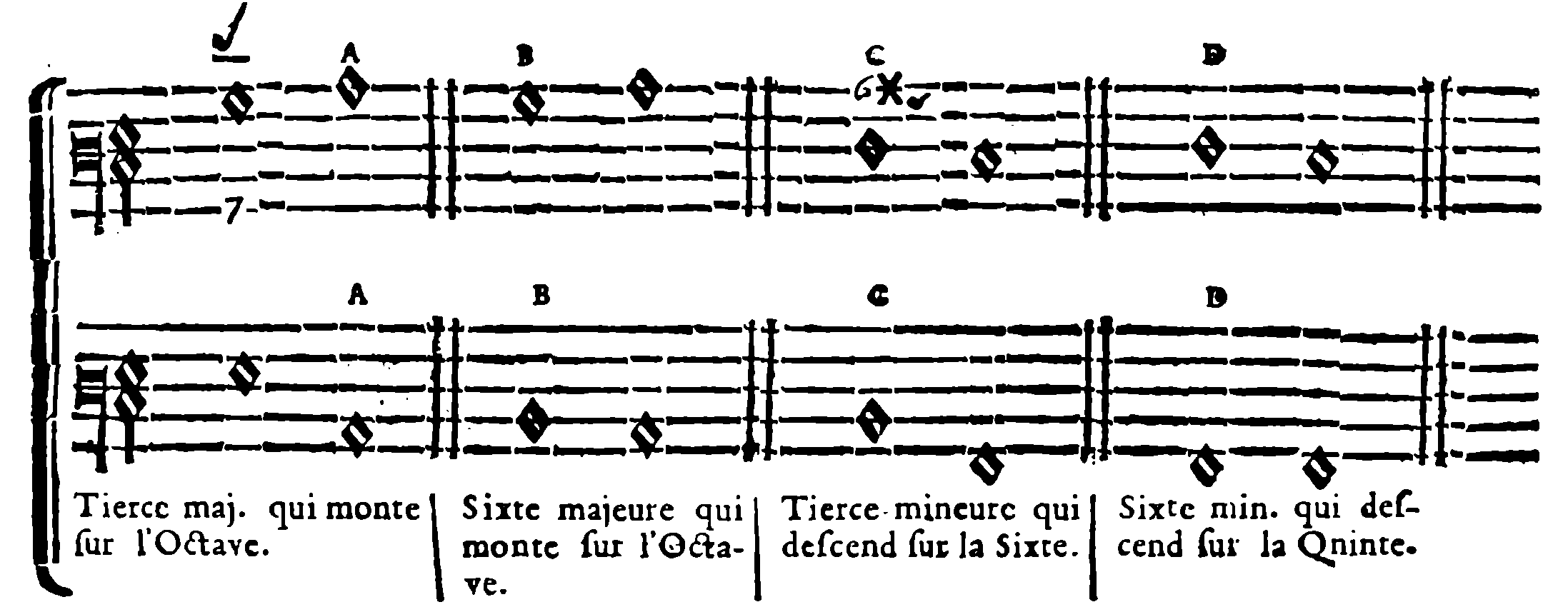
A represents a perfect cadence, inverted at B; C represents an irregular cadence, inverted at D. As we see, our rules can always be fully contained in the principal cadences, where the thirds and sixths must ascend or descend by a semitone. Moreover, if we observe that a seventh or major sixth can occur in the first chord of each cadence, we see that its thirds become dissonant against these added sounds. Together they form a diminished fifth or tritone, containing the major and minor dissonances. Thus, even if these thirds are not themselves dissonant, they become so in relation to the other sounds completing the chord, and must consequently have a determined progression. We also see that the seventh, arising from a minor third added to the perfect chord, descends a semitone, while the major sixth added to the perfect chord ascends a semitone, according to their properties, as marked by custodes

; hence the rule never to ascend from a minor third or minor sixth to the octave. But these rules, founded on fundamental harmony, have not been followed literally in its inversion, because most authors have misapplied them. For example, Zarlino* and several others erred in saying that the minor third should descend to the unison or octave. This occurs only in an inversion of the harmony in which the fifth and diminished fifth descend to the octave.
Example
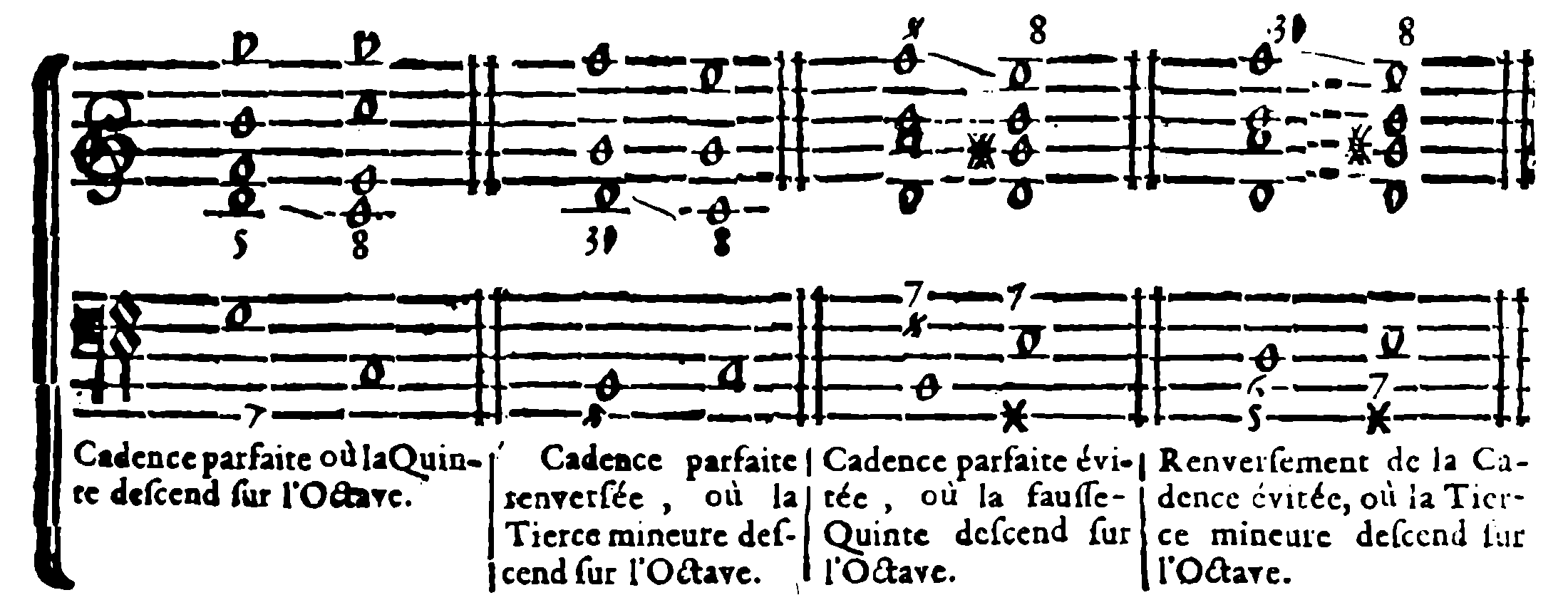
Zarlino's mistaken application arises only because he considered two parts at a time when establishing his rules. This occurs almost everywhere—for instance, when he says in the same place that the major third ordinarily ascends to the fifth. That too arises only from inverted harmony, in which this third may ascend to the seventh; even that progression is not drawn from the most natural harmony.
* Third part, chapter 10, fol. 182.
Example
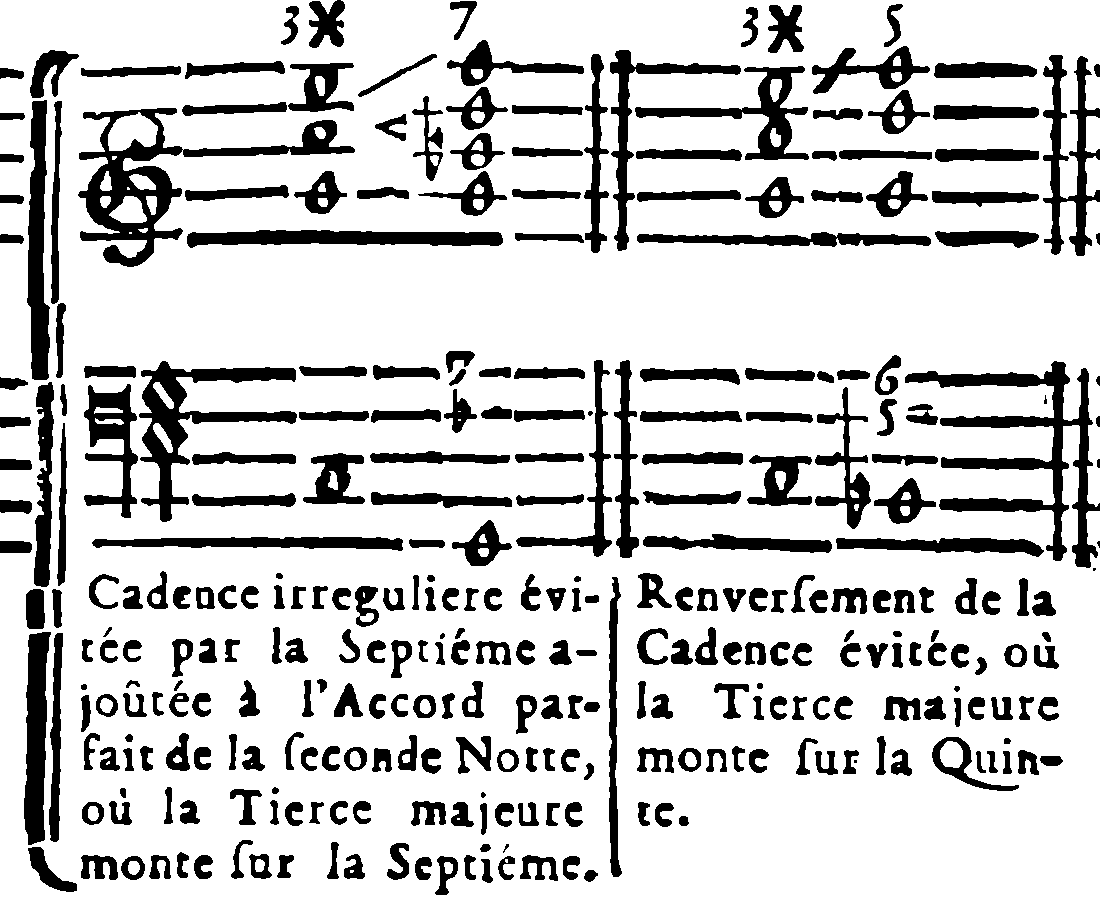
We could simply give the perfect or seventh chord to the note whose fifth follows the major third, but only by license: we observed that in natural harmony the fundamental bass must move by consonant intervals, which would not occur here.
Moreover, besides the natural progression of thirds, observe that the major third must descend to the fifth in an irregular cadence in a major mode. It does not then form a dissonance with the sixth that may accompany it, so its progression is limited only by the nearest consonance, here the fifth.
Example
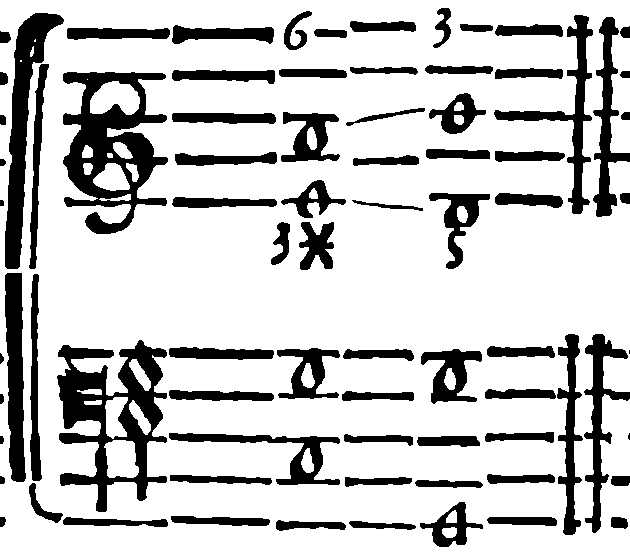
Take care to understand the rule correctly. It does not forbid a minor third to ascend or a major third to descend; it says only that the latter's property and nature are to ascend to the octave, and so forth.
Rules originating in fundamental harmony always remain valid in its derived chords. An interval specified by the rule is such only with reference to the chord on which the rule is based, not to its derivative. Thus a third, fifth, or octave may become a sixth, fourth, and so forth in inversion. We should no longer regard this sixth or fourth as such, but as representing the original intervals on which the rule was established. Once the rule is laid down, modulation must guide us. It readily shows that one chord succession derives from another, and consequently that inverted intervals must always follow the progression assigned to those they represent and which we proposed as the principle. Otherwise one might say the following succession is worthless because its minor sixth ascends to the octave.
Example
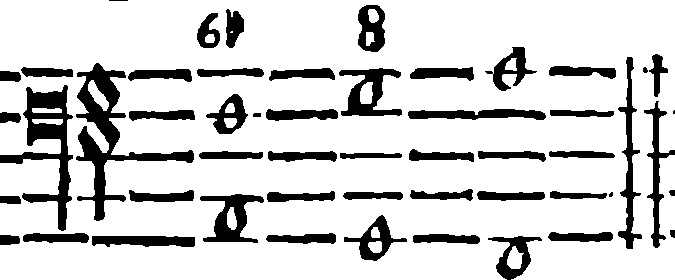
But in fundamental harmony it is no longer the sixth; it is the octave ascending to the fifth.
Example
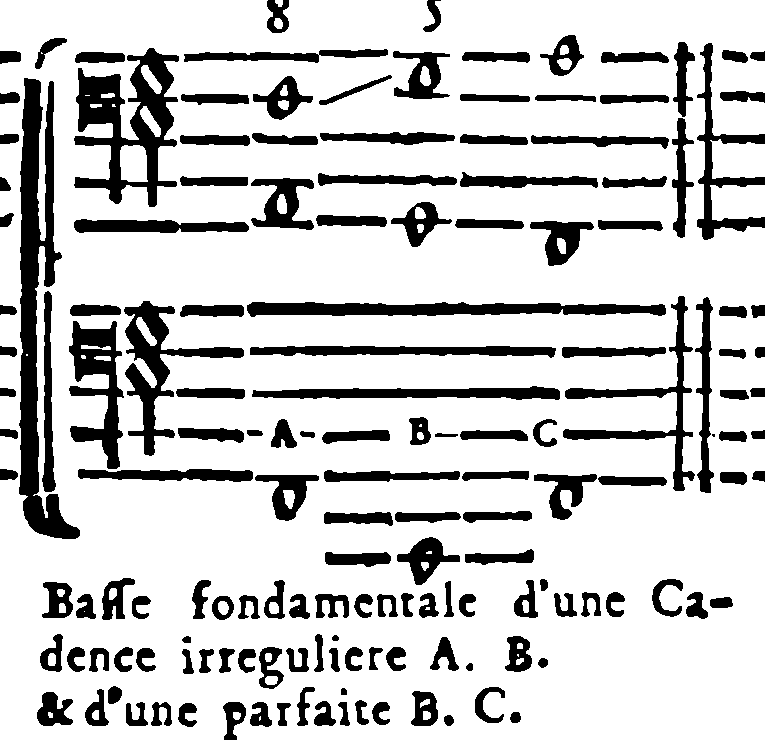
One might also refuse to allow the minor third to ascend to the octave in this manner.
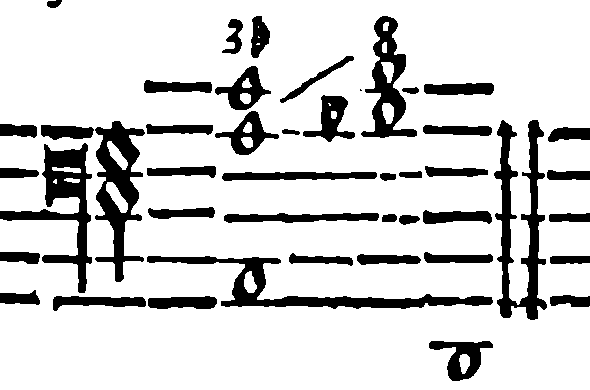
Yet according to fundamental harmony, it is not the third but the fifth ascending to the third.
Example
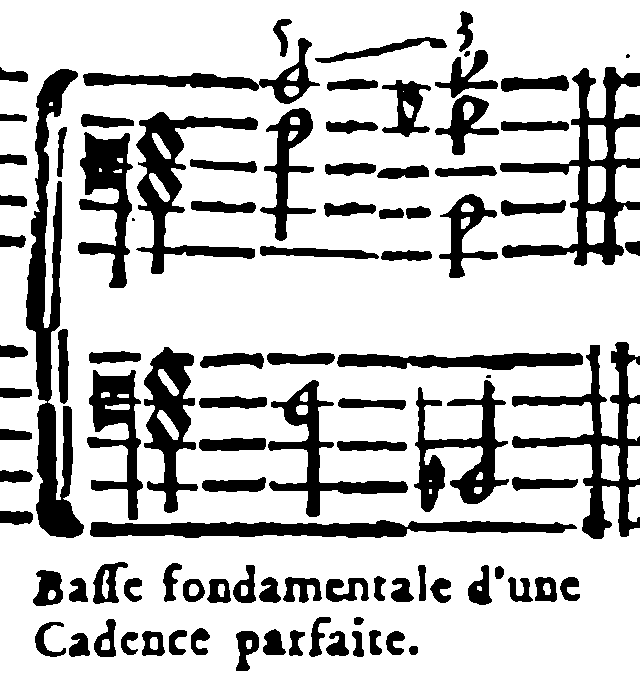
We must be guided as much by modulation as by the fixed place occupied in a fundamental chord by the interval specified in the rule. For if I ascend from a minor third to the octave in the key of A or D, thus:
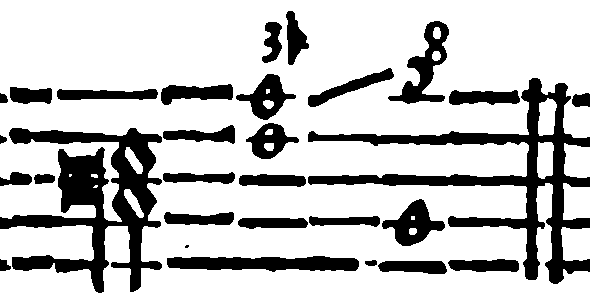
This will be worthless, because the perfect chord on which the rule is founded will actually sound on each bass note. But I may do it in F or B♭, because each bass note will bear a sixth chord inverted from the perfect chord, which remains implied. It will then be the fifth, no longer the minor third, that ascends. Anyone reluctant to accept this need only examine the first example of a minor sixth ascending to the octave in F or C, which every skillful musician uses without scruple. Observe that it would be worthless in G, for precisely the reasons just given.
Furthermore, if a minor third or minor sixth is doubled in a chord, one of the thirds or sixths may move contrary to its natural progression, provided the other follows the rule:
Example
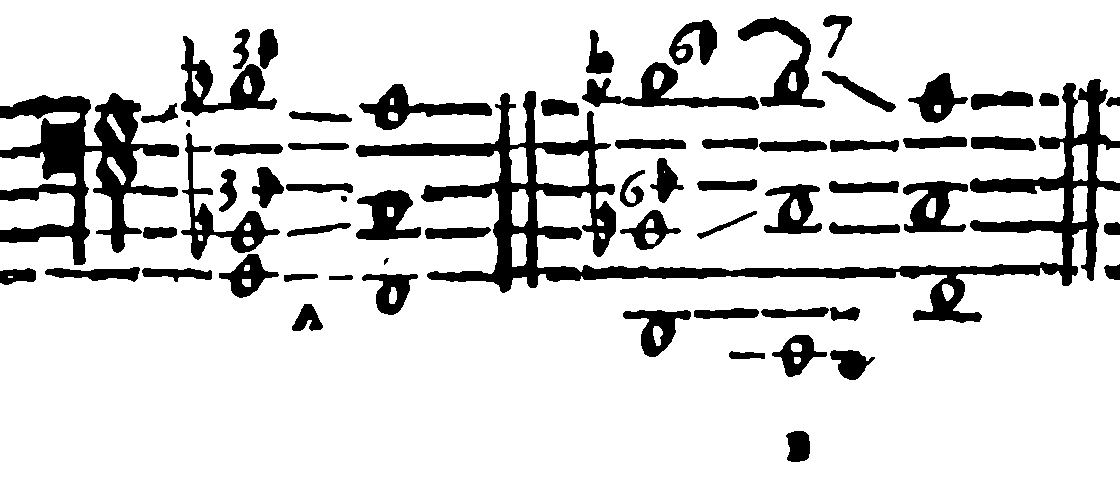
At A the minor third descends as it should, as does the minor sixth at B after remaining on the same degree to form the following seventh. Their replications, however, must ascend; otherwise two consecutive octaves would be difficult to avoid. Moreover, the satisfaction obtained where the interval follows its natural progression is so complete that its replication seems only a supernumerary sound escaping our attention. Yet since a dissonance can never be doubled, thirds must obey the same law wherever they represent dissonance, especially the major third. If the minor third can be excepted, this is tolerated only in pieces of more than three parts, or when the subject absolutely requires it, whether for beautiful melody, fugue, or certain imitations contributing to music's beauty.