 Playable Books
Jean-Philippe Rameau · section 35 of 109
Chapter twenty-one
Read and hear this section in the playable edition →On modes
Although modern authors have taught that there are only two modes, they have become so enslaved to rules borrowed from others that they are blind to the benefits of this fortunate discovery. They speak only of arbitrary chords, leaving their entire conduct to our judgment even when mode alone governs it.
It is well known that a mode consists in the octave of a single sound, within which all sounds usable in melody and chords must be contained. The ancients considered melody alone and were mistaken: melody depends entirely upon the chords fixed by the mode.
We distinguish two kinds of mode, named after the major or minor third of the sound that, with its octave, is the mode’s first object. Since there are only two thirds, major and minor, there are only two modes, major and minor. These names imply the third accompanying the mode’s fundamental sound.
The first mode known to us was drawn from the perfect diatonic system, where C’s octave contains six other notes whose intervals with C cannot be altered without changing the mode. Its principal notes were first taken from C’s perfect chord: the third was called mediant, the fifth dominant. It was then felt that the mediant better suited a sixth chord than a fifth chord. Yet we were not told that it thereby always represents the principal or tonic note, since its sixth chord inverts the tonic’s perfect chord. Likewise, the dominant was felt to require a perfect chord with an invariably major third. The seventh dissonance containing the diminished fifth was assigned to it alone when immediately preceding the tonic; these two notes alone form perfect cadences. But we were not told that diminished-fifth and tritone chords derive from that seventh chord, nor that, since the seventh chord exists to precede the tonic’s perfect chord, all its derivatives must likewise precede that perfect chord or its derivatives. Experience reveals this, but the rules do not mention it. These observations would have shown that whenever such a seventh chord or one of its derivatives appears in any mode, the tonic’s perfect chord or a derivative must immediately follow. This would have begun to clarify matters. First, these two chords contain every note of the mode except the sixth, which is easily found because it follows the third’s nature. Second, they show what chords the notes require before the tonic or mediant. Only the chords preceding the dominant remain to be found. Reason thus: a note’s perfect chord is preceded by the seventh chord a fifth above it; the dominant ordinarily carries a perfect chord, whose foundation is not destroyed by an added seventh; therefore it too must be preceded by the seventh chord a fifth above. To preserve the mode, the third of this new note must be minor, as it is when forming the tonic dominant’s seventh or the tonic’s fourth. The new seventh chord supplies the mode’s sixth note. We can thus judge both the intervals within the tonic’s octave and the chords they should carry, deriving these chords by inversion of the fundamental chords containing those intervals. Minor mode differs from major only in requiring minor third and sixth, with certain qualifications concerning the sixth explained in the next book.
Had this principle been followed, Masson’s rule* would have been unnecessary: “If the bass rises a semitone, use the minor sixth followed by the fifth, or two major sixths,” and so forth. This distinction concerns different notes in two different modes. The rule therefore determines nothing unless mode is its object. When he discusses dissonances for melodic expression or by supposition, he also cites many already contained in the chord formed by the preceding or following consonances. Since consonance and dissonance then form one chord, the dissonance supposes nothing: it is already implied because it belongs to the chord. We pass over many other errors of this kind.
Those giving rules often copy others with excessive deference. Their own sound statements are sometimes contradicted by what they borrow elsewhere.
The ancients defined very well the modes’ properties in producing different effects and governing harmony and melody. But they never knew their nature, attributing all their force to melody, supposedly confined without further distinction to the perfect system’s seven diatonic notes. They thought making each note principal would produce as many different effects as there are notes, but lost sight of their model. Does the perfect system have nothing distinctive worth imitating? Why imitate its consonances by adding a flat to B to obtain F’s fourth, then abandon it in the dissonances approaching the tonic from either direction? C to D is a whole tone; C to B a semitone. Yet when E becomes tonic, they retain E–F’s semitone and D–E’s tone instead of adding sharps to F and D to match the perfect system, just as they flattened B. One may object that these differences defined their modes. Experience leaves no doubt that this was an error. Zarlin’s reflections, contradicting his rules, reveal his modes’ faulty foundation. He says* that the bass is the principle and foundation of all other parts; and* that its natural perfect-cadence movement descends a fifth. His examples always include a rising semitone from the note before the final to the final itself. Other examples with this rising semitone also have a descending whole tone to the same final. Assemble these approaching notes: the one rising a semitone is the dominant’s major third; the one descending a tone is its fifth. Every perfect conclusion requires a tonic preceded by its fifth, the dominant. That dominant’s perfect chord requires its fifth and major third. There is therefore always a whole tone from its fifth to the tonic and a semitone from its major third to the tonic. No mode can lack these properties. If the bass naturally descends a fifth in a perfect cadence, the other parts cannot make that cadence unless one rises a semitone and another descends a tone. A piece can end only with a perfect cadence on its mode’s principal note; otherwise the soul cannot be satisfied. How absurd to propose modes incapable of this! This same principle underlies Zarlin’s prohibition against raising the minor third or minor sixth to the octave. It proves that the tonic dominant must always have a major third, a semitone below the principal note’s octave, as B lies below C in the perfect system. Yet the ancient modes on D, E, G, and A lack this semitone. Clearly they followed melody alone. Regard for harmony would have prevented such gross errors. Zarlin, apparently abler than his predecessors, could have recognized this truth but deferred too much to things he was virtually compelled to accept: the Church’s plainchant, established long before him and hard to reform because of custom and expense. It suits harmony only in keys conforming to the perfect system. Thus only people without taste, steeped in ancient rules whose true meaning they do not know, vainly try to make good and pleasing harmony over such chants. Yet this should occupy our study and labor, since music is made only to sing God’s praises. How distressing for someone convinced of this to be unable to display his genius on so great a subject! He can pile chords upon these chants and proceed faultlessly to the end, but faultless music and perfect music differ greatly. Enslaved by their first discoveries, the ancients formed all these chants from the perfect system’s melody and ended where they should have begun: they based harmonic rules on that melody instead of starting with harmony, which comes first, as string division proves, and deriving melodic rules from it. Those rules would produce chant easier and more flowing than that now heard in our churches. Their blindness also appears in the distinction between authentic or principal modes and plagal or collateral modes.
* Chapter III, pages 36, 37, and 38.
* Terza Parte, chapter 58, folios 281 and 282.
[ * Chapter 51, folios 251 and 252. ]
The distinction between harmonic and arithmetic proportions so absorbed them that they applied to octave division what belonged only to fifth division. We shall see that this distinction, properly belonging to harmony, was applied almost entirely to melody.
When Zarlin divided the octave by the fourth to create a new mode, he merely relocated the sounds of the octave divided by the fifth—what we call inversion. Thus the principal mode, divided by the fifth, and collateral mode, divided by the fourth, are one mode. Both have the same principal or tonic note, mediant, and dominant. Their difference concerns melody alone.
Here is his example.* The first is principal, the second collateral. C means that “C sol ut,” the note C, serves as tonic for both. Thus C has no mediant but E, labeled b, and no dominant but G, labeled a. The difference is that the principal mode’s melody moves from one C to the other, the collateral’s from one G to the other. This distinction is useless: melody’s range is limited only by voices, whose limits natural experience immediately teaches.
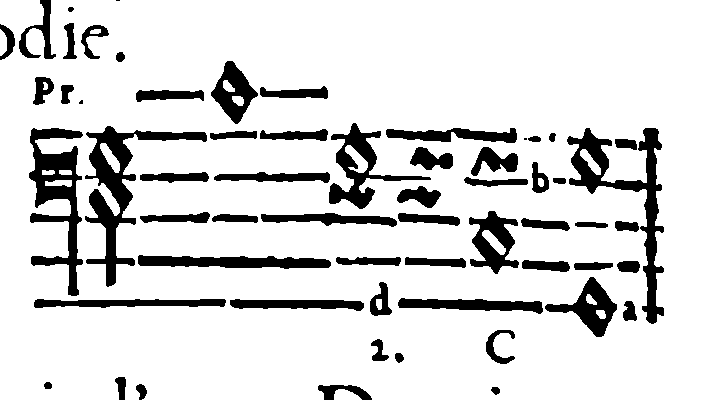
When he subsequently divided the fifth by the lower sound’s major and minor thirds, he could not create two modes corresponding in the same way. Their mediants differ, and consequently their sixths. This is the whole difference in modulation—not second, fourth, fifth, or augmented seventh ascending to the octave, whose intervals never change, and still less melodic range, since intervals above or below the octave do not differ from those within it. Had he followed Plato’s view, which he reports,* that melody should arise from harmony, he would have sought modulation’s foundations there. Harmony would have supplied certain paths to the perfection he believed he had reached. True modulation, and therefore the entire connection of good harmony and beautiful melody, comes only from the tonic’s perfect chord, the dominant’s chord with a seventh added when appropriate, and the second note’s seventh chord. Our preceding rules conform to this principle, which maintains equal force everywhere.
* Quarta parte, chapter 13, folio 384.
[ * Secunda parte, chapter 12, folio 95. ]