 Playable Books
Jean-Philippe Rameau · section 68 of 109
Chapter twenty-five
Read and hear this section in the playable edition →How to Recognize the Chords to Be Given to the Notes of a Bass in Any Progression
Article one
First, one must attend to all cadences and everything relating to a melodic conclusion. Beginners can hardly avoid introducing these continually into their bass, especially when they wish to change key. This is not difficult to recognize, because these conclusions always fall on the first beat of a measure; with even a little cultivation of taste, one senses them at once. Thus the notes on the first beat of a measure on which the melody in some way comes to rest must always bear the perfect chord, which causes them to be regarded as tonic notes.
2. If, after a tonic note, the bass moves by consonant intervals, one may give a perfect chord to each bass note up to the one followed by a diatonic interval. An exception is a note lying a third above or below another that bears the perfect chord: the former may then bear a sixth chord just as well, and even preferably, rather than the perfect chord. Conversely, if the first note is recognized as requiring a perfect chord, the following note a third above or below must bear a sixth chord, provided that this last note is not followed by another in consonant progression. Such a progression naturally calls for a perfect chord or seventh chord on each note, as will become clearer later.
Moreover, the note that may bear a sixth chord in the case just described is always either a mediant or a sixth note, although one may simply give each of these notes a perfect chord when afraid of making a mistake.
Example
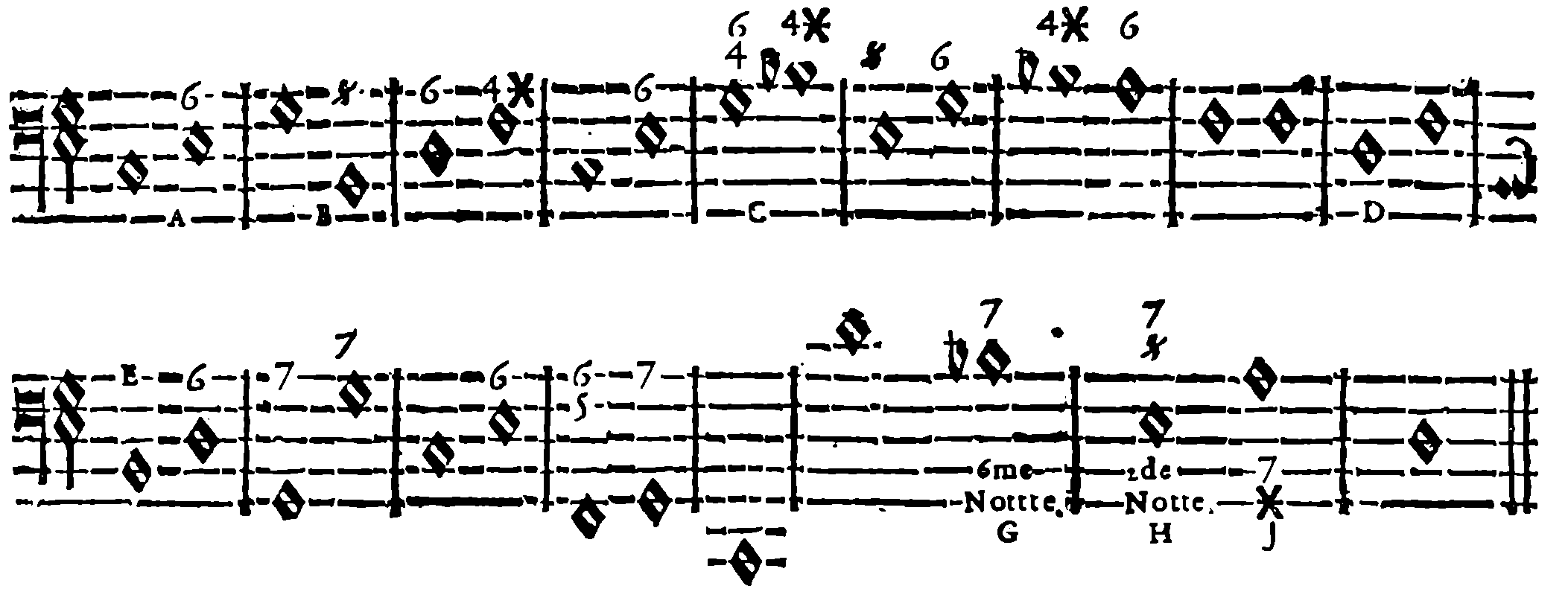
Being in the key of C, we see that the note a third above this C and below the dominant that follows must bear the sixth chord, A.
B. The note a third above the dominant, or a sixth below it, which amounts to the same thing, could bear a sixth chord. But we already know that the diminished-fifth chord suits it better, because this is the leading note of C, the key not yet left and still continuing as far as C. Moreover, the difference between the sixth chord and the diminished-fifth chord consists only in adding the diminished fifth to that sixth chord, just as the difference between a perfect chord and a seventh chord consists only in adding the seventh to the perfect chord. One could have added that seventh to the dominant immediately preceding the note that bears the diminished-fifth chord. This agrees with what we said in Chapter XI.
We find four notes ascending successively by thirds from the tonic. The mediant bears the sixth chord, and the dominant bears the sixth–fourth chord, C, rather than the perfect chord, because the flat appearing on B determines another key. This key is recognized in the bass progression through the diminished fifth formed by B-flat and the E following it. This E, being the lower sound of the diminished fifth, therefore becomes the leading note. Consequently the chord on B-flat must conform to the key prepared by the leading note, since this B-flat is not included in C, the key now being left. The dominant of C likewise adapts its chord to the one that is to follow. Thus, without leaving C, it bears the sixth–fourth chord, which makes up the tritone chord on B-flat. Had this dominant borne the perfect chord, its third would necessarily have had to be minor to avoid what is called a false relation. This means never sounding in succession, in two different parts, two notes whose names differ only by a sharp or flat added to them. That is, after sounding B in one part as the major third of G, I cannot sound that same B with a sharp or flat in another part. We shall discuss this more fully elsewhere. Thus we give the sixth–fourth chord to the note at C only to bring its harmony into closer agreement with the following chord. A perfect chord with a minor third could have been given to that same note at C; indeed, it could have received a small-sixth chord, and the note immediately before it a diminished-fifth chord, because there is a diminished fifth between this E and the following B-flat. As soon as such an interval appears in the bass, it determines the key absolutely, the lower sound of that diminished fifth always being, as we have said, the leading note. What we say of the diminished fifth also applies to the tritone, whose upper sound is then the leading note. Nevertheless, if the bass proceeds up a fourth or down a fifth after such a diminished fifth or tritone, there might no longer be a leading note there. Each of these bass notes could then be regarded as a dominant seeking the tonic dominant, which immediately follows those forming a diminished fifth or tritone, as seen at G, H, J. But this can happen only between the second and sixth notes of minor keys, which form these diminished-fifth or sharp-fourth intervals with one another.
According to our preceding rule, the note at D should bear a sixth chord. But its sixth could only be minor, in conformity with the key of the preceding and following notes. We observe that B loses its flat immediately afterward; and because one must always conform to what follows rather than what precedes, it is better to give the note at D a perfect chord, avoiding a false relation with what follows while also observing our rule for consonant bass progression.
The note at F bears the diminished-fifth chord for the reasons just given, since a diminished fifth lies between it and the preceding note. Remember well that in changing key, we must adapt the harmony of our chords to the following key rather than to the one being left, especially when a note can bear two chords between which the choice would otherwise be immaterial in this case.
Article two
On Imperfect Cadences
Besides the bass progression natural to perfect cadences, there are others related to it, called imperfect cadences. (See Book II, Chapter VIII.)
We say that imperfect cadences are related to the perfect cadence, not in their bass progression but in the correspondence of their harmony. To recognize this, simply arrange together all the sounds making up the perfect cadence and consider separately the progression of each part. Any of these can form the bass progression, the chords differing only in their different arrangements.
Example
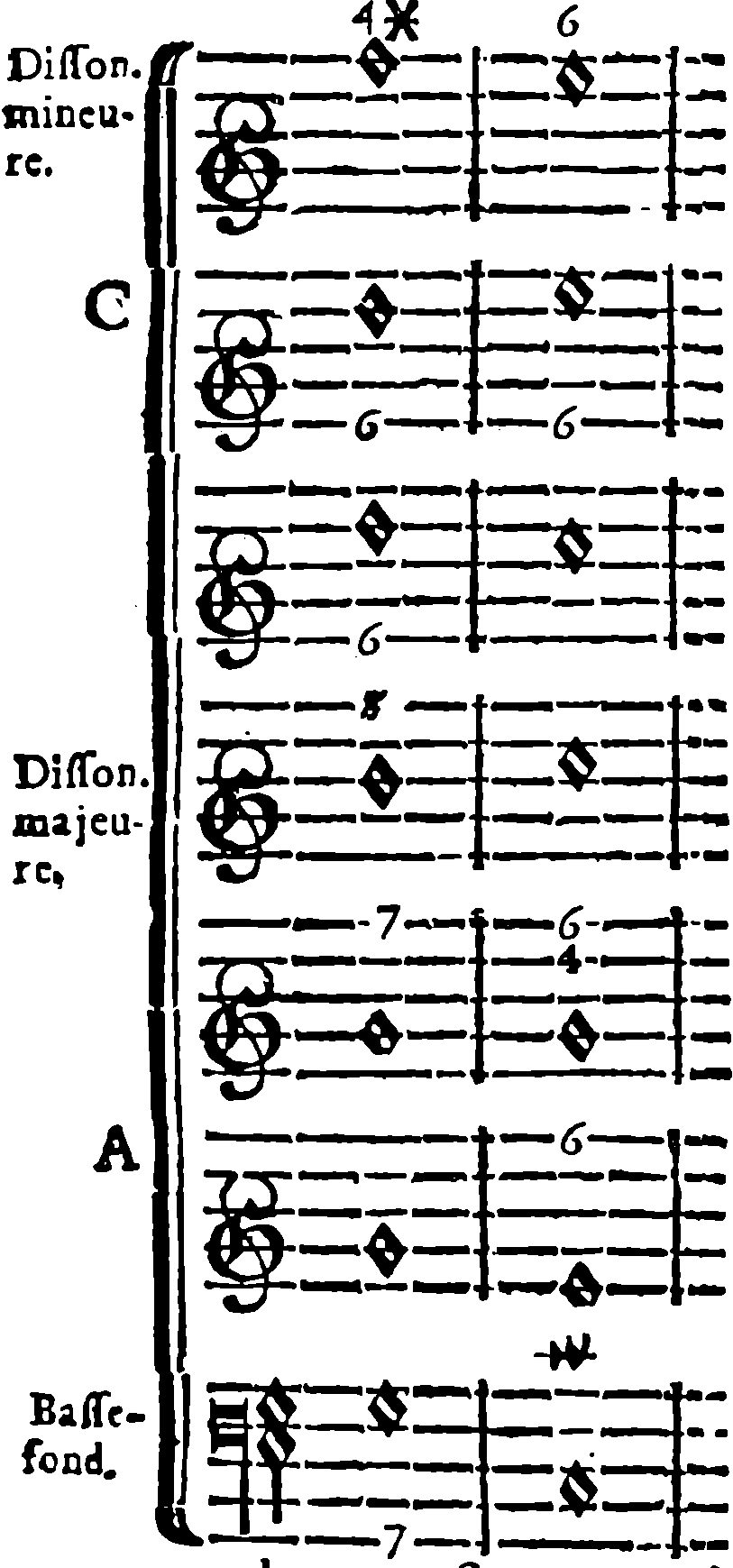
When one wishes to hear all these parts together, parts A and C must be omitted, since they resemble the highest part too closely; the note resolving the minor dissonance there does not welcome its octave equivalent on this occasion. But A and C may be heard if the highest part is omitted. They have been placed together only to distinguish their different progressions. We see that the dissonant parts have a fixed progression, while the others may ascend or descend. The fundamental-bass note, found in the three lowest parts, can remain on the same degree or descend a third, just as it naturally descends a fifth. Observe that the seventh is ordinarily omitted from its chord when it descends a third, A, because something like two consecutive octaves is heard there; although, strictly speaking, this can be tolerated, especially in four parts.
The progression of all these parts is specified in the octave example in Chapter XI, with the same chords they bear here. To verify this more fully, use whichever part you please as bass, avoiding placing the two lowest parts above the others. The remainder produces a good effect together however arranged, and the chords figured in one part are contained in the others.
These kinds of imperfect cadence may have been noticed in most of the preceding examples. But their ending notes do not always fall on the first beat of a measure, since they occur in a diatonic progression, which cannot determine a perfect conclusion.
Article three
How to Distinguish the Key in Which Imperfect-Cadence Progressions Occur
A diatonic progression certainly leads us to several different keys; but to distinguish the key toward which it leads, several things must be observed.
1. The leading note must guide our decision first. Here is how to distinguish it in the bass.
Knowing the opening key also tells us its leading note. We know that this key can move only among certain notes within its octave, conforming to C major or D minor. If any of these notes is altered by a sharp or flat, the key certainly changes.
The first new sharp encountered certainly marks a leading note; if two or three are found in succession, the last must always be taken as the leading note. Thus a sharp beside F makes that note the leading note and simultaneously indicates G as the key. If, along with the sharp on F, I find one beside G, F-sharp is no longer the leading note: G-sharp is, and it simultaneously indicates A as the key. By counting according to the order in which sharps are placed—F, C, G, D, A, and so on—one cannot go wrong. Whatever flats are mingled among these sharps should be disregarded. But if there is no sharp, a flat then indicates a new key, and the leading note must always be taken as the note that would receive another flat if one had to be added. For example, if B has a flat and there is no sharp, E—the note to which the new flat could be added—will be the leading note. Likewise, if E has a flat, A will be the leading note. Thus, counting in the order of flats, B, E, A, D, and so on, the unflattened note immediately following the flattened one is always the leading note. Remember also what we said in Article One: diminished-fifth or tritone intervals reveal it in the bass progression as well. The note that could receive the added flat lies precisely a tritone above, or a diminished fifth below, the note with the last flat. To avoid mistakes in this, one must never use the natural sign.
2. The bass does not always go to the leading note, and the key may change without our perceiving it in that way. Indeed, a diminished fifth or tritone may very often occur in the bass between the second and sixth notes of a minor key, or rather from the latter to the former, provided there is no sharp, for a sharp always decides the matter. We must first observe whether the key indicated by these intervals or other signs has the proper relationship to the key being left; and whether, after the repose established to some degree by a diatonic progression, a note follows that relates more closely to one key than another. This is especially so when the last diatonic note is followed by a note in consonant progression, which often leads to final cadences where the key is then determined.
Example
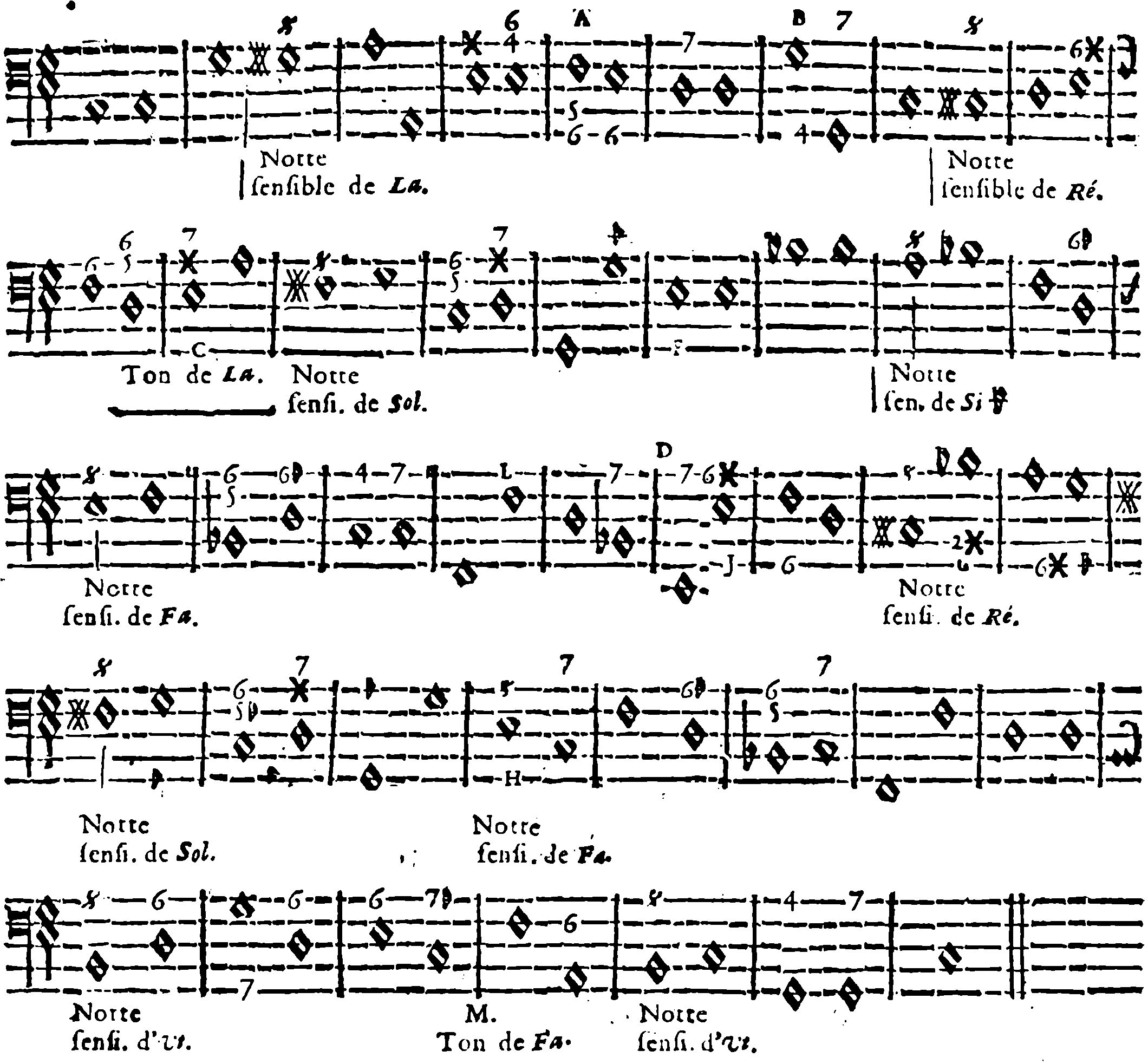
After the first leading note, which is easy to recognize, a diatonic progression begins at A and is interrupted at B, where the rule of sevenths must be followed. This interruption leads us to a cadence on C and obliges us to conform the diatonic notes, beginning with the dominant of A, to C’s key. After that dominant nothing appears that could keep us in A. For this reason we have given the repeated dominant the sixth–fourth chord, to unite its harmony more closely with that of the following chords. Furthermore, G becoming natural at B tells us that it is no longer the leading note. Finding neither sharp nor flat as far as the cadence on C, we see clearly that C is declared from A onward. We must always regard the following key rather than the present one, especially when there is no obstacle to adapting the chords to that following key, no sharp, flat, consonant progression, or repose directing us elsewhere.
With G-sharp no longer in force, the C-sharp that follows indicates a new key. The repose at C, followed by a consonant interval that requires a seventh on that note at C, determines our return to A, since the ascending-fourth progression ends on A.
F-sharp indicates a new key, since no other sharp follows it.
The flat at F obliges us to give the preceding note a minor third for greater agreement of harmony. With flats on B and E, we judge that A must be the leading note. Then E loses its flat and itself becomes the leading note, since the flat remains on B and no sharp is present.
The diminished fifth between the notes at D may reveal a leading note there, since the note that would be taken as such rises a semitone at J, the leading note’s natural progression. But the consonant intervals used from L, where the key of F ends, oblige us to give the following notes perfect chords or seventh chords according to the different bass intervals. At the same time they lead us to choose the key determined by the following leading note. This does not mean that, according to the rules for movement by thirds, one could not have proceeded thus:

And then one would continue in F as far as D, which is followed by the leading note. This is a matter of choice when good taste guides us. Such taste, delighting in variety, always prompts us, when possible, to abandon a key heard for too long.
The diminished fifth made above the leading note of D is not immediately resolved in the next chord. But it also forms the sixth above the note at G without any change in the chord’s foundation, and resolves directly afterward by descending to the sharp sixth of the neighboring note. There the diatonic progression obliges us to conform our harmony to the key prescribed by the following leading note.
As we have not yet discussed the augmented-second chord borne by the note at G, one may disregard it for the present.
The note at H becomes the leading note both because of the semitone progression between it and the note following in the next measure, and because the diminished-fifth chord it then bears is the same as the seventh chord required by the note immediately following it, since that following note rises a fourth. Moreover, no sharps remain and B stays flat; thus E is the leading note. Then, as flats and sharps disappear, B is the only leading note, and C is established as the key. The notes of that key must receive their prescribed chords, and so it continues to the conclusion, although the ascending fourth at M obliges us to give C a seventh chord and F a perfect chord, since F is itself followed by another consonant interval. The perfect chord, which always makes its bass note a tonic, thus makes F a tonic again. But the B-flat that should prevail in that key disappears at once. With neither sharps nor flats remaining, B again becomes the leading note. C has been interrupted only for a moment, for variety, since the consonant bass progression allowed this.
To conclude this subject, consonant progressions must decide our choice absolutely, and diatonic progressions must relate to the consonant ones following them rather than those preceding them. If the leading note cannot be distinguished, there is a certain sequence of chords in diatonic progression from the last consonant chord that the final note in consonant progression must have borne. We must not depart from this sequence as prescribed in the octave of Chapter XI. If the bass rises a semitone, which might cause the first note to be taken as a leading note, see whether any sharps follow or any notes lose their flats. These signs determine the leading note more surely than a rising semitone, which may occur in major keys from the mediant to the fourth note, and in minor keys from the second note to the mediant or from the dominant to the sixth note, this sixth note nevertheless descending immediately afterward. In such cases, therefore, a consonant progression, a sharp or flat, or a particular succession of chords must decide our choice absolutely.
As soon as a diatonic progression is followed by a consonant one, the note ending the former and beginning the latter must bear the perfect chord or the sixth chord. If it must bear the perfect chord, its leading note will have preceded it by an ascending semitone; or else it will be the dominant, approached by an ascending whole tone. If it is the mediant, it will be approached by an ascending semitone in a minor key and an ascending whole tone in a major key. If, instead, these notes are approached from above, the tonic is always approached by a descending whole tone, the dominant by a descending semitone in minor keys and a whole tone in major keys. These different progressions in different keys cannot fail to tell you something, since you already know the relationship required between a key and the one being left. The difference between major and minor is drawn from the third and fifth, which must be formed from notes belonging to the key being left. Furthermore, it is almost impossible that no leading note should appear before or after, or that the following consonant progression should fail to lead us to some conclusion that can decide the matter. Observe carefully that all conclusions are determined by fourth or fifth progressions, unless such a progression is followed by a diatonic progression of two or three notes, ascending or descending, whose final note provides a melodic repose in relation to a new consonant or disjunct progression beginning again.
Example
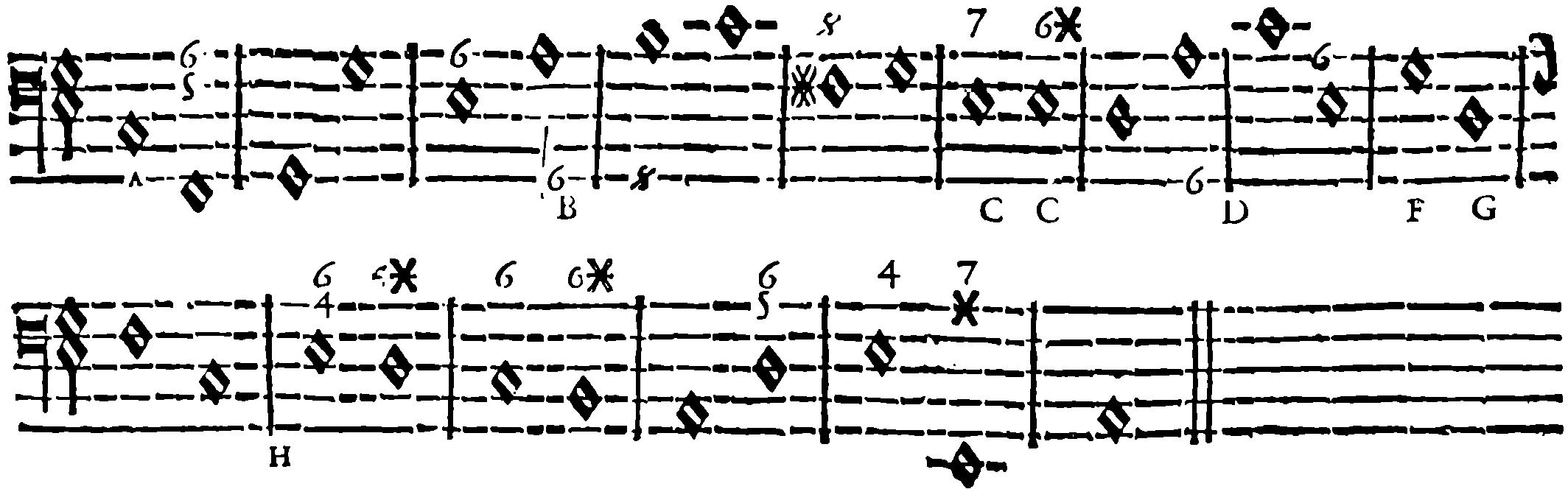
Although the bass descends a fifth at A, I must not put a seventh on the first note, because the second must bear neither the perfect chord nor the seventh chord. The following diatonic progression, where the melody comes to rest, determines my choice.
The melody resting on the third note after B obliges me to conform the note at B to its key. Therefore the preceding note must bear only the chord determined by that key, not the one called for by consonant progression, because the note at B must bear neither the perfect chord nor the seventh chord.
I adapt the chord of the second note at C to the key of the following note, where the melody rests. I give this note at C a seventh chord before the small-sixth chord that belongs to it, because the seventh is prepared in the preceding chord and resolves agreeably onto the sixth of this same note. We shall discuss this again in the next chapter.
At D and F I observe the rule prescribed for notes moving by thirds. To be still more certain of the chord choice in this case, observe that notes struck on the first beat should bear the perfect chord rather than those struck on the last beat, to which the sixth chord then belongs; although each of these notes may be given a perfect chord, as we have done at G.
The conclusion suggested by the consonant interval at the end obliges me to conform the chords of all the preceding diatonic notes, from H onward, to that key.
Article four
How to Distinguish Whether a Diatonic Melody Will Come to Rest on the Tonic or the Dominant
To distinguish whether a diatonic melody is about to rest on a tonic or a dominant, keep in mind that to move from a tonic to its dominant, the bass ascends a fifth or descends a fourth; from a dominant to the tonic, it ascends a fourth or descends a fifth. If the diatonic progression exceeds this range, the leading note will either appear in the bass or not. If it appears, it simultaneously declares the tonic; if not, you may be certain that the melody will rest on the dominant.
Example

The bass rising a whole tone at A reveals the dominant, and at B, where it rises only a semitone, the tonic.
Furthermore, whatever note of the key begins a diatonic progression, the consonant interval between that note and the preceding one, the repose immediately following, the whole tones and semitones within that diatonic progression, and its interruption by consonant or disjunct movement must unfailingly reveal that note’s place in the present key or in the key that may replace it. Admittedly, the consonant interval preceding diatonic movement is less decisive than the one following it, as the last example of the preceding article proves. Yet the whole tones and semitones composing each interval of a diatonic progression suffice by themselves to make the situation clear. It is therefore useful to observe carefully where the semitones lie in each mode, both ascending and descending, and to remember that diatonic movement is ordinarily interrupted only after a tonic, mediant, or dominant. Even when this happens otherwise, as it sometimes does after any other note, does not the following consonant progression decide, and do not the rules given on this subject suffice to prevent mistakes? We know what is required by a progression of thirds, fourths, or fifths, ascending or descending, and by the representation of the same chord that often occurs over two notes in successive thirds or otherwise, according to the following progression. In a word, if we attend somewhat to all that we have said on this subject; keep to modulation, which must always be our first concern; observe how chords relate to bass progression; compare the whole with a fundamental bass; and watch the leading note, a great help wherever it occurs, it is difficult to go wrong. Once you have recognized the chord belonging to a particular note, you need only follow the order of the octave from that note to the one where diatonic movement stops. (See Chapter XI.) The variety of harmony that may additionally be introduced will be learned later.