 Playable Books
Jean-Philippe Rameau · section 70 of 109
Chapter twenty-seven
Read and hear this section in the playable edition →How the Same Dissonance Can Occur in Several Successive Chords on Different Notes, and How It Can Resolve on Notes That Seem Foreign to Us
Observe that the seventh chord consists of four different notes that can precede the same note, and that these notes may be arranged successively in the bass. Each will thus bear a chord different in appearance but always the same in its foundation, as specified in Chapter XII. Having heard a certain dissonance in a chord that cannot resolve in the next chord, therefore, see whether that same dissonance can serve in the chord on the following note, and continue thus until it can resolve.
Example

The difference between examples A and B is that the major dissonance occurs in the first, while only the minor dissonance occurs in the other. In the small-sixth chord at A, natural to the second note, there is a dissonance between the third and fourth that must resolve by making the third descend. This cannot happen over the following note. But the same chord makes up the tritone chord on that latter note, where the dissonance still cannot resolve, and so on until C. There it resolves downward to the third of C. Notice that G, bearing the seventh chord, is the foundation of these four different chords. Thus, when a dissonance appears in a chord, always refer that chord to its foundation, then seek in the bass the note on which the dissonance can resolve. As long as only the notes contained in the dissonant chord appear in the bass, the dissonance certainly cannot resolve there. A note of the resolving chord must necessarily appear in the bass, allowing the dissonance to descend if minor or ascend if major. This note is easily distinguished by referring the dissonant chord to its foundation and saying: the fundamental note of this fundamental chord is dominant to such-and-such a note a fourth above; therefore I must find that note in the bass, or at least one of the notes making up its perfect chord, or its seventh chord if the melody does not rest there. If only the dominant of that note is found to resolve the dissonant chord, this dominant being the foundation of the dissonant chord now heard, it must be divisible into at least two beats if not repeated, so that on its second beat it may bear the chord derived from the note to which it is dominant. This last rule admits a few small exceptions, explained in Chapter [number obscured], on licenses.
It follows that if a seventh has been sounded on a note that naturally requires another chord in relation to the next note, or according to the order of the octave, and that note does not last long enough to sound its proper chord, the following note must be able to bear the same chord in its foundation. That is, the notes in the following note’s chord must be those that should have made up the chord natural to the first note.
See the following example.
Example
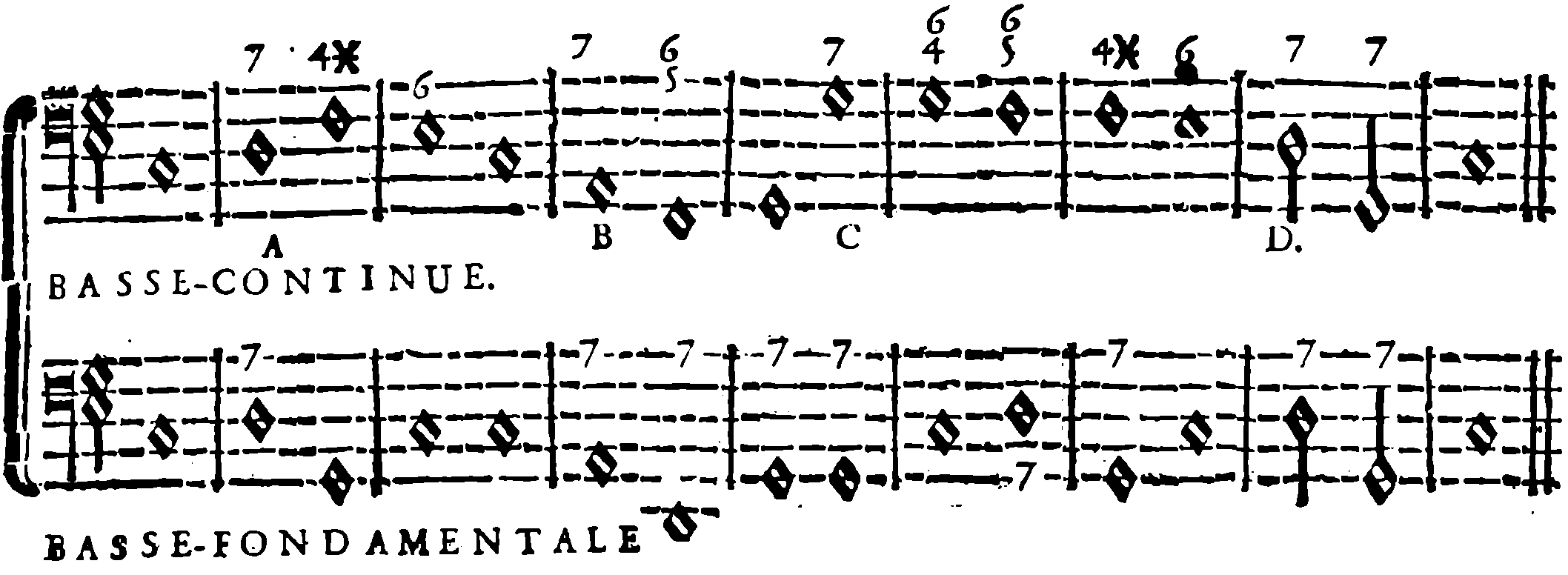
The small-sixth chord naturally belonging to the second note of the key at A and D is found in the tritone chord following A and in the seventh chord following D.
The small-sixth chord naturally belonging to the descending sixth note at B is found in the great-sixth chord of the following note.
The seventh heard above the dominant resolves through the sixth of that same dominant, repeated at C. This is why a dissonance can resolve through different consonances: it is always properly resolved provided that, if minor, it descends onto a consonance of the same bass note that bore it or of the following note. If major, it resolves upward onto a consonance.
One further small point deserves attention. If the natural succession of chords seems to require giving a note a chord derived from the following note’s chord, see whether that first note could instead bear the chord dominant to the following one. It would then be much better to give it that dominant chord than one fundamentally identical to the next chord, especially when the dissonance in this first dominant chord can be prepared by a consonance of the preceding chord.
The succession of harmony is nothing but a chain of tonics and dominants, whose derivatives must be well understood so that one chord always dominates the next. Thus the perfect chord and its derivatives dominate nothing; after them one may pass to any chord, provided the rules of modulation are observed. But any dissonant chord always dominates the next, in accordance with the examples of 7, 7 and 6, 2, 4♯, 5, and barred 5. Here we need all our discernment to recognize derived chords and give them a suitable succession, although all the different rules given for each chord and each bass progression suffice to overcome these difficulties.
Example of the Preference to Be Given to a Chord in Relation to the One Following It

The second note at A should naturally bear the small-sixth chord derived from the seventh chord on the tonic dominant that appears immediately afterward. But for greater variety, we observe that this second note is dominant to the dominant, and should therefore bear the chord prescribed in such a case instead. Although this dominant does not appear immediately after B, the intervening note can bear only a chord derived from the seventh chord on B. Thus B must bear the seventh chord, all the more so because its seventh is prepared by a consonance of the preceding chord.
Observe that all our rules have so far concerned only harmony, and the melody of each part has been restricted by it, except for the bass on which we base that harmony. Wait, therefore, until you have a thorough knowledge of harmony before thinking about melody. We shall discuss melody after explaining the licenses, which can further embellish harmony through the variety they introduce.