 Playable Books
Jean-Philippe Rameau · section 96 of 109
Chapter IX
Read and hear this section in the playable edition →The different chords that must follow a seventh chord on a note remaining at the same degree
First article
Any note that has borne a seventh chord must next bear a sixth, whatever chord follows that seventh on the same note. Since the sixth occurs in several different chords, this needs explanation.
Small-sixth, great-sixth, diminished-fifth, sixth, sixth–fourth, tritone and second chords may follow a seventh chord on a note at the same degree, since all contain a sixth. The choice can therefore be judged only from the note following those repeated notes—or following one note long enough to take two different chords, which amounts to the same thing. Here is how to proceed when the bass has no figures or is incorrectly figured, as very often happens.
Although a composer may give the same chord to several notes at the same degree, when there are two and the first begins on the first beat of the measure, it ordinarily bears a seventh chord. The second must then bear one of the proposed chords. To choose well, one must understand modulation perfectly. This is easy when considering just one key. The tonic and dominant naturally bear perfect chords, setting aside the seventh that may be added to the dominant’s chord. The second degree bears a small-sixth chord, as does the sixth degree when descending. The mediant bears a sixth chord, as do the sixth degree when ascending and the seventh when descending. The fourth degree bears a tritone chord when descending and a great-sixth chord when ascending. Finally, the leading note or seventh degree bears a diminished-fifth chord when ascending. Since your bass must contain one of these notes, you know which chord should follow the seventh on the same degree. Furthermore, if you ascend or descend diatonically to one of these notes, you also know the chord that naturally precedes it, so you cannot go wrong. If the repeated notes are the dominant, you know that its only chord containing a sixth is the sixth–fourth chord. All that remains is to recognize changes of key during a piece, and that is not the hardest part.
Example
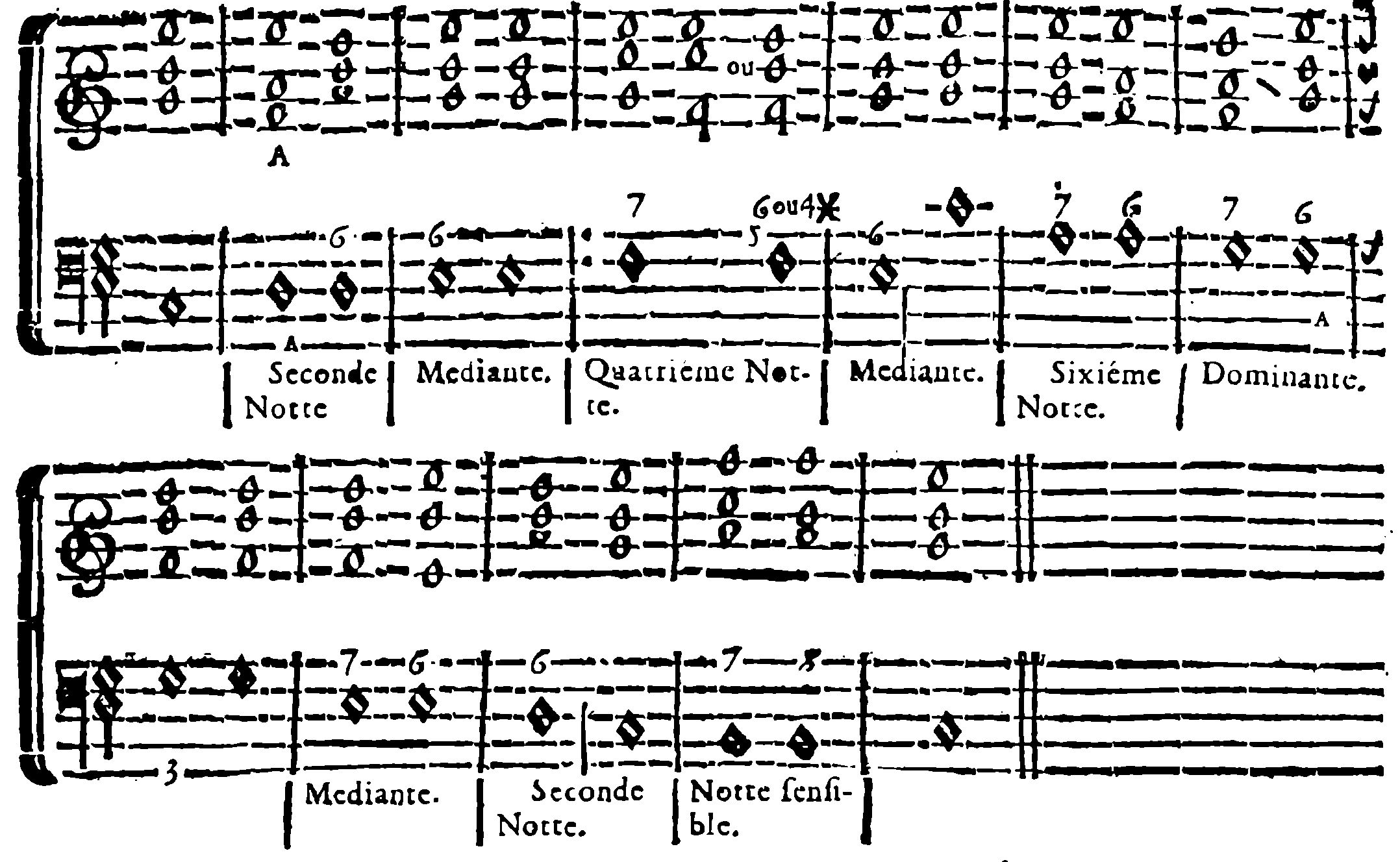
Here you recognize the chord containing a sixth that should follow the seventh chord on the same note, not only from that note’s degree in the key, but also from the degree of the following note and the chord it must bear.
Our rule is unfailing when the bass ascends diatonically. When it descends diatonically, however, and every note is long enough for two different chords, or the figures indicate this, follow the preceding chapter’s rule: the chord preceding a seventh chord in descending diatonic motion is always the small-sixth chord.
Notice at (A) that when the bass rises diatonically to sound a seventh after a perfect chord, that seventh must be accompanied by the octave instead of the fifth. The finger that played the bass’s octave in the perfect chord thus remains on the same degree to form the following seventh, while the other two fingers descend diatonically.
If the bass moves diatonically after a seventh chord, our last rules can be contradicted only when the note bearing that chord passes immediately to its nearest neighbor, leaving no time to give it the chord that naturally follows the seventh. If it ascends in this case, it can lead only to a perfect chord or another seventh chord, as stated in the preceding chapter. If it descends, it can lead only to another seventh chord. Moreover, the following note often bears a chord made of the same notes as the chord that should naturally have appeared on the note where the seventh sounded. Our rule therefore still holds in this case, because the fingers follow their customary progression. See Book III, Chapters XXVI and XXVII.
Second article
A note passing to its sharp or flat, or a sharpened or flattened note becoming natural, should be regarded as the same note for purposes of chords. Thus, in moving from C to C♯ or C♯ to C, B to B♭ or B♭ to B, and so forth, decide as though there were two Cs or two Bs, following our previous rules while adapting the chords to the modulation.
A bass moving by leaps can never rise a fifth or fall a fourth after a seventh chord. But if it falls a third or rises a sixth, or rises a third or falls a sixth, determine the chord by the note following the one reached after the seventh chord.
Example
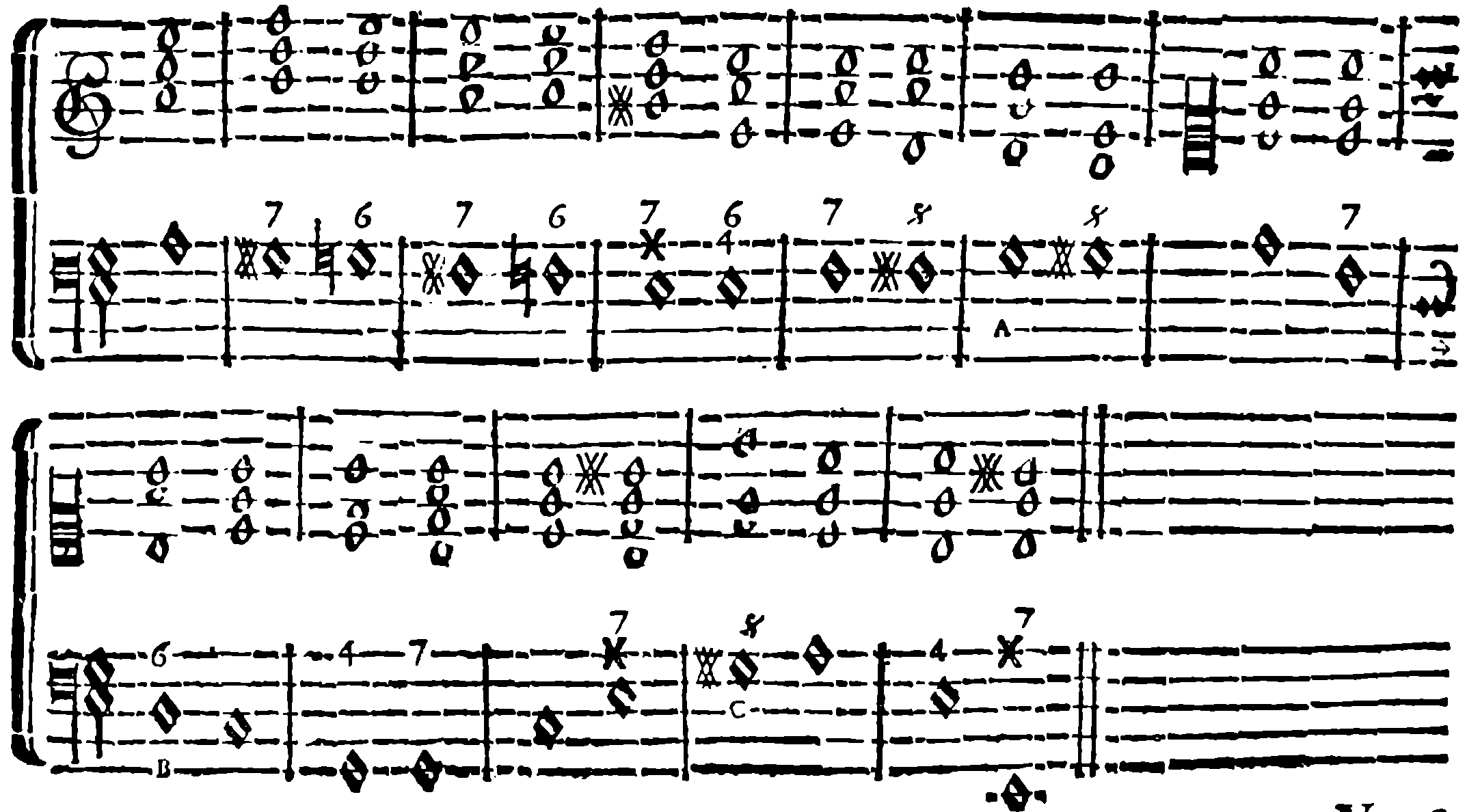
You see that sharpened notes descending to natural notes, and notes ascending to their sharps, do not prevent the natural chord succession. To be more certain, reason as follows: these sharps encountered in descending motion do not belong naturally; therefore I should regard the notes as if there were no sharps, to determine the chords more quickly. Conversely, these sharps belong naturally in ascending motion; therefore I should regard the notes as sharpened. There is this exception: a composer may give a perfect chord to any note rising a semitone, as at (A), although a great-sixth chord could have been given there. That great-sixth chord would then have been the same as the diminished-fifth chord on the sharpened form of note (A).
At (B), where the bass falls a third after the seventh chord, only the next note determines the chord. That next note must bear a perfect chord, requiring a small-sixth chord on the note descending diatonically to it. If instead the note ascended diatonically to the perfect chord, it would require a great-sixth or diminished-fifth chord, and so on.
When the bass rises a third after the seventh chord, the arrival note ordinarily bears a chord derived from the preceding one. At (C), for example, the diminished-fifth chord is simply the preceding seventh chord in another form.
Remember that rising a third and falling a sixth amount to the same thing, and so forth.
We do not discuss the descending-fifth progression after a seventh chord here, since the preceding chapter has already mentioned it.