Playable BooksREADING EDITIONS
Rimsky-Korsakov, Practical Manual of Harmony in English

Nikolai Rimsky-Korsakov · section 48 of 96

Free use of all the degrees of each mode

Read and hear this section in the playable edition →

§ 46.—For the student who has profitably learned everything set out so far, we add here a few rules concerning a freer use of the chords.

1) Chords of the diminished fifth are used only as chords of the sixth.

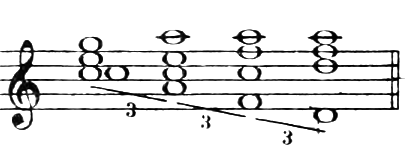
2) Three-note chords of the second order most often follow chords of the first order at the third below. A succession of several chords related by thirds gives the feeling of a rather weak harmony:

Four chords whose roots fall by thirds — C, A minor, F, D minor — with the bass line marked 3, 3, 3
Fig. 171 · See it in the reader

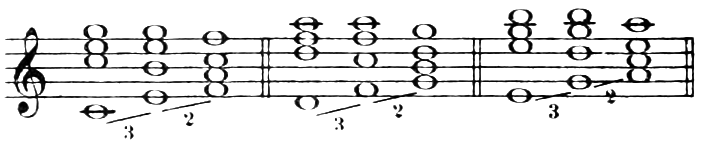
3) Every three-note chord placed a third above the one preceding it must be followed by another a second higher:

Three progressions in C major, each rising a third then a second: I–III–IV, II–IV–V, III–V–VI
Fig. 172 · See it in the reader

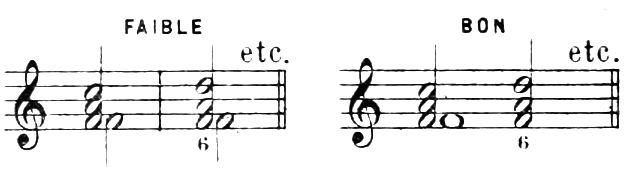
4) A triad and a chord of the sixth on the same bass give a feeling of harmony without vigour when they are placed in passing from the weak beat to the strong beat:

Weak: the F major triad on the weak beat, the sixth chord F–A–D on the following strong beat; good: the triad on the strong beat and the sixth chord after it ov
Fig. 173 · See it in the reader

In any case, the chord of the sixth will always be placed after the triad.

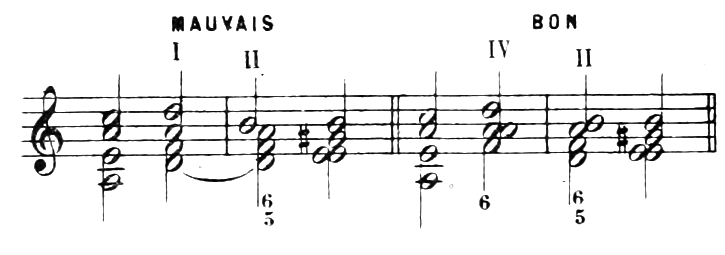
In general it would be desirable for the bass not to remain stationary in passing from the strong beat to the weak beat, even when the chords succeeding one another are on different degrees:

Bad: the bass D held (tied) under two different chords, IV and II 6/5, before V; good: a moving bass, I–IV6 | II 6/5–V, in A minor
Fig. 174 · See it in the reader

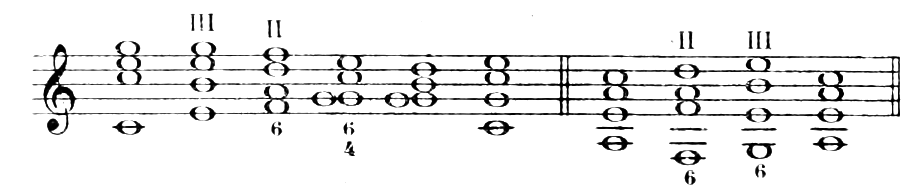
5) The first inversion of chords of the second order (except that of the IInd degree) is better used after the root-position chords of those degrees:

The VI chord moving to its first inversion (VI–VI6) over a bass A–C, then to II; and again VI–VI6, then to III (C major)
Fig. 175 · See it in the reader

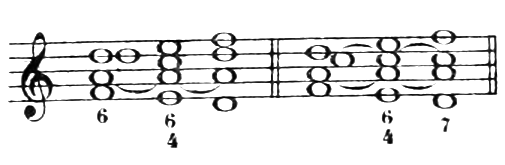
6) The second inversion of chords of the second order is used as a passing chord:

The 6/4 chord on E (A minor in second inversion) as a passing chord over the bass F–E–D: II6–VI6/4–II, then II 6/5–VI6/4–II7 with C held
Fig. 176 · See it in the reader

and in contrary motion.

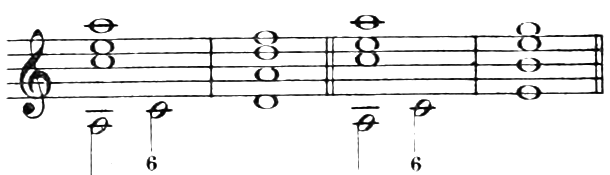
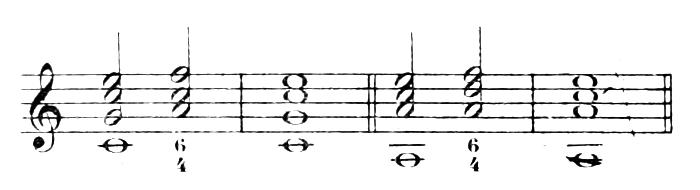
The six-four chord is sometimes placed between two chords of the same degree over the same bass:

Six-four chord between two root-position chords on the same bass: C major (I – I6/4 – I) and A minor (I – I6/4 – I)
Fig. 177 · See it in the reader

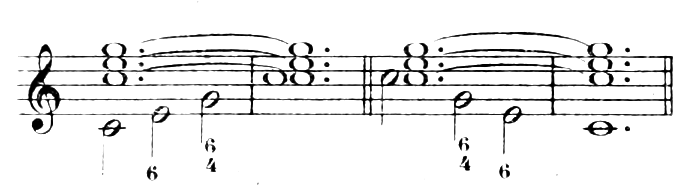
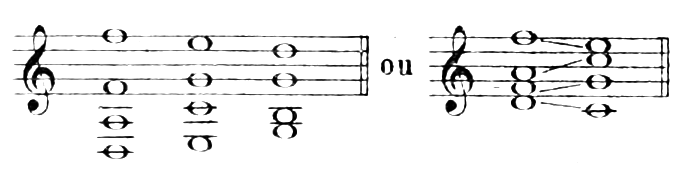
or else between a chord of the sixth and its root position, when the bass moves successively through the notes that make up the chord:

The bass arpeggiates the C major chord under held upper voices: root – sixth chord – six-four chord, then the reverse
Fig. 178 · See it in the reader

7) The chords of the IInd and IIIrd degrees of the major mode are very rarely connected, and in any case only in inversion:

III–II and II–III in C major, connected only with the second chord (or both) in inversion
Fig. 179 · See it in the reader

8) Secondary seventh chords, especially those containing a major seventh, are used as passing chords (with a passing seventh) or prepared by notes held in common with the preceding chords:

Sequences of secondary seventh chords in C major (VI7, II7, V7 resolving to I), with the sevenths prepared by ties
Fig. 180 · See it in the reader
Further seventh-chord successions in C major, including inversions (4/3, 6/5, 2), resolving to I
Fig. 181 · See it in the reader

Harmonic sequences containing more than four seventh chords do not sound well. The minor and diminished leading-note seventh chords may be used in inversion, resolving to the tonic chord.

9) Doubling the third or the fifth in triads is sometimes called for by special circumstances:

Triads with doubled third or fifth, C major: II (doubled third) – I6 (doubled third) – V; or II (doubled third) to I
Fig. 182 · See it in the reader

10) Movement by augmented intervals is not used at all; movement by diminished intervals is preferable in descending.

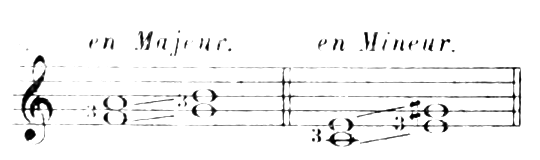
11) Parallel motion of two major thirds cannot always be avoided:

In major: F–A to G–B; in minor: C–E to E–G♯ — two major thirds in parallel motion
Fig. 183 · See it in the reader

We do not give special exercises; the student may apply the free use of chords of the various degrees in the exercises that follow, and especially in the chorales.