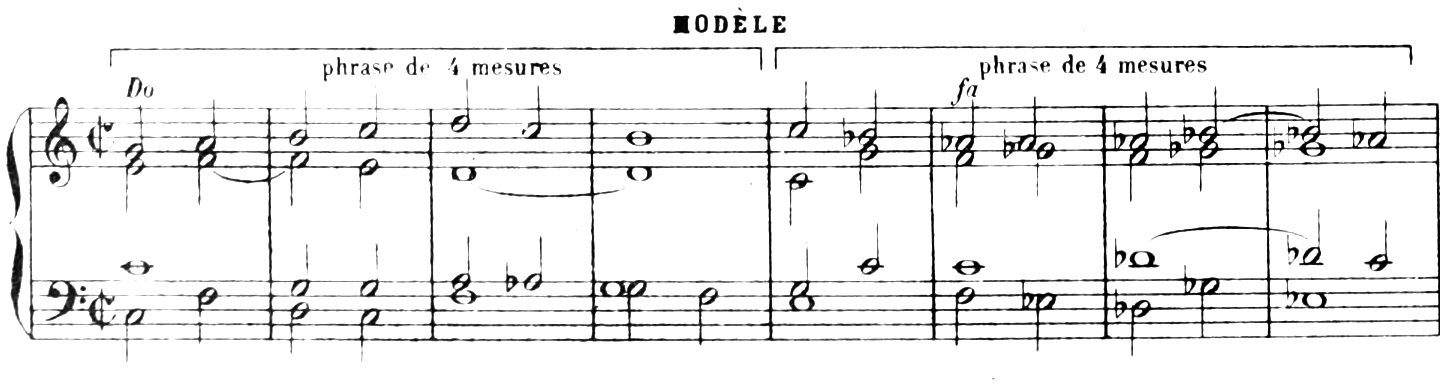
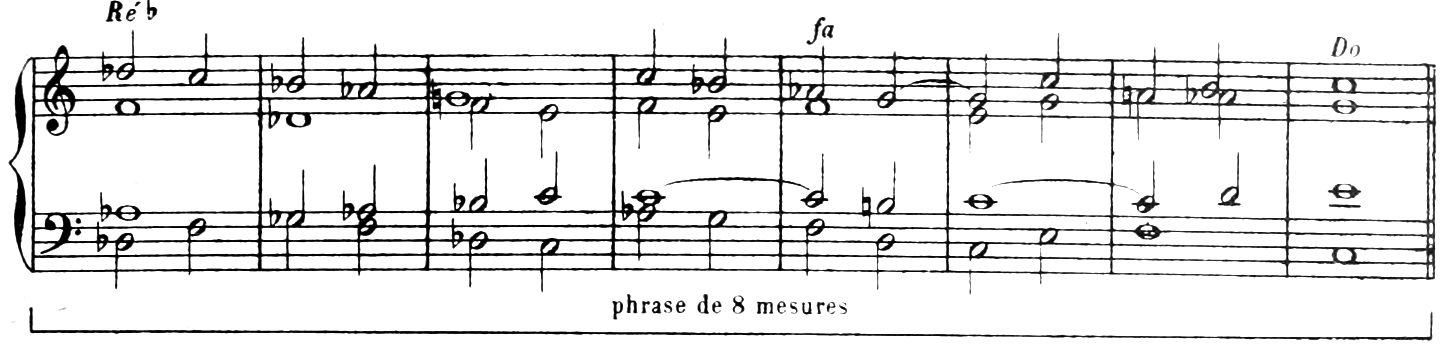
a) Modulate in whole notes, without division of the bar, to the various keys of the second class.
b) Compose, in various divisions of the bar, periods of eight bars modulating to keys of the second class.
NOTE. — Before modulating from a major key to a minor key whose key signature differs by four accidentals (C–f), and after modulating from a minor key to a major key whose key signature differs by four accidentals (a–E), it is better not to modulate to transient keys, above all not to that of the IInd degree or to the major subdominant (C–d–C–f) (E–f♯–E–A), in order to avoid the contradiction of these keys and the contradiction of the chords in general (see § 56, Note). These keys must be established as firmly as possible.
c) Write modulations of sixteen bars to keys of the second class in binary form:
Part I — One phrase of 8 bars. Part II — (Return to the preceding key) two phrases of 4 bars each, or:
Part I — Two phrases of 4 bars each. Part II — (Return to the preceding key) one phrase of 8 bars.
 Playable Books