Nikolai Rimsky-Korsakov · section 91 of 96
Polytonic Succession of Dominant Seventh Chords in the Relation of an Upper or Lower Third Read and hear this section in the playable edition →
§ 90. 1) Example of the connection of triads with dominant seventh chords a minor or major third away:
Fig. 376 · See it in the reader 2) Example of the connection of dominant seventh chords with triads a minor or major third away:
Fig. 377 · See it in the reader NOTE. Example (1) is less good, because it looks as if it contained an incorrect suspension.
3) Example of the succession of dominant seventh chords a major or minor third apart:
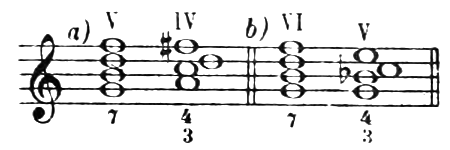
Fig. 378 · See it in the reader 4) Example of the succession of two dominant seventh chords a fourth and a fifth apart:
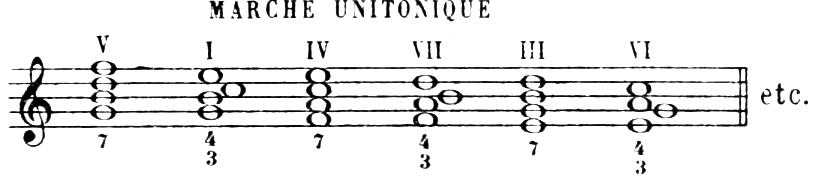
Fig. 379 · See it in the reader NOTE. — Succession (a) of the example above has a rather harsh effect because of the ascending motion of the seventh; succession (b), on the other hand, is fairly common. It derives from the modulating sequence, a modification of the one-key sequence; that is, each seventh chord of the one-key sequence is transformed into a dominant seventh chord in the modulating sequence.
Fig. 380 · See it in the reader Fig. 381 · See it in the reader Such a modulating sequence, through the enharmonic change of one of the dominant seventh chords, brings about the modulation back to the original key.
REMARK. — Modulating sequences can also be composed with half-diminished or diminished leading-note seventh chords, and with ninth chords alternating with seventh chords.
← Supplement All sections Application of Polytony to Sudden Modulation → More Playable Books Tchaikovsky, Guide to the Practical Study of Harmony Tchaikovsky’s Moscow Conservatory harmony course, with playable examples. Fux, Gradus ad Parnassum Learn how independent voices work together, one species at a time. Goetschius, Exercises in Elementary Counterpoint Build independent melodies through graded exercises, with 471 recorded examples. Goetschius, Counterpoint Applied Study imitation, canon, and fugue with 393 recorded examples. Kitson, Counterpoint for Beginners Strict counterpoint in two and three parts, species by species, with every example playable. Prout, Analysis of J. S. Bach’s Forty-Eight Fugues Follow Prout through all 48 fugues of the Well-Tempered Clavier, every example playable. Rameau, Treatise on Harmony Explore the foundations of harmony, composition, and accompaniment. Fenaroli, Partimenti Six books of partimenti, with playable basses, contrapuntal exercises, and bilingual rules. Reger, Supplement to the Theory of Modulation Explore Reger’s modulation method with 100 analyses and 102 playable examples. Cutter, Harmonic Analysis Learn to name every chord and non-harmonic tone in real music, from Bach to Wagner, with the passages playable. Schoenberg, Theory of Harmony Read all 22 chapters, with the original German beside a new English translation. Rimsky-Korsakov, Principles of Orchestration Discover instrumental colors through scores and orchestral recordings. Forsyth, Orchestration A witty, thorough guide to every orchestral instrument, with the original pages. Forsyth, Choral Orchestration A whole Te Deum orchestrated bar by bar, with Forsyth’s reasons, the full score and the vocal score playable. Berlioz, Treatise on Instrumentation Berlioz’s treatise on the orchestra, revised by Richard Strauss, with the original pages. McKay, Creative Orchestration Ranges, transpositions, texture and balance, taught through projects, with the supplied examples played by orchestral samples. Sanganeria, Arrival Build jazz lines that land, with 30 original playable examples. Bona, Complete Method for Rhythmical Articulation Practice rhythm through 120 graded studies, with playable notation and original scans. ← All Playable Books  Playable Books