 Playable Books
Percy Goetschius · section 22 of 24
Chapter XX. The canon for more than two parts
Read and hear this section in the playable edition →The canon for more than two parts
205. The 3-voice Canon. This consists of a Leader and two Followers (similar to the 3-voice Round). In order to decrease the very great difficulties of this contrapuntal form, it is necessary, or at least customary, that the same melodic interval and time-interval should prevail between the first and second Follower, as préceded, between Leader and first Follower; in other words, that the contrapuntal relations between successive voices shall exactly correspond, thus ensuring at least this degree of continuous agreement. For instance, if the first Follower is in the 8ve, after one measure, the second Follower will also be in the 8ve, after one additional measure (or two measures from the beginning); or, if the first Follower is in the 5th, the second Follower will be in the next 5th, or in the 2nd from the Leader; if in the 4th, the second Follower will be in the 7th, and so on. Thus:
Ex202

In any other than the 8ve8ve species, the same modifications of interval quality (not affecting the letters) are necessary, for the sake of smooth harmonic and modulatory succession, as were noted in par. 1935.
The difficulty of obtaining intelligible form is greatly enhanced: but much may be accomplished by wise and generous use of Rests. Review par. 1926, thoroughly.
The 3-voice Canon is rarely accompanied, though the addition of one or even more auxiliary parts is possible.
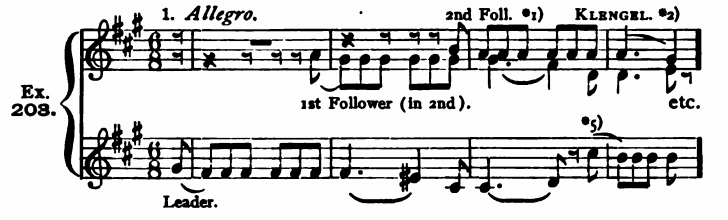
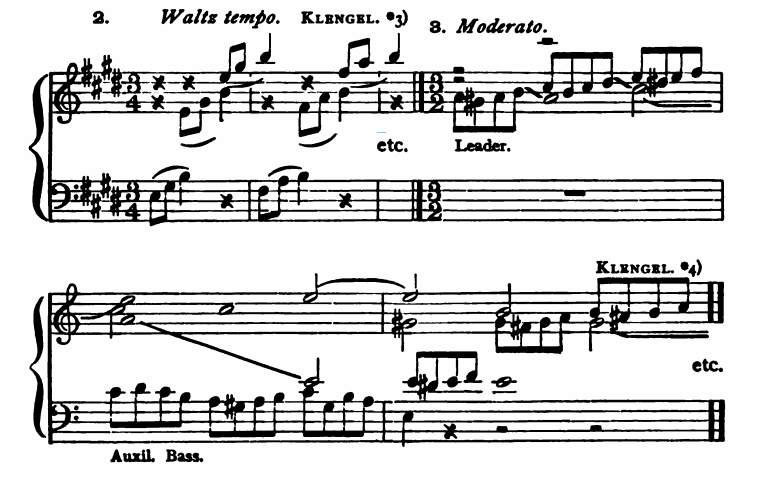
For general illustration :
Ex203-1
Ex203-2
*I) The znd Fóllower is not again in the "and from the Leader," but in the and from the preceding Follower, or 3rd from the Leader; the Canon is therefore "in the and and 3rd," after one measure, respectively. The contrapuntal relations between the inner and upper parts in measure 3 therefore correspond exactly to those between the lower and inner parts in measure 2; and so on continuously, from measure to measure, throughout.
*2) Vol. I, Canon 14. Analyze minutely.
*3) Vol. II, Canon 9; in 8ve and 8ve, after one beat; an extraordinary example.
*4) Vol. I, Canon 20; in 3rd and 5th; like the preceding, this has also a very brief time-interval (one beat), and is even more unique, in some respects; analyze carefully; the auxiliary Bass is coördinate.
See further, Klengel, Vol. I, Canon 2; in 3rd and 5th, after one measure, unaccompanied. — Vol. I, Canon 4; in 7th and 6th, after one measure, unaccompanied. — Vol. I, Canon 9; 8ve-8ve. — Vol. I, Canon 12 ; in 6th and 4th, after six measures; very definite form, in consequence of long time-interval. — Vol. I, Canon 13; in sth and znd, after one measure. — Vol. I, Canon 23; 8ve-Sve. — Vol. I, Canon 24; 8ve-8ve. —Vol. II, Canon 2 ; in 4th and 7th, after one beat; at first unaccompanied; later a running Bass is added, and still later an auxiliary upper part (5-voice texture) ; Prelude and Postlude. — Vol. II, Canon 14; 8ve-Sve, after 2½ measures. — Vol. II, Canon 17; in 5th and znd, after 2 beats; at first unaccompanied; in Part II an auxiliary Bass is added; later the canonic parts are shifted down (to 3 lower parts), and the upper part becomes a running auxiliary. — Vol. II, Canon 22; in 3rd and 5th, after 4 measures. — Vol. II, Canon 24; 8ve-8ve. — Vol. I, Canon 1; in 2nd and 3rd after 1 męasure; auxiliary running Bass. — Vol. I, Canon 6; Sve-8ve, in simultaneous Diminution and Augmentation; the 3 parts begin exactly together, the Leader in inner voice; 14 measures of the Leader are imitated in Augmentation (to meas. 28), and 28 measures are imitated in Diminution; the latter (upper part) becomes, therefore, "free " after meas. 14, and all the parts are free from meas. 28 to end.
Mozart (Breitkopf & Härtel, Serie 7), No. 42; unison. — No. 50; unison and 8ve.- No. 51; in and and 3rd. Both vocal.
G. W. Chadwick, Organ Canons, op. 12, No. 9; in 4th and 7th, after one measure; auxiliary Bass. - No. 1o; in and and 3rd, ditto.
206. Contrary motion is employed as follows: The first Follower is the Contrary motion of the Leader, in any of the usual methods of correspondence (Tonic = Dominant being probably the best); the second Follower, being the Contrary motion of the first one, returns to the original direction, and the corresponding series of interval-relations is obtained by giving to the and Follower, in every case, the exact tones of the Leader (i.e., 8ve-imitation of the latter). Thus:
Ex204
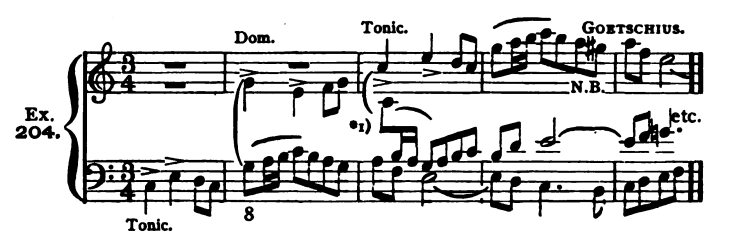
*1) The 2nd Follower imitates the Leader in parallel direction, in the double 8ve. The successive intervals described by Leader and 1st Follower (beginning with the 8ve, as indicated) are exactly reproduced between 1st and and Followers, but, naturally, in inverted forms. This will be the invariable result, no matter what the location of the 1st Follower is, if the and Follower corresponds thus to the Leader.
207. The 4-voice Canon. The principles of par. 205 apply here also, simply extended to include the 4th voice. For example (8ve-8ve-8ve, after one measure):
Ex205
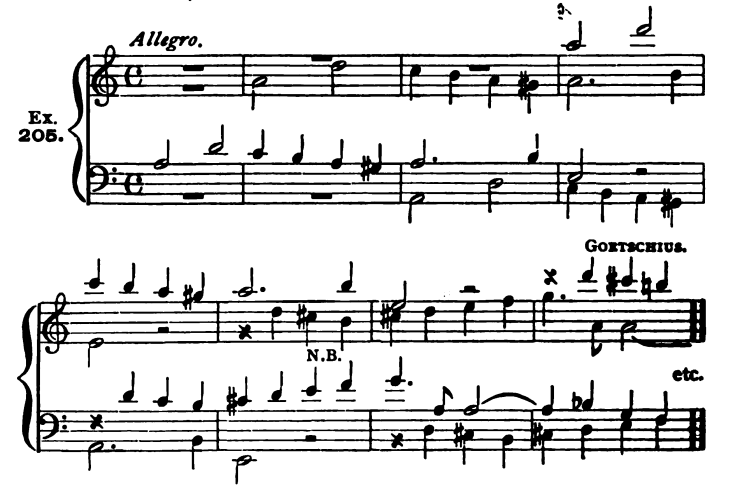
See also Klengel, Vol. I, Canon 15; in the 6th, 4th, and and (comp. Ex. 202), after one measure respectively; unaccompanied.
Mozart (Breitkopf & Härtel, Serie 7), No. 54; vocal; all unison, after 4 measures.
Clementi, "Gradus ad Parnassum,' Schirmer ed, No. 68 (orig. ed. 33), is i 4- voice Canon, in unequal melodic intervals; the succession is 4th, 5th, and 8th; hence, the second pair of parts (and and 3rd Followers) correspond in their relations to the first pair, but the interval-relations between the first and second Followers are so shifted as to involve Artificial double-cpt. Analyze minutely.
Brahms, Round-canons, op. 1I3, No. 6; in contrary motion; indep. cadence.
Exercise 58
A. An example of the 3-voice Canon in 8ve-8ve; unaccompanied; for pianoforte, organ, or string-trio.
B. Two or more examples in other intervals of Imitation, according to Ex. 202 ; with or without auxiliary part, at option.
C. A 3-voice Canon in Contrary motion.
D. One or more 4-voice Canons, for string-quartet.