 Playable Books
Percy Goetschius · section 23 of 24
Chapter XXI. The double-canon, etc
Read and hear this section in the playable edition →The double-canon, etc
208. Like the Double-fugue, the Double-canon has two Leaders, or a "Double-leader," imitated by two Followers. The number of canonic parts is therefore four; to these an auxiliary part may be added, but it is rarely done.
The two Leaders may begin together, but it is more common to introduce the subordinate Leader (so-called) a beat or more, possibly a measure or more, later than its fellow. The rules of par. 165 apply, to a certain extent, and may be reviewed.
The interval of Imitation is optional, the 8ve being here again possibly the most convenient. The time-interval is apt to be a little longer than in the single Canon, but must be adhered to by both Followers; i.e., the second pair of parts must agree with the first pair in time-relation. Any two of the four parts may be chosen for the two Leaders. For example:
Ex206
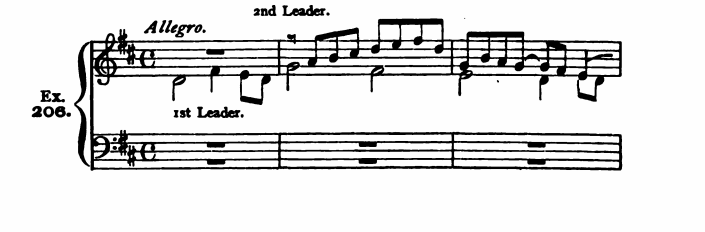
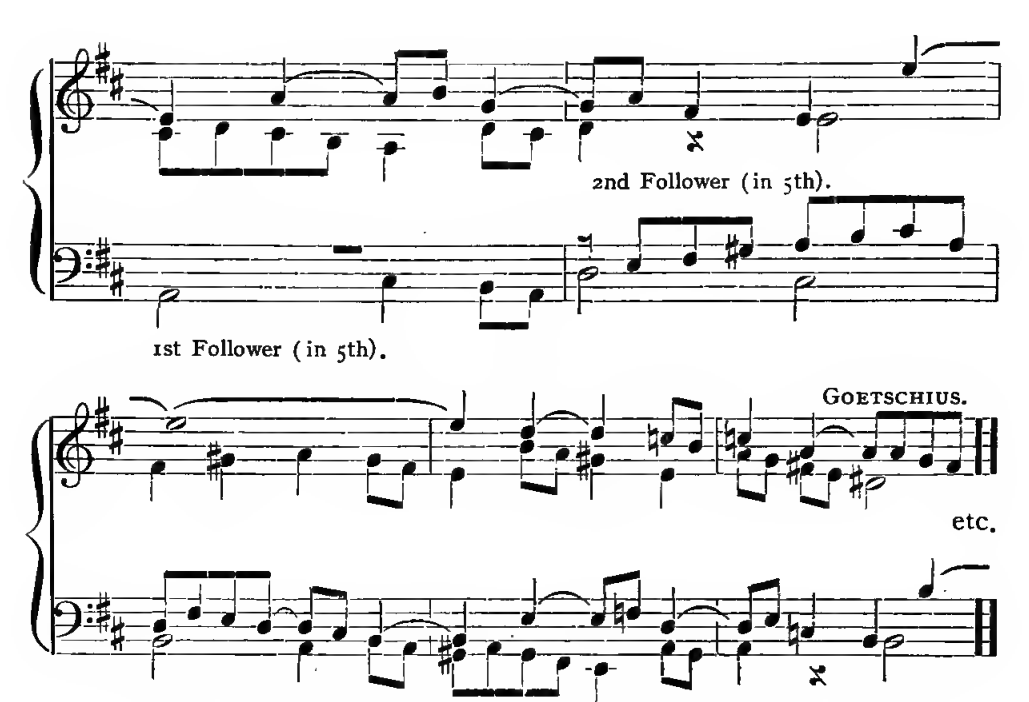
This is a Double-canon in the 5th, after 3 measures. See further, Klengel, Vol. I, Canon 21 ; in the 5th, after one measure; unaccompanied; 2 Leaders begin simultaneously in Tenor and Soprano, 2 Followers in Bass and Alto. — Vol. II, Canon 4; in 5th, after 2 long measures; = Leaders begin together in Bass and Alto; they are contrasted through the novel device of making one lyric and the other its (apparently inferior) figural accompaniment.
Mozart (Serie 7), No. 41; Double-canon as Round (vocal, unacc.); in 4th, after one measure; no cadence; • Leaders in Alto and Tenor, one measure apart, — hence the 1st Follower begins simultaneously with and Leader.
Brahms, Sacred quartet, op. 30; in 7th, after one measure; with accompaniment, including Prelude and Interludes. — Round-canons, op. I13; No. 8, unison, after 4 measures; No. 9, in 4th, after one-half measure.
Clementi, "Gradus ad Parnassum," Schirmer ed. No. 706 (orig. No. 84b); in 8ve, after one beat; unaccompanied.
209. The Triple-canon is far less frequent than the preceding. It consists in 3 Leaders, imitated by 3 Followers, and therefore involves six canonic parts.
See Brahms, op. IIS, No. 4, Div. Il (meas, 51-91); Leaders (simultaneous) on upper staff, Followers on lower, after one beat; unaccompanied.
The Quadruple-canon is still more rare; it involves eight canonic parts, and is practicable only in Double-chorus or orchestral writing.
An extraordinary example of the Quadruple-canon is found in Mozart (Serie 7), No. 49; it is written for 12 parts (as triple-chorus), and consists in a full quartet of
Leaders, imitated in the unison, after 14 measures, by a quartet of Followers, and If measures later by still another quartet; it is designed as a Round, with cadence indicated.
Exercise 59
A. One or two examples of the Double-canon; all conditions optional.
B. An example as " Song-form with Trio," for pianoforte, 4 hands; the principal Song a Double-canon, with auxiliary (subordinate) Bass; the Trio a brief Triplecanon, in the 8ve, unaccompanied.