 Playable Books
Percy Goetschius · section 24 of 24
Chapter XXII. Canon as chorale elaboration
Read and hear this section in the playable edition →Canon as chorale elaboration
210. Chorale as Canon. In this species the chorale-melody itself appears in two voices as Canon, while the other parts provide a contrapuntal accompaniment.
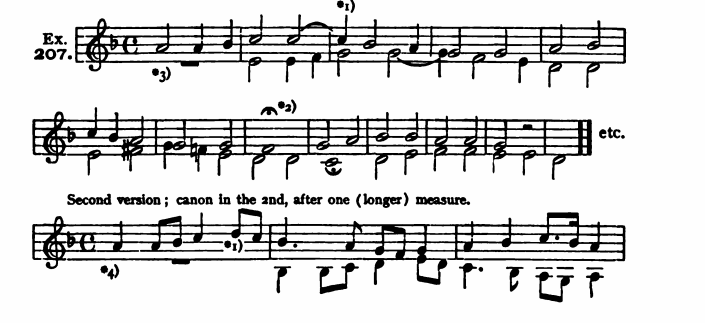
The interval of canonic imitation, and the time-interval, are optional. But the relations adopted at the beginning should be, as a rule, maintained uniformly throughout the chorale; therefore it is usually necessary to experiment repeatedly with the whole, before valid relations can be determined; and it is not considered unpermissible, in case the advantage is manifest, to adopt new relations for a new Section (or even for some single line) of the chorale. It is greatly preferable, however, to overcome the necessity for such changes of canonic relation by judicious (slight) rhythmic modification, or strictly unessential melodic embellishment, of the chorale-melody, in the manner shown in Ex. 125. For example (Table, Exercise 26, Chorale 29):
First version; canon in the 5th, after one measure.
Ex207
Second version; canon in the 2nd, after one (longer) measure.
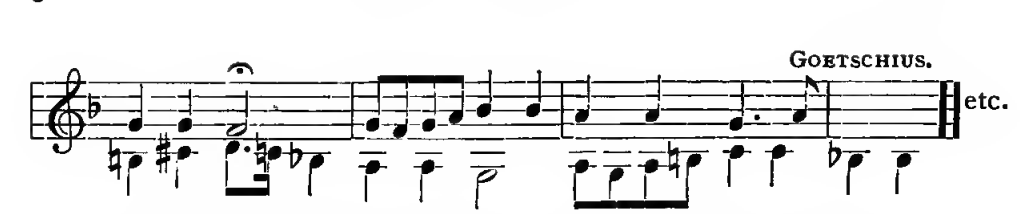
*1) Observe the slight modifications of the original chorale-melody.
*2) The m simply indicates, as usual, the end of a Line, and is not respected.
*3) In the completed elaboration of this first version the canonic parts are Soprano and Pedal-bass, — the latter two 8ves lower than here written. The inner parts are thematic, as in the "Invention with chorale" (par. 99), preceding the Leader by two measures.
*4) Canonic parts are Soprano and Tenor; Pedal independent; Alto pursues constantly a Figure of its own; comp. pars. 93, 96.
211. The parts which accompany the canonic voices are in a sense their " auxiliaries," but should be strictly contrapuntal, and thematic (based upon some Motive or Motives), as described in par. 92, which review. See also pars. 99 and 93-
The number and choice of these accompanying parts, and the location of the canonic voices, are wholly optional. Either the small or large species of chorale-figuration may be employed.
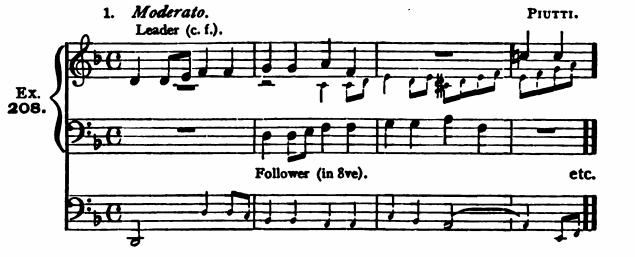
For general illustration •
Ex208-1
Ex208-2
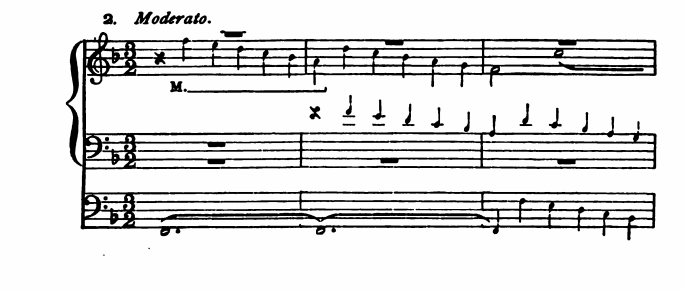
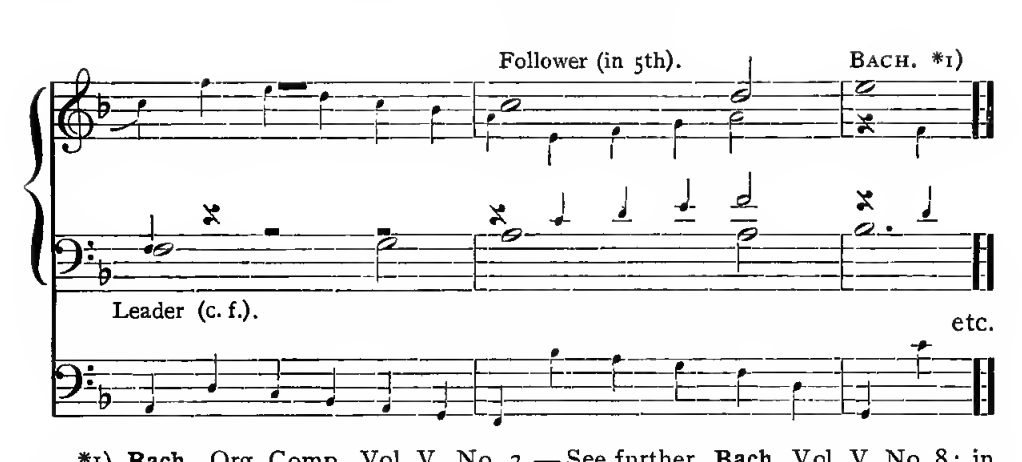
*I) Bach, Org. Comp., Vol. V, No. 3.— See further, Bach, Vol. V, No. 8; in 8ve, outer parts; z auxiliary thematic parts. — Vol. V, No. 19; 4-voice; Canon in 8ve, Soprano and Tenor; Bass independent; running Alto. — Vol. V, No. 29; 4- voice; Soprano and Alto, in 5th, after z beats; running Tenor, independ. Pedal.— Vol. V, No. 37, 5-voice; Soprano and Alto, in 5th. — Vol. V, No. 44; 4-voice; Bass and Alto, in 5th, after 2 beats. — Vol. V, No. 35 ; 4-voice; Double-canon (in Sve) for 24 measures; then single Canon, with longer time-interval, for 7 measures; then free Coda (6 measures). In this example the triplet notation differs from modern usage
(i.e., dod = O).— Vol. VI, No. 19; 5-voice; Canon in two Tenors, after 2 long
measures; Pedal independent, Soprano and Alto thematic. — Vol. VII, No. 52; 5- voice; Soprano and Tenor, 8ve; Pedal independent, other two parts imitatory; the canonic imitations alternate at each Line; time-interval changed once.
A superb masterpiece is found in Bach, Vol. V, page 100; Canon in Contrary motion; Sec. I (to meas. I4) in upper parts, Tonic = Mediant, Pedal auxiliary; Sec.
II (to meas. 27) the contrary motion of Sec. I, Mediant = Tonic, Pedal new; Sec.
III (to meas. 39), Canon in lower parts, Dominant = Mediant, two upper parts auxiliary; Sec. IV (to meas. 52) contrary motion of Sec. III; Sec. V is a Coda, containing Diminutions of first Line, and a remarkable stretto of all 4 Lines together.
212. Canon with Chorale, i.e., canonic accompaniment to the single chorale-melody.
All conditions are optional. Additional auxiliary parts are sometimes employed. For example:
Ex209
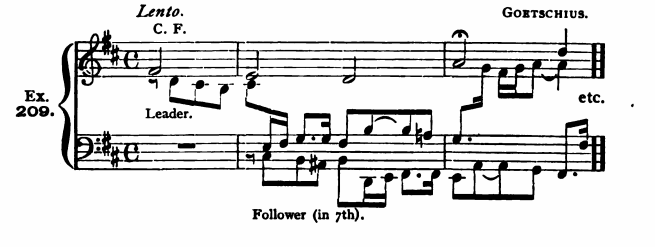
parts; c.f. in Pedal as Tenor; Large species (with Prelude, Interludes, and Postlude). — Vol. V, page 94; Canon in 4th, after 1 measure; other conditions similar to preceding. — Vol. V, page 96 ; Canon in 7th, Pedal-bass and Alto; ..f. in Soprano; additional lyric auxiliary part in and Soprano. — Vol. V, page 98; Canon in Augmentation, Soprano and Bass, in 8ve; the Leader ends in , meas. 21, the Follower in meas. 42 (end of the composition); c. f. in Pedal as Tenor; an auxil. Tenor is added.
Exercise 60
A. Two or more examples of the Chorale as Canon (pars. 210, 211), for Organ.
B. Two or more examples of the Canon with Chorale (par. 212).
"canonic" compositions
213. When the canonic imitation falls short of the characteristic requirements of the legitimate Canon (par. 180), either in being interrupted (periodic instead of continitus), or in containing more or less frequent licences (instead of being strict), the product forfeits the title of "Canon," and is called simply " canonic" composition.
To this class belong also the fairly numerous examples of homophonic (or even polyphonic) forms with canonic sections, or passages.
See Beethoven, Pfte. Var., op. 120, Var. 6 (1st section of Parts I and II) ; Var. 19 (the same) ; Var. 20 (similar).— Pite. Var., op. 35, Var. 7 (Parts I and III; Part II harmonic). — Pite. Sonata, op. 101, and movement, portions of the "Trio." — Symphony No. IV, first movement, meas. 103-119 of Allegro. — Violin Sonata, op
30, No. 2, "Trio" of Scherzo.— Pfte, Sonata, op. 7, 3rd movement, Part II.- Op.
31, No. I, Finale, meas. 86-97.
Schubert, Trio, op. 100, Scherzo.
Schumann, op. 56, No. 4; Parts I and III; in 4th, at first after 3 measures, then after one; Part II free, but imitatory. — No. 6; Sec. I, Sve-canon, harmonic accompaniment; Sec. II, a 4-voice Fughetta; Sec. III again canonic.
Chopin, Mazurka 34 (op. 56, No. 2); Part V, meas. 32-17 from end.
Brahms, Var., op. 9, Var. I0; contains several brief canonic passages, and duplications in simultaneous regular and contrary motion (belongs to the once pópnlar species called "Quodlibet," a contrapuntal medley; see the Finale of Bach's "Air" with 3o Variations).
Brahms, Motet, op. 74, No. I, 2nd movement. — Op. 118, No. 4, Divs. I and III.
Jadassohn, op. 56, Prelude No. 5; Song-form with Trio; Principal Song homophonic, Trio an Sve-canon.
Bach, "B-minor Mass," No. 14, Et in unum Dominum. — Org. Comp., Vol. V,