 Playable Books
Mayank Sanganeria · section 1 of 12
Preface: One Grammar, Two Axes
Read and hear this section in the playable edition →A jazz line has to be solved twice: once in time, once in pitch. Hal Galper's Forward Motion solved the time problem. Lines move toward strong beats, not away from them, and a phrase is a pickup aimed at a landing. Bert Ligon's Connecting Chords with Linear Harmony solved the pitch problem. A bebop line is voice-leading in disguise: a stepwise skeleton of guide tones, decorated with a small vocabulary of arpeggios, enclosures and chromatic approaches.
Each book leaves the other half implicit. Galper tells you where the line is going in time but keeps the note vocabulary loose: chord tones on strong beats, play what you hear. Ligon gives you a rigorous pitch vocabulary but takes the rhythm for granted, leaning on the bebop habit of chord tones on downbeats. Practice either one alone and you get half a grammar: lines that land well but say little, or lines full of the right shapes that land in the wrong places.
This book fuses them into one operational unit: the arrival. An arrival is a chord tone on a structural beat, approached by a figure sized to the time left before it lands. Everything else in the book is a way of choosing arrivals, timing them or connecting them.
The working equation is Line = Skeleton × Grid × Cells. The skeleton is what lands: a guide-tone voice moving by step. The grid is when it lands: beats 1 and 3. The cells are how the line gets there: pickup figures one to three eighth notes long. Change any factor and you change the line. Get all three right and the line sounds inevitable.
The whole book in three bars
Ex. P.1 — A ii–V–I line (top) and its arrivals alone (bottom). Blue notes are arrivals; numbers name each note's function against the chord.
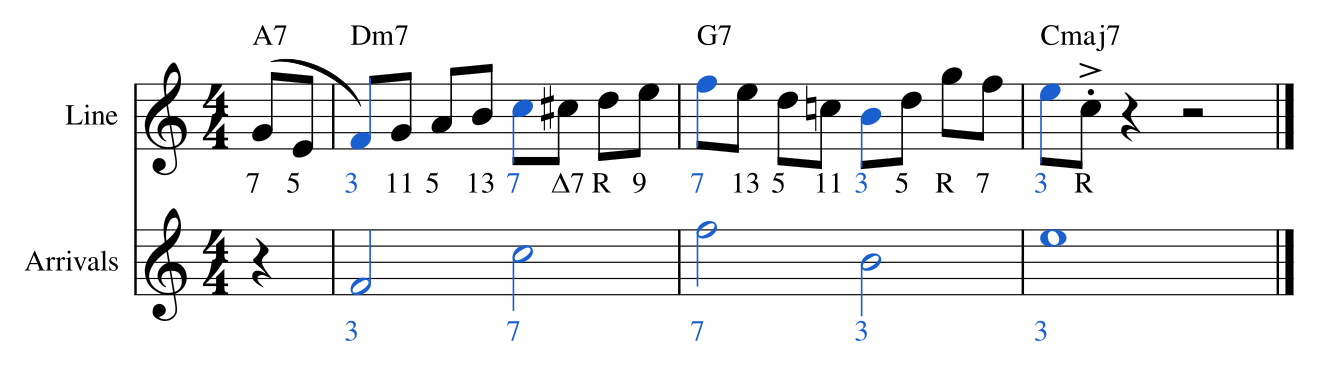
The top staff is a finished line. The bottom staff keeps only its notes on beats 1 and 3, and they make a slow voice-leading melody on their own: F, C, F, B, E. Every other note in the top staff exists to deliver the next note in the bottom staff on time.
Read it twice. First read the bottom staff as harmony. On each beat 1 it carries the 3rd of Dm7 (F), which holds to become the 7th of G7, then falls to the 3rd of Cmaj7 (E). On beat 3 it dips to the other guide tones, C and B. Then read the top staff as time: a two-note pickup before the first bar line, a run that rises through one chromatic passing tone so every chord tone lands on a beat, a run down to B, an arpeggio that parks F on the last upbeat, and F falling into E across the final bar line.
By Chapter 9 you will be able to build that line from scratch, and dozens like it, in any key.
How to use this book
Read Chapters 1–3 in order; they build the frame. Chapters 4–6 are vocabulary and belong at the instrument. Each ends with a drill, and the drills matter more than the prose. Chapters 7–8 cover phrasing and time feel, Chapter 9 applies everything to a ii–V–I, a blues and rhythm changes, and Chapter 10 is the daily practice system.
All examples are original and written in C unless noted. Play them, sing them, then take them through 12 keys. The two source books remain the deeper references, especially for transcribed vocabulary. This is a synthesis and a method, not a substitute.