 Playable Books
Mayank Sanganeria · section 2 of 12
Chapter 1 — The Two Axes
Read and hear this section in the playable edition →Every note in a line does two jobs at once. On the time axis it is either an arrival or a pickup heading toward one. On the pitch axis it is either a skeleton tone, part of the voice-leading that carries the harmony, or an elaboration of one.
The central claim of this book is that the two axes line up. Arrivals in time are skeleton tones in pitch; pickups in time are elaborations in pitch. When the alignment holds, the line sounds like it knows where it is going. Break it by accident and the line sounds lost. Break it on purpose, for a beat or two, and it sounds like tension (Chapter 7).
Galper's axis: time has a direction
Notation draws the bar line immediately before the downbeat, so the eye learns to treat beat 1 as a beginning. The ear hears it the other way around. Beat 1 is where motion comes to rest, the end of a gesture that started in the previous bar. Speech works the same way: "I went to the store" leans toward its stressed syllables, and nobody hears "store" as the start of something.
Galper's correction is to hear every phrase as an anacrusis: a pickup that resolves on a strong beat. The smallest version is two notes leading into one.
Ex. 1.1 — A two-note pickup lands on F, the 3rd of Dm7. The slur marks the gesture, and it crosses the bar line.
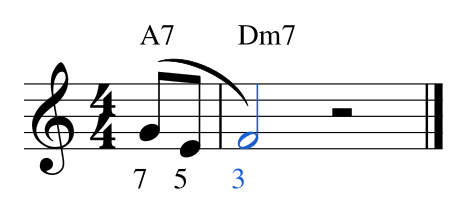
G and E belong to the previous bar on paper. Musically they belong to F. Hear the three notes as one unit and say them that way: da-da-DUM, never da-da, DUM.
So you never think "start on beat 1 and play forward." You think "land on beat 1 — what gets me there?"
Ligon's axis: harmony is voice-leading
Chord symbols look vertical, like stacks of notes that change every bar. But a progression is really a handful of voices moving by step. In a ii–V–I, the 7th of each chord falls a half or whole step into the 3rd of the next, while the 3rd holds and becomes the next 7th. Those two strands carry the progression; the roots are almost an afterthought.
A good bebop line carries one of those strands, usually hidden. Strip away the arpeggios, enclosures and scale runs, and a stepwise melody remains underneath. Ligon's method is to learn the elaborations as connective tissue: each one is a way to get from one skeleton tone to the next.
So you never think "which scale goes with this chord?" You think "which voice am I carrying into the next chord, and how do I deliver it?"
When the axes agree, and when they don't
Ex. 1.2 plays the same eight notes twice. In the top version, the G Mixolydian scale starts on G on beat 1. Every beat carries a chord tone of G7 (R, 3, 5, 7), the upbeats carry the tensions, and the last upbeat, D♯, steps into E on the downbeat of Cmaj7.
In the bottom version, the identical notes start one eighth later. Now the beats carry 9, 11 and 13, D♯ lands on the downbeat instead of leading to it, and the 3rd of Cmaj7 shows up on an upbeat.
Ex. 1.2 — Same notes, one eighth apart. Aligned: chord tones on the beats. Shifted: tensions on the beats, and the arrival lands late.
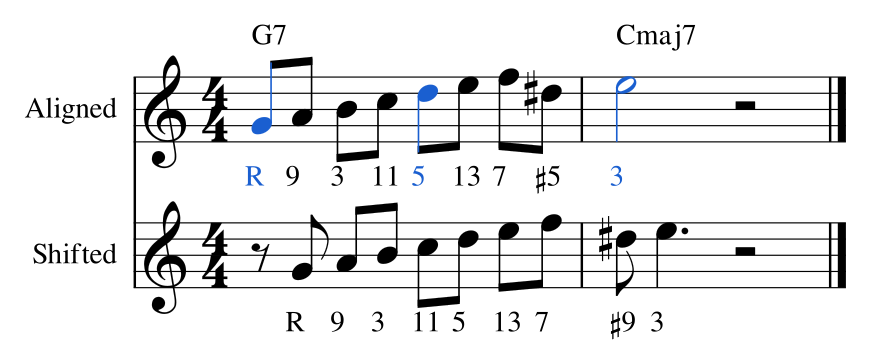
Play both against a G7–Cmaj7 backing track. The shifted version has no wrong notes; every pitch is in the scale. It's rhythmically wrong. The harmony and the line disagree about where the strong points are, and the line loses. This is the most common reason that a student's correct scale playing doesn't sound like jazz.
How to read the examples
Every example in this book is notated the same way.
- Chord symbols sit above the staff. A chord holds until the next symbol.
- Blue notes are arrivals: structural landing points, almost always on beat 1 or beat 3.
- The numbers under each note name its function against the chord sounding at that moment. R, 3, 5 and 7 are chord tones; 9, 11 and 13 are tensions; ♭ and ♯ mark altered tones. Δ7 is a major 7th over a chord whose own 7th is minor, which is how chromatic passing tones usually show up. On 6 chords, 6 is a chord tone.
- Eighth notes are written straight and played swung (Chapter 8).
Read the numbers along with the notes. Within a few chapters you'll see the pattern before you read it: chord tones on the beats, color on the upbeats, and every & of 4 leaning into the next bar.