 Playable Books
Hector Berlioz · section 33 of 67
The Bugle
Read and hear this section in the playable edition →We coneizde the discussion of the wind instruments with a few words concerning che bugle family.
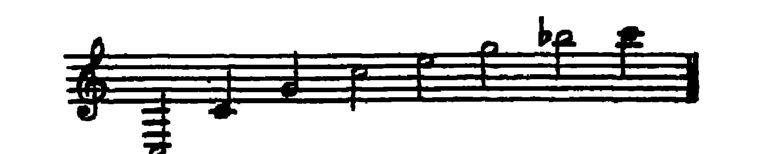
Tle simple bug:e is written in the G-clef like the tranpet and has altogether eight tones:
ably the most that one could expect from it.
Since its tube is much shorter than that of the trumpet, the bugle has only the tones of the three lower octaves of the latter:

The highest of these, C. can be produced almost only on the lowest bugle; and the lowest tone is of very poor quality. This instrument exists in three keys—B?, C and E+: other keys are very rare. The flourishes played on it. consisting exclusively of the three notes of the common chord. are necessarily of a boring uniformity bordering on vulgarity. The tone of this instrument is not very pleasant, it has no distinction, and it is hard to play on it in tune. Since it cannot execute diatonic successions. trills are of course impossible.
Bugles appear to me to held no higher rank in the hierarchy of brass instruments than the fifes do among the wood-wind instruments. At best. both can serve the purpose of leading recruits to the parade, although in my opinion our soldiers—old or young—ought never to listen to such music: for there is no reason why they should become accustomed to the vulgar. However, since the tone of the bugle is very strong, there might be some occasion for using it in the orchestra; for instance, to reinforce some terrible outcry of simultaneously played trombones, trumpets and horns. This is prob-
On account of the small length of its tube, these notes sound an octave higher and are therefore written as follows:
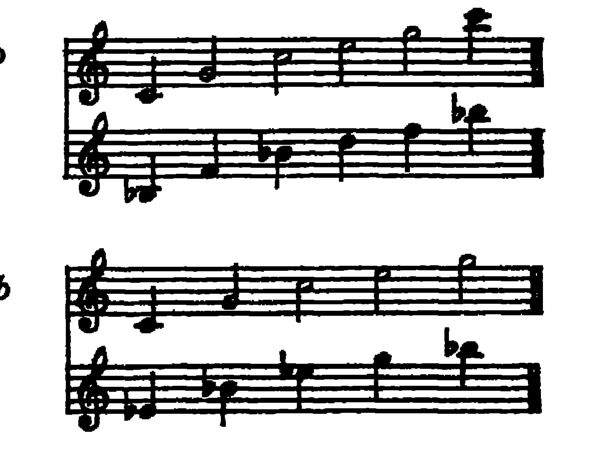
Consegently the bugle in C is a non-transposing instrument; bugles in B® and E> are transposing and are written like trumpets in B® and Eb:
Bugle in Bb
The rey bugle
In cavalry music and even in some Italian orchestras one finds bugles with seven keys, which have a chromatie range of more than two octaves:
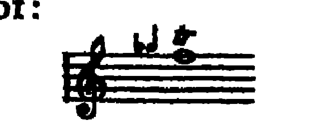
The bugle can execute trills on all tones of its scale,
with the exception of: +
It does not lack agility, and some artists play it excellently; but its tone is exactly like that of the plain bugle.