 Playable Books
Hector Berlioz · section 46 of 67
The Keyboard Harmonica
Read and hear this section in the playable edition →(Glass Harmonica) -
This instrument is of the same type as the preceding; its hammers, however, strike glass plates. Its sound is of an extremely voluptuous delicacy and might be used in the most poetic effects. Its tone, like that of the keyboard with steel bars, is very weak. This fact should be kept in mind when it is to be combined with other orchestral instruments. The slightest forte accent of the violins would cover it completely. It would blend better with a light accompaniment in pizzicato or in harmonics, or with some very soft tones of the flutes in their medium range.
The keyboard harmonica sounds as it is written. It can scarcely be given a range of more than two octaves.
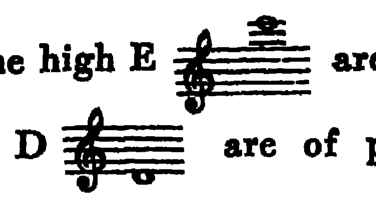
All tones above the high E — are scarcely audible and those below D — are of poor quality and even weaker than the rest of the scale. This shortcoming
might perhaps be remedied by using stronger glass plates for the low range.
Pianoforte manufacturers usually also build this charming and too little known instrument. It is written on two staves and in two G-clefs.
It should not be necessary to add that the manner of playing these two little keyboard instruments is the same as that on the pianoforte and that one can write for them (of course within the limits of their range) the same runs, arpeggios and chords as one would for a tiny pianoforte.
The Celestia, invented by Mustel in Paris, is an important addition to the orchestra. It may be considered an improved Glockenspiel, provided with a keyboard; its tone, produced by stee] plates, is similar both to the Glockenspiel and to the harp. Its range is five octaves. Its beautiful sound is frequently utilized by modern French and Russian composers, but older works benefit by it as well (e.g. Papageno’s aria in ‘“Zauberfloete’’),.
G. Charpentier in particular has combined it very subtly and effectively with other soft orchestral colors in his opera “Louise”.