 Playable Books
Hector Berlioz · section 61 of 67
The Concertina
Read and hear this section in the playable edition →This is a small instrument with metal tongues which are vibrated by a stream of air. The concertina and later the melodium developed from the accordion, which was popular as a musical toy for a number of years. The timbre of the concertina is penetrating and soft at the same time; in spite of its weakness it carries quite far. It combines well with that of the harp and the pianoforte, and still better with that of the melodium, the present head of this family. This latter combination, however, would be of little use because the sound of the melodium is too similar to that of the concertina and produces the same effects as well as some additional ones not possible on the concertina.
The concertina is a small expansible box, held horizontally between both hands and compressed and expanded alternatingly. It is played by means of buttons which, when pressed with the finger tips, open valves which admit a stream of air to a series of metal tongues. The air is furnished by bellows between the two side-walls of the instrument, which carry the buttons on the outside and the vibrating tongues inside. The bellows, having no valve, can be filled and emptied only through the valves of the metal tongues, which inhale and exhale the air necessary for the vibration of these tongues.
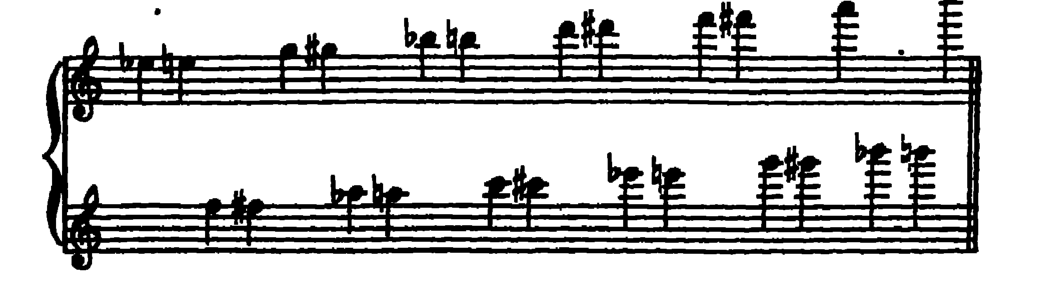
Besides being related to the melodium, the concertina has a complete, small family of its own. There is a bass, alto and soprano concertina. The bass concertina has the range of the violoncello, the alto concertina that of the viola, and the soprano concertina that of the violin. The soprano concertina is almost the only one in use. Owing to the popularity of this instrument in England, it is also called the English concertina, In the first three octaves of the two chromatic scales—one of which is played on the right side, the other on the left side of the instrument (cf. the table of ranges below)—the manufacturer established enharmonic intervals between the Ab and G# and between Eb and D# by giving the Ab and Eb a somewhat higher pitch than the G# and D#; this is in accordance with acoustical theory but contrary to musical practice. It is a strange anomaly.
Being an instrument with fixed tones like the pianoforte, the organ and the melodium, the concertina should, of course, be tuned in equal temperament like these instruments. Because of the enharmonic tones it cannot be played in its present state together with these other instruments without producing dissonances as soon 45
the melodic phrase or the harmony cause unisons between the enharmonic A® or G#, or E® or D# of the concertina with the same, but well-tempered tones of the other instrument. On the instruments with equal temperament A> and G# as well as E> and D# are identical; not so on the concertina, Neither of the enharmonic tones Ab and G# of the concertina is in strict unison with the A> or G# of the well-tempered instrument, which holds the mid-point between the two tones of the concertina.
The different tuning of a part of its scale becomes still more annoying if the concertina plays together with an instrument with movable tones such as violin. Musical practice, musical feeling and the ear of all peoples cultivating modern music demand that in certain cases the leading tones, which are drawn upward to the higher tonic, become slightly higher than in the welltempered scale, and that correspondingly the minor seventh and ninth, drawn downward toward the tones into which they resolve, are made slightly lower.
In the following passage, for instance,
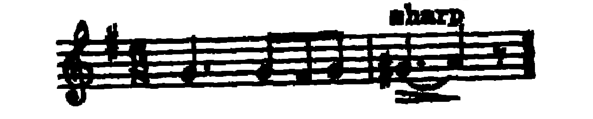
the slightly sharp G# of the violin would not be in
tune with the somewhat flat G# of the concertina. Likewise in this passage
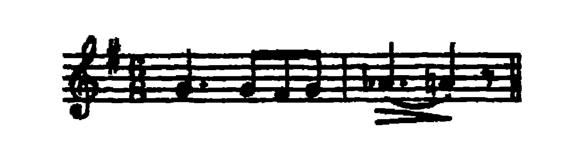
the flat AD of the violin would not correspond with the sharp Ab of the concertina (each player following a law diametrically opposed to that of the other - on the one hand the law of the calculation of vibrations and on the other the purely musical law). To effect strict unison, the violinist would have to adapt his tones tc the fixed ones of the other instrument; he would have tc play off pitch. This is actually done, but to a Jesse degree—uneonsciously and without offending the ear— when the violin plays with a pianoforte or with othe: well-tempered instruments, To be sure, the system of th English concertina might be reconciled with the systen of raised Jeading tones and of lowered sevenths by : very odd procedure, namely, by doing the opposite o what acousticians think should be done about enharmonic tones: one would have to play A® instead of G# and vice versa. The violinist, executing the following phrase musically,
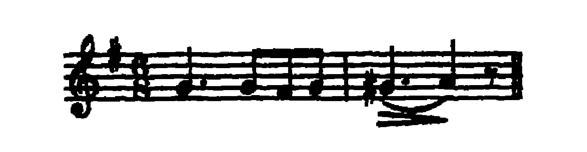
would be almost in unison with the concertina playing according to this absurd notation:
The old presumption of acousticians to impose the results of their calculations upon the practice of art is no longer tenable; for musical practice is based above all on the study of the impressions by tones on the human ear.
It is certain that music must reject them if it wants ‘to exist at all. It is equally certain that the customary modifications of intervals between two mutually attractive tones constitute extremely subtle shadings employed with the greatest care by virtuosos and singers and generally avoided by orchestral players, and that they require special treatment by composers.
Finally, it is certain that the great majority of musicians instinctively abstain from them in harmonic ensemble playing. Consequently, tones called incompatible by acousticians are entirely congenial in musical practice; relations found by calculation to be false are accepted as true by the ear, which completely disregards these very tiny differences—the opinions of mathematicians notwithstanding. There is hardly any modern score without melodic or harmonic passages written—to facilitate execution or for some other reason, frequently also without any reason at all—in a sharp key for one part of the orchestra and in a flat key for the other.
Examples




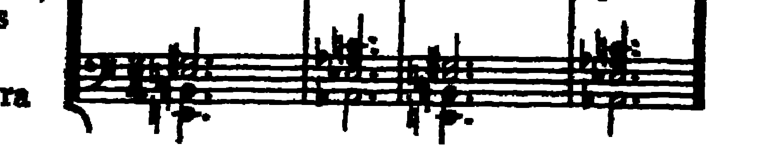
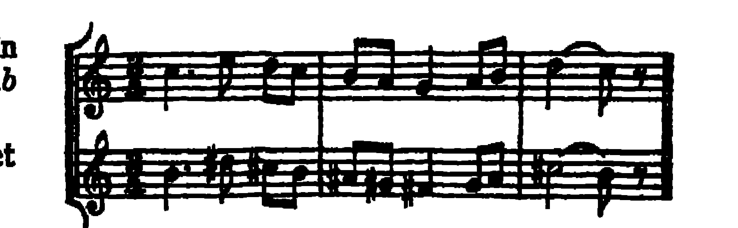
(These two instruments are in unison)
Seemingly in two different keys, of which only two tones. are enharmonically related, as in this passage from Weber’s “Freischuetz”:
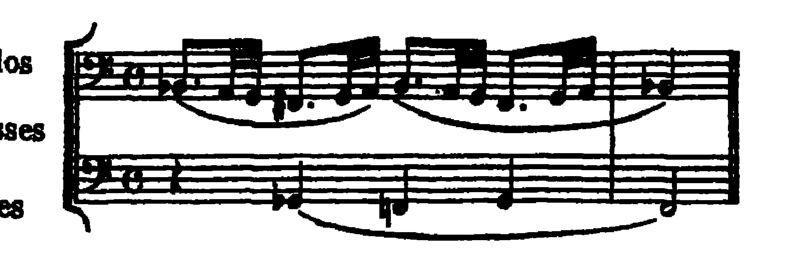
The violoncellos and double-basses seem to play in G minor with the trombones in Bb minor.
In the latter example one would doubtless notice if the violoncellos and double-basses played their F# too high and the trombones their Gb too low. But this must not happen in a good performance; the two tones will be in perfect unison in spite of their opposing tendencies, In these and many other cases the orchestra becomes one large well-tempered instrument without the players being aware of it.
In the celebrated chorus of demons in his “Orfeo,” Gluck established an enharmonic relation between two parts in an indefinite key. I mean the passage about which J. J. Rousseau ‘and others have written so much nonsense based on the supposed difference between GO and F#.
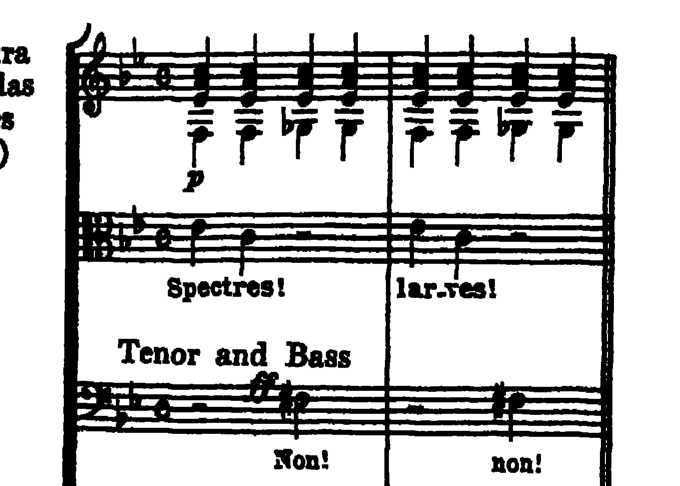
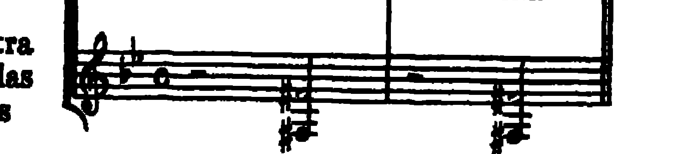
If it were a fact that the F# of the chorus and the pizzicato Gb of the basses are executed differently, an intolerable and unmusical dissonance, highly offensive to the ear, would result. In reality this phrase makes a deeply stirring and entirely musical impression upon the hearer, awakening in him feelings of terror and awe. It is true that he does not know what key he is hearing — B? minor or G minor; but he does not care. His ear is by no means offended by the combination of the different instrumental and vocal parts. The tremendous effect of the F# of the chorus and orchestra is based on the unexpected introduction of this tone and on the strange character it has within an indefinite key, but not on the alleged, harsh dissonance with the G5. It needs a naive ignorance of the effects of combined sounds not to understand that this dissonance cannot possibly be the cause of the impression, since the Gb, played pizzicato and piano by only a few basses, is necessarily covered or rather extinguished by the sudden entry of fifty or sixty men’s voices in unison and by the entire body of stringed instruments playing the F# fortissimo (coll’arco).
These insipid discussions, this idle talk of littérateurs, these absurd deductions of theoreticians, all of whom are possessed with a mania of speaking and writing about an art concerning which they know nothing, can only amuse musicians. Nevertheless, it is a pity; erudition, eloquence and genius ought always to command the admiration and respect due to them.
After this long digression I return to the English concertina; this is its barbaric scale:
Tones on the left side of the concertina

Notwithstanding the arrangement of the preceding example, the concertina is written on a single stave and in the G-clef. The trill is practicable on all steps of the scale, but it is more difficult in the lower range. The double trill (in thirds) is easy. Rather rapid diatonic, chromatic and arpeggiated passages can be executed on this instrument. It is possible to add to the main voice a second one moving approximately parallel with the melody, but not several complicated voices as on the pianoforte and organ. One can also play chords of four

The German concertina—popular also in England— is not constructed according to the system of the preceding. Its scale, which extends lower, to C and Bb:

has no enharmonic intervals; it is tuned in equal temperament.
The range of concertinas depends on the number of buttons or keys, and this changes according to the manufacturer's whims. Finally, this instrament — like the guitar — requires that the composer who wants to use it successfully should know its mechanism thoroughly and be able to play it more or less adequately.