 Playable Books
Hector Berlioz · section 62 of 67
The Melodium Organ
Read and hear this section in the playable edition →This is a keyboard instrument, like the pipe organ. Its sound, like that of the concertina, is produced by delicate metal tongues over which passes a stream of air. This stream of air is caused by a bellows and set in motion by the player’s feet. The tones of the instrument are stronger or weaker according to the force with which the feet act on the mechanism of the bellows.
Hence, the melodium organ possesses the crescendo and the decrescendo; it is expressive. One of its special mechanisms is therefore called “Régistre d’Expression.” The fingering is the same as that on the organ and pianoforte. One writes for it on two or even three staves, as for the organ. It has a range of five octaves.
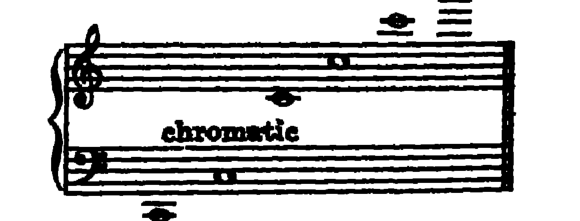
Melodiums with more than one register are not limited to this range. The number of registers varies considerably.
The simplest melodium with only one register, whose range we have just indicated, has two different kinds of tone—that of the English horn in the left half of the keyboard and that of the flute in the right half. The instruments with several registers may have—according to the intentions of the manufacturer—bassoon, cornett, flute, clarinet, fife, and oboe registers, so called because of their similarity with the instruments after which they
are named; also the Grand Jeu (full organ), the forte and expressive registers. These give the melodium a range of seven octaves although its keyboard has only five.
The player puts these registers into action by means of a mechanism similar to that of the organ; it is arranged at both sides of the keyboard and has wooden handles which are pulled out by either hand. Several other stops are obtained by a similar mechanism beneath the body of the instrument, which is moved from right to left or from left to right by the knee of the performer.
The melodium does not possess the mixture stops of the organ, whose effect excites a traditional admiration in many people, while in reality they cause terrible confusion. The melodium has only single and double octave stops, by means of which each key can play, in addition to its own tone, the single and double octave, or the double octave without the single, or even the
* higher and lower octaves of this tone.
Many ignorant players and lovers of noise make lamentable use of these octave stops. ‘This crude metho¢ is, to be sure, not as bad as the mischief done with the mixture stops of the organ; for there the two other tone: of the common chord are heard at the same time (th major third and the fifth); but it remains crude jus the same.
The resulting, unintended inversions of the chords in troduce the most frightful disorder into the harmon: (to say nothing of the thickening of the harmonic tex ture). Ninths are transformed into seconds and seventht seconds become sevenths and ninths, fifths become fourths and vice versa, and so on. To preserve true musical relations with these stops, they should be used only in pieces written in double counterpoint in the octave; but this is not done.
The introduction of these monstrosities into the organ is doubtless to be ascribed to the ignorance of the middle ages, groping blindly for the laws of harmony. They were preserved by senseless convention, and it is to be hoped that they will gradually disappear.
The tones of the melodium respond somewhat slowly, like those of the pipe organ, They are suited predominantly to the legato style of religious music and for slow, soft and tender melodies. Pieces with skipping rhythms or of violent character, written for the melodium or played on it, attest in my opinion to the ignorance of the composer or to the poor taste of the performer, or to the ignorance and tastelessness of both.
The real object aimed at and achieved by M. Alexandre was to give the melodium a dreamy, religious character and to endow it with all the shadings of the human voice and of most instruments.
The melodium is at once an instrument for the church and for the theater, for the drawing-room and
for the concert hall. It occupies little space ana is easily movable; hence, it is of indisputable utility to composers and amateurs. Since Meyerbeer, Halévy and Verdi have used the organ in their dramatic works, bow many provincial theaters of ‘France and even Germany have found difficulties in performing these works, and how many mutilations and more or less clumsy rearrangements of the scores have been caused by the lack of an organ! Nowadays theater managers have no longer an excuse to tolerate this, for the missing organ can be replaced easily and at moderate cost by the melodium. The same applies to small churches where music hitherto has not been available at all. A melody played there by a sensitive musician can and will awakes a feeling for harmony and will do away with the grotesque howling which now takes the place of singing in the religious service. - The melodium‘is well suited to arrangements of symphonic works with piano, violin and violoncello, as a substitute for the wind instruments. This combination is very popular with French families for house music; it is definitely preferable to the piano duets customary in Germany.