 Playable Books
Hector Berlioz · section 66 of 67
On Conducting
Read and hear this section in the playable edition →Theory of the Art of Conducting
Music is probably the most exacting of all arts and certainly one of the most difficult to cultivate. Its works are rarely presented to us under conditions which allow their true value to be recognized and their character and meaning to be completely discerned.
Among creative artists the composer is almost the only one depending upon a host of intermediaries between him and the public—intermediaries who may be intelligent or stupid, friendly or hostile, diligent or negligent. It is in their power either to carry his work on to brilliant success or to disfigure, debase and even destroy it..
Singers are often considered the most dangerous of these intermediaries; I believe that this is not true. In my opinion, the conductor is the one whom the composer has most to fear. A bad singer can spoil only his own part, but the incapable or malevolent conductor can ruin everything. A composer must consider himself happy if his work has not fallen into the hands of a conductor who is both incapable and hostile; for nothing can resist the pernicious influence of such a person. The most exeellent orchestra becomes paralyzed, the best singers feel cramped and fettered, all energy and unity are lost. Under such direction the noblest and boldest inspirations can appear ridiculous, enthusiasm can be violently brought down to earth; the angel is robbed of his wings. the genius is transformed into an eccentric or a simpleton, the divine statue is plunged from its pedestal and dragged in the mud. Worst of all, when new works are performed for the first time, the public and even listeners endowed with the highest musical intelligence are unable to recognize the ravages perpetrated by the stupidities, blunders and other offenses of the conductor.
For all the obvious shortcomings of a performance the conductor is not blamed; his victims shoulder the burden. If he misses the entry of the chorus in a finale, if he causes a wavering between the chorus and orchestra or between distant groups in the orchestra, if he drags or rushes the tempo, if he interrupts a singer before the end of a phrase, people say: “The chorus is terrible, the orchestra lacks assurance, the violins have spoiled the melodic line; nobody has vigor and fire, the tenor has made mistakes, he does not know his part; the harmonies are confused; the composer does not know how to write accompaniments for singers, ete., ete.”
Only when he is listening to familiar and recognized masterworks can the intelligent listener distinguish the real culprit and do justice to the other partners in the performance. However, the number of such listeners is still so small that their opinion carries but little weight. Thas, the incapable conductor maintains himself with all the calm of a bad conscience in the presence of a public that wonld hiss an excellent singer pitilessly at the slightest vocal mishap.,
Fortunately I am now speaking only of exceptions: capable or incapable conductors who are at the same time malevolent are very rare.
The conductor who is willing but incapable, on the other hand, is very common. There may be some doubt regarding the good faith of the many mediocre conductors who frequently have to conduct artists far superior
to themselves. But nobody will accuse an author of conspiring against the success of his own work, and yet there are many composers who unknowingly ruin their best scores because they fancy themselves to be great conductors.
Beethoven, it is said, more than once spoiled performances of his symphonies, which"he liked to conduct even at the time when his deafness had become almost ccmplete. In order to keep together, the musicians finally agreed to follow the slight signs of the concertmaster and to ignore Beethoven’s baton. Moreover, it should be remembered that conducting a symphony, an overture or any other composition with extended movements which contain few changes and contrasts is child’s play in comparison with conducting opera and other works containing recitatives, arias, and numerous orchestral passages interspersed with irregular pauses. The example of Beethoven just cited shows that the direction of an orchestra, very difficult for a blind man, is entirely impossible for a deaf one, whatever may have been his technica] skill before he lost his hearing.
The conductor must see and hear, he must be resourceful and energetic, he must know the nature and the range of the instruments and be able to read a score. Besides the specific talent whose component qualities we are going to discuss he must have other, almost indefinable gifts, without which the invisible contact between him and the performers cannot be established. Lacking these, he cannot transmit his feelings to the players and has no dominating power or guiding influence. He is no longer a director and leader, but simply a time-beater, provided he is able to beat and divide time regularly.
The players must feel that he feels, understands and is moved; then his emotion communicates itself to those whom he conducts. His inner fire warms them, his.enthusiasm carries them away, he radiates musical energy. But if he is indifferent and cold, he paralyzes everything around him, like the icebergs floating in the polar sea, whose approach is announced by the sudden cooling of the atmosphere.
The conductor's task is very complex. He must not only be able to conduct a work with which the performers are familiar, according to the intentions of the camposer, but also, in the case of a new work, to make them acquainted with it. During the rehearsals he has to point out to each of the performers his mistakes and errors. He must be able to employ the resources at his disposal so as to secure the greatest result from them in the Shortest time possible; for, in most cities of Europe. musical art is in a sad plight. Musicians are poorly paid and the necessity of thorough study is so little under stood that the economical utilization of time is one of the most imperative requisites of the conductor’s skill. —Let us now see what constitutes the mechanical aspects of his art,
While not requiring particularly outstanding musical qualities, the art of beating time is nevertheless rather difficult to learn; very few people really possess it. The signs which the conductor makes are generally very simple, but they may occasionally become quite complica- ted by the divisions and subdivisions of the meter. The conductor must above all have a clear idea of the main features and the character of the work to be performed so that he can determine without hesitation and error the tempi planned by the composer. Unless he had the opportunity of receiving instructions directly from the composer or is familiar with the traditional tempi, he must consult the metronomic indications and study them thoroughly. Most modern composers mark compositions at the beginning and whenever there is a change of tempo. I do not mean to say by this that it is necessary to imitate the mathematical regularity of the metronome, which would give the music thus executed an icy frigidity; I even doubt whether it would be possible to maintain this rigid uniformity for more than a few bars. The metronome is nevertheless an excellent medium for determining the initia] tempo of a piece and its main alterations.
If the conductor has neither the instructions of the composer nor traditional or metronomic tempo indications—as is frequently the case with works written before the invention of the metronome—he has no other guide than the customary, very vague tempo markings; for the rest he must rely on his own instinct and his feeling for the composer's style. To be sure, it cannot be denied that these guides are frequently insufficient or misleading. This is proved by the manner in which older operas are given in towns where the tradition for these works has been lost. Out of ten different tempi at least four will be wrong.I once heard a chorus from “‘Iphigénie en Tauride” performed in a German theater; instead of Allegro non troppo in 4-4 time it was played Allegro assai in 2-2 time, i.e twice as fast. I could quote an immense number of similar mistakes caused either by the ignorance and negligence of the conductor, or by the fact that sometimes it is really very difficult even for the most talented and careful man to discover the exact meaning of the Italian tempo marks. Of course, nobody will fail to distinguish a Largo from a Presto. If the Presto has two beats to a bar, an intelligent conductor, by examining the passages and melodic designs contained in the piece, will soon find the degree of speed intended by the author. But with a Largo in 4-4 time and of simple melodic design, what means has the unfortunate conductor of discovering the correct tempo? The different degrees of slow movement that may be used for such a Largo are very numerous; only the individual feeling of the conductor can be the guide in such a case, although what matters most is the composer’s rather than the conductor's feelings. Therefore, composers ought not to neglect furnishing their works with metronomic indications, and it-is the conductors’ duty to study them closely. To neglect this study is equal to an act of dishonesty toward the composer.
We now assume that the conductor is thoroughly familiar with the tempi of the work to be performed or rehearsed. His next task is to impart the rhythmic feeling within him to the orchestral players, to determine the duration of each bar and to make all participants observe this duration uniformly. This precise and uniform collaboration of a more or less large orchestral or choral body can be attained only by means of certain signs given by the conductor.
These signs indicate the main divisions—the beats.
of each bar, and frequently also the subdivisions—the half beats. It is not necessary to explain the difference between the strong and weak beats; I assume that I am writing for musicians.
The orchestral conductor generally uses a small light stick, about 20 inches long (better white than of dark color, for the sake of visibility). He holds it in his right hand and distinctly marks with it the beginning, the divisions and the close of each bar. Some concertmasters use the violin bow for conducting, but it is less suitable than the baton. The bow is somewhat flexible; this lack of rigidity and the greater resistance it offers to the air because of the hair make its movements less precise.
The simplest of all meters—iwo in a bar—is indicated very simply, After raising the baton so that the hand is on a level with his head, the conductor marks the first beat by dropping the point of the baton perpendicularly (as far as possible by bending the wrist and not by moving the entire arm) and the second beat, in the opposite way, by raising it again:
The meter with one beat in a bar is, especially from the conductor’s point of view, the same as a meter with two beats in a very rapid tempo; therefore, it is indicated like the preceding. The necessity of raising the point again after lowering it divides the movement in two anyway.
With four beats in the bar, it is customary to mark the first strong beat (the beginning of the bar) by a downward movement. The second movement of the baton diagonally upward from right to left marks the second (the first weak) beat. The third, horizontally from left to right marks the third-(the second strong) beat and a fourth movement diagonally upward marks
the fourth (the second weak) beat. These four movements result in this figure:
It is important that the conductor uses his arm as little as possible for these movements and consequently does not let the baton cover too much space; for each movement must be almost instantaneous or, at least, should occupy a moment so short as to be practically incommensurable. If the time interval becomes appreci~ able, it canses—since it is repeated many times— a retardation of the intended tempo and a very unpleasant heaviness in the orchestral performance, Moreover, this mistake has the result of needlessly tiring the conductor, and of producing exaggerated; almost ridiculous move~ ments of the body, which distract the attention of the listeners.
In a bar with three beats, the first downward movement is customary for marking the first beat; but there are two ways of marking the second. Most conductors beat from left to right:
some German conductors, however, do the contrary and carry the baton from right to left:
If the conductor has his back turned to tHe orchestra, as is customary in theaters, the latter method has a disadvantage in that only few players can see this very important marking of the second beat since the body of the conductor hides the movement of his arm. The other method is better because the second movement is outwards and the baton therefore remains perfectly visible to everybody, especially if the conductor raises it slightly above the level of his shoulders. If the conductor faces the orchestra, it is immaterial whether he makes the second. movement to the right or to the left. The third beat is indicated in all cases by a diagonal, upward movement, like the last beat in 4-4 time:
The meters with five and seven beats in a bar are not indicated by special series of gestures, but are treated as combinations of simple meters: the five beats as consisting of three and two beats, and the seven as four and three. They are therefore marked as follows:
These divisions of the various meters are suited for moderate tempi. However, if the tempo is very fast oF very slow, this method would be inadequate. As we have already seen, two beats in a bar can be marked only as shown above, however fast the tempo. On the other hand,
if the tempo is exceptionally slow, the conductor has to subdivide each beat. A very rapid four in a bar should be marked by only two movements, since the four movements as used in moderate tempo would follow each other so rapidly that the eye could not follow them clearly; the players would be irritated rather than made secure. Moreover, and this is even more important, the conductor checks the rhythmic flow by the unnecessary four motions and loses all freedom of movement which he would retain with the simple division of the bar into two halves.
In such cases it is usually wrong for composers to indicate a 4-4 meter. When the tempo is very fast, they should always use the time signatare ( and notC, which is misleading.
Triple time, ic. rapid 34 and 34 meter, is treated similarly. The conductor does not mark the second beat, holding the first gesture for two periods and raising his baton only on the third beat:
It would be ridiculous to mark all three beats in a Beethoven Scherzo,
If the tempo is very slow, each beat must be subdivided; consequently, quadruple time is marked by eight movements, triple time by six movements, by repeating each of the previously indicated main movements in abbreviated form:
triple meter ad
The arm should not take part in‘the short supplementary gestures marking the subdivisions of the bar; these are carried out by the wrist alone.
The purpose of this subdivision of the beats is to prevent rhythmic divergences which could easily arise in the orchestra during the intervals between two beats. If the conductor gives no sign at all during this long interval (which is unusually extended because of the slow tempo), the orchestra is left to itself for too long a time. Since not all players have the same rhythmic feeling, some will rush while others drag behind, and the ensemble will soon be destroyed. The only exception from this rule is a first-rate orchestra composed of virtuosos knowing each other very well and accustomed to play together, and who know the work to be performed almost by heart. Even then the carelessness of a single player may cause a mishap; why incur such a risk? I know that it hurts the vanity of some artists to be thus kept in leading-strings (like children, as they say); but with a conductor whose main aim is the excellence of the performance such considerations should have no weight. Even in, a quartet the individual feeling of the players can rarely be allowed to follow its own paths. In a symphony the conductor’s conception alone must rule. The quality of the performance depends on his conception and on the art of realizing it; the feelings of the individual players must never make themselves manifest.
Once this is clearly understood it becomes obvious that in very slow compound meters (such as 6/4, 6/8, 8/9, 12/8 ete.) the subdivision is even more important. These meters with triple time can be divided in various ways. If the tempo is rapid or moderate, only the simple beats are indicated according to the procedure adopted for the analogous simple meters. Hence, a 6/8 Allegretto or 6/4 Allegro requires a beat similar to duple meters (@ or 2 or 2/4); 9/8 Allegro—like 8/4 Moderato or 8/8 Andantino; 12/8 Moderato or Allegro—like 4/4. But
if the tempo is Adagio, Largo assai or Andante maestoso, °
all eighths-notes (or a quarter followed by an eighthnote) require beats, according to the form of the melody or the predominant figuration.

In this triple meter it is unnecessary to mark all eighth-notes; the rhythm of a quarter plus am eighthnote to a beat is sufficient. One uses the little supplementary gestures indicated for subdivisions of simple meters, dividing each beat, however, into two unequal parts because it is necessary to mark the value of the quarter as well as of the eighth-note.
If the tempo is still slower, all eighth-notes require beats regardless of the meter; only thus can uncertainty be avoided and complete mastery assured.


With the indicated tempi, the conductor will beat in the 6/8 meter three eighths to each time unit, ie. three beats down and three beats up:
in the 9/8: three down, three to the right, three up:
in the 12/8: three down, three to the left, three to the right, three up:
Sometimes a difficulty arises if certain voices in a score are given a triple rhythm for the sake of contrast, while the others continue in duple rhythm:
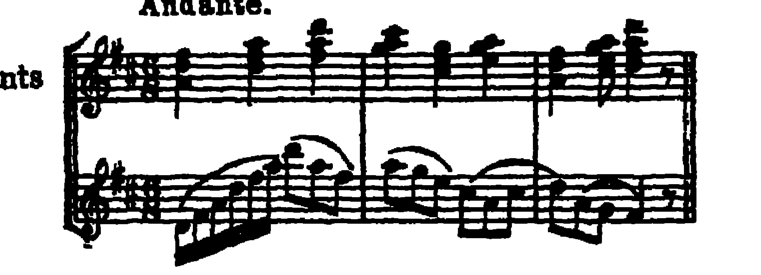
‘Wind instruments
If the players of the wind instruments are very musical, there will be no need to change the manner of marking the bar and the conductor can continue to beat six or simply two. The majority of players, however, usually become uncertain when the syncopation begins and the triple rhythm clashes with the duple; they need assistance, which can be given to them in the following manner. The uncertainty in a group of performers caused by the sudden entry in a group of performers caused by the sudden entry of this unexpected rhythm conflicting with that of the rest of the orchestra always makes them look instinctively at the conductor, as if seeking his assistance. He should also look at them, turning a little toward them and marking the triple rhythm by small movements of his hand (as if this were the real meter); but this must be done in such a fashion that the violins and other instruments continuing the duple rhythm cannot see the altered beat, which would otherwise confound them completely. Thus, the new triple rhythm, being marked fartively by the conductor, is executed with assurance, while the duple rhythm, already firmly established, continues without difficulty although no longer indicated by the conductor.
On the other hand, in my opinion nothing is more objectionable and contrary to good musical sense than the application of this method where not two different and contrasting rhythms clash, bat where simple syncopation is introduced. If the conductor divides the bar according to the number of accents in it, he destroys the effect of the syncopation for all listeners who see him, substituting an ordinary change of time for a rhythm of stimulating charm. Such is the case in. the following passage from Beethoven's Pastoral Symphony if the conductor marks the accents instead of the beats:.
by making six movements to a bar, as indicated above the notes, instead of the four previously maintained; only the latter enable the listener to recognize and. feel the syncopation clearly:
This voluntary submission to a rhythmical form which the composer actually intended to be resisted is one of the gravest stylistic mistakes a conductor can make.
Another difficulty, extremely troublesome to the conductor and requiring all his presence of mind, is caused by the combination of different meters. It is easy to conduct a duple meter, each of whose beats is subdivided in two, together with a superimposed duple meter whose beats are divided in three, if both have the same tempo. Their bars have the same duration and it is only -necessary to divide them in half and to mark the two principal accents:
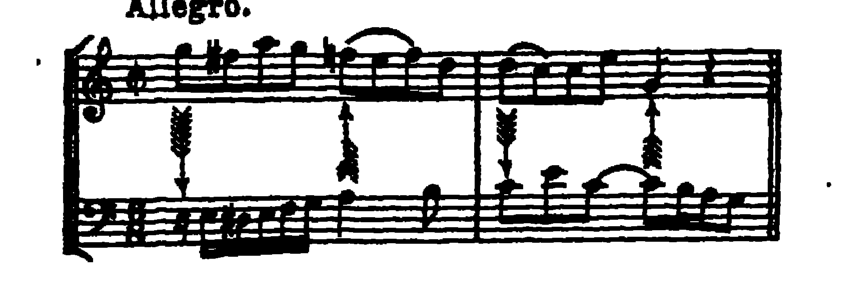
However, if a new, fast figure is introduced into a slow movement and if the composer has adopted for this new tempo the corresponding, short bar (either to facilitate the execution of the fast tempo or because it could not be written otherwise), two or even three of these short bars may then coincide with one bar of the slow movement:

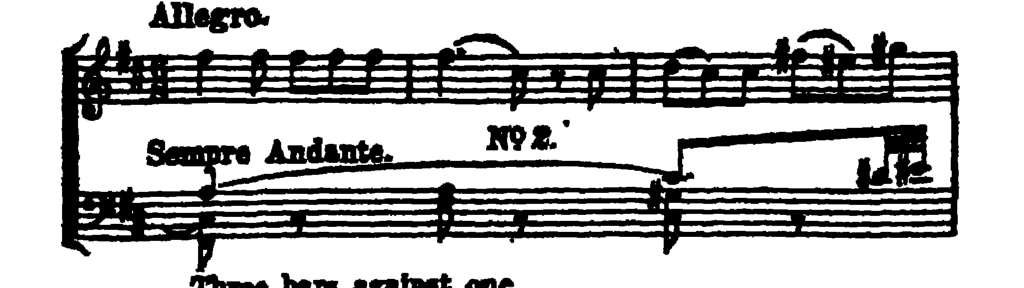
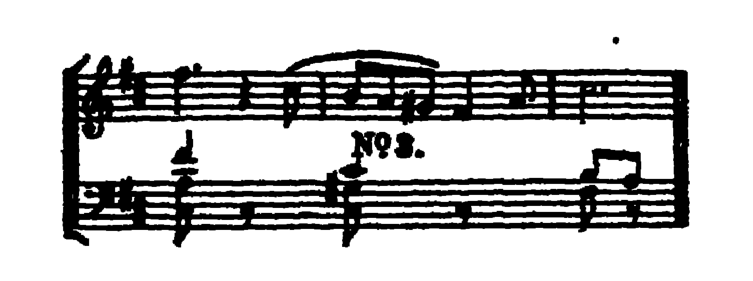
even more markedly. The players of the Allegro 6/8 will understand that the two gestures represent the two beats of’ their short bar, while the players of the Andante take these same gestures merely for a divided beat of
their long bar.
Bars No.
One sees, this is really quite simple because the divisions of the short bar coincide with the subdivisions of the long bar. The following example, however, in which a slow bar is superimposed over two short ones, but without this coincidence, offers greater difficulties:
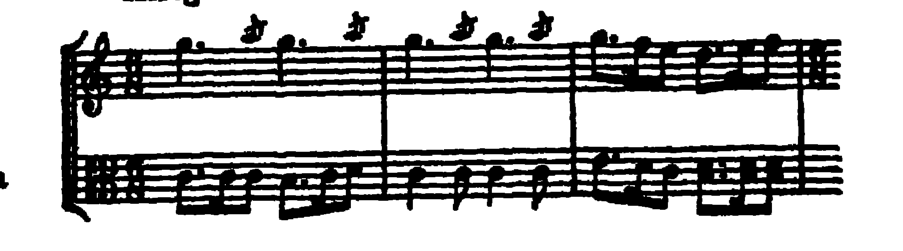
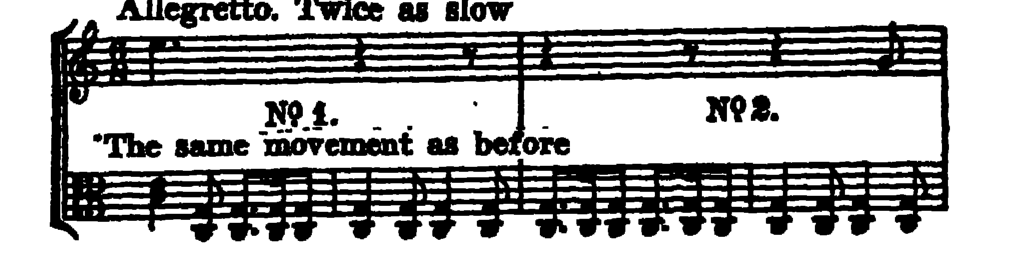


Here the three bars of the Allegro assai preceding the Allegretto are conducted as usual, two 9 a bar. When the Allegretto begins, the conductor marks two divided beats for the long bar with two (unequal) movements down and two up:
The two large movements of the conductor divide the long bar in half and indicate its value to the oboes without confusing the violas, who maintain their fast movement supported by the shorter, subsidiary gestures dividing the short bar in half. From bar 8 on, the conductor ceases to divide the long bar in four because of the triple rhythm of the 6/8 melody entering here, with which this gesture would interfere. He confines himself to marking the two beats of the long bar. The violas, already accustomed to their fast rhythm, continue it without difficulty knowing that each movement of the baton marks the beginning of their short bar.
The preceding shows that subdividing a beat must be avoided if a part of the instruments or voices execute triplets on this beat. Such a division cutting through the second note of the triplet would make its execution insecure or actually impossible. The division should be avoided even a short time before the start of a triple rhythm or of a melody in triplets in order not to give the performers the feeling of a rhythm contrary to the one they are to execute,.
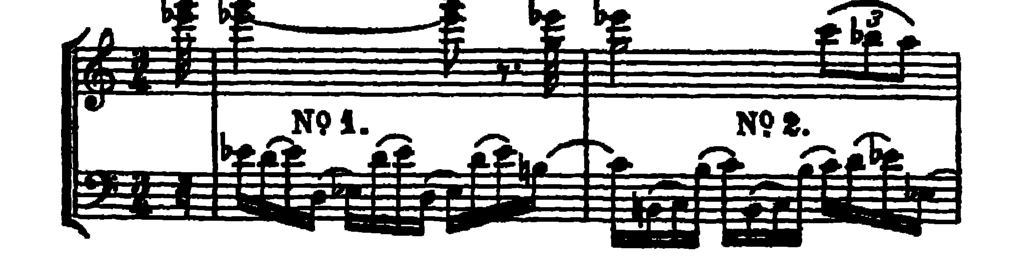


In this example it is advisable to divide the entire bar No. 1 in six, i.e. to’ subdivide each beat in two carrying out the following movements:
With the beginning of bar No. 2 it is necessary to omit the subdivision and to carry out only the simple move-
because of the triplets entering on the third beat, which would be impeded by the double movement. In the famous ball scene in Mozart’s “Don Giovanni”, where three orchestras in three different meters are combined, the difficulty of holding them together is not as great as might be assumed. It is sufficient to mark each beat of the Tempo di menuetto by a downward movement:

Once brought together, the two Allegros—the small one in 8/8 whose whole bar is a third (i.e. one beat) of the minuet bar, and the other in 2/4, whose bar is two thirds (ie. two beats) of the minuet bar—fit together as well as with the main theme and proceed together without the slightest difficulty. The main thing is to make them enter correctly.
A gross fault that I have seen committed consists in slowing up the tempo of a piece in duple meter when triplets in half-notes occur:
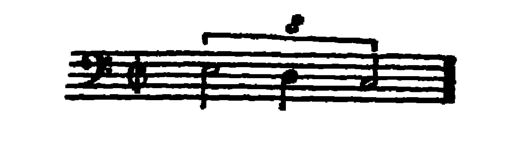
The third note adds nothing to the duration of the bar, as some conductors seem to imagine. They may mark such passages with three beats if the tempo is slow or moderate, but the duration of the whole bar must remain exactly the same. If triplets occur in a very short bar in duple meter (Allegro assai), three beats would cause confusion. Only two should be marked—one down on the first note, the other up on the third, Owing to the quickness of the movement the two beats differ little from those of the bar with two equal beats and do not affect the execution of the parts continuing in duple meter.
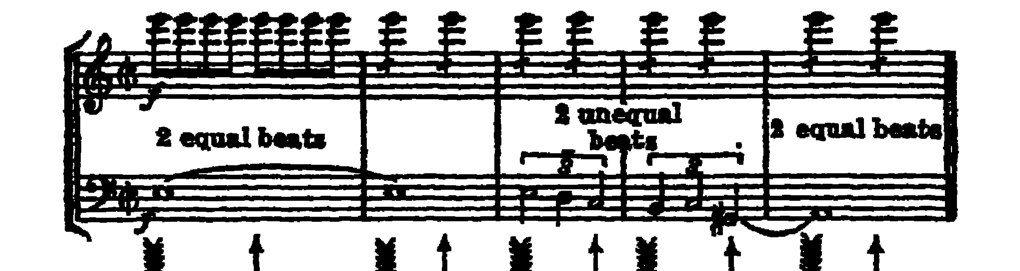
We shall now consider the method of conducting recitatives. Here the singer or instrumentalist is not confined to the regular divisions of the bar. The conductor must therefore follow their recitation attentively and must see to it that the chords and other instrumental passages inserted in the recitative are executed precisely and uniformly by the orchestra. If the recitative is accompanied by sustained notes or a tremolo in several voices and the harmony changes, he must indicate the change at the proper moment; sometimes the least conspicuous of the voices is the one whose progression changes the harmony and on which the conductor must therefore concentrate his attention.
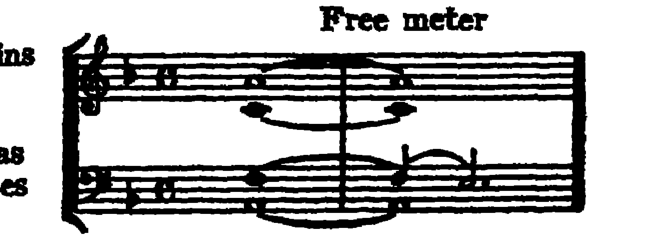
In this example the conductor, while following the reciting, metrically free part, must also watch above all the viola part and make it move from F to E at the correct moment at the beginning of the second bar. Since this part is exeeuted by several players, some might hold the F longer than others and thereby cause a@ momentary dissonance.
Many conductors have the habit of completely disregarding the written divisions of the bar when conducting recitative; they mark an up-beat on a heavy beat if it-precedes a short chord of the orchestra, even if this chord comes on a weak beat:
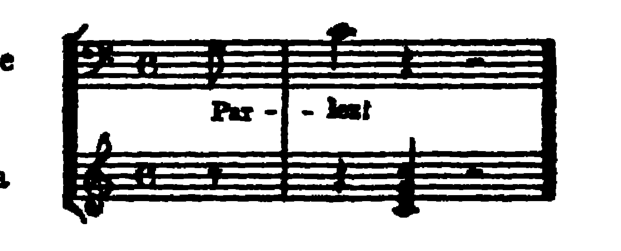
In a passage such as this they raise the baton on the quarter-rest at the beginning of the bar and lower it on
the second beat to mark the entry of the chord, I cannot,
approve this absolutely unjustifiable method; it may frequently cause mishaps in the execution. I cannot see why in recitatives the bar should not be divided regularly and the real beats be marked in their proper place as in music played strictly according to meter. I therefore recommend marking the first beat in the preceding example with a downward motion, as usual, and to move the baton to the left with the entry of the chord on the second beat; and accordingly in other, similar cases, always dividing the bar regularly. It is also very important to divide it according to the tempo previously indicated by the composer; if it is an Allegro or Maestoso and the reciting voice has sung for some time without accompaniment, one mast not forget when the orchestra - ye-enters to give each beat its proper value in an Allegro or Maestoso. If the orchestra plays by itself, it usually does so in strict time; it plays in irregular meter only when accompanying a reciting voice or instrument. In the exceptional case where the orchestra or chorus itself or part of them have to execute a recitative and where it is thus essential to keep a certain number of performers (im unison or in several parts) uniformly together although not in strict time, the vonductor himself becomes the real reciter, giving to each bar the duration he considers to be correct. According to the form of the phrase, he sometimes marks the main beats, sometimes the subdivisions, sometimes the accents, sometimes the sixteenthnotes; in short, he designs with his baton the melodic form of the recitative. Of course the performers must know their music almost by heart and keep their eyes constantly on him; otherwise, no security or precision is possible.
Even with music in strict time, the conductor must generally insist that the players look at him as often as possible. An orchestra which does not watch the conductor’s baton has 20 conductor. For instance, frequently after a pause the conductor is forced to wait before marking the re-entry of the orchestra until he sees the eyes of all performers fixed upon him. It is his task to accustom them during rehearsals to look at him simultaneously in all decisive moments.
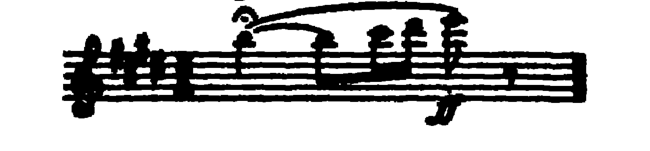
Since in the preceding example the first note is in- : definitely prolonged by the pause, the notes following it eannot be executed with the necessary verve and precision if this rule is disregarded; for without looking at the baton the performers cannot know when the conduc-
tor proceeds to the second beat and resumes the tempo momentarily suspended by the pause.
The obligation on the part of the performers to look at the conductor implies an equal obligation on his part to make himself visible to all of them, Whatever the arrangement of the orchestra may be, whether on steps or on a horizontal plane, the conductor must select his place so that he can be seen by everybody. The greater the number of performers and the larger the space occupied by them, the higher must be his place. His desk should not be too high lest the board carrying the score hide his face. For his facial expression has much to do with the influence he exercises. If a conductor practically does not exist for an orchestra unable or unwilling to look at him, he exists just as little for one unable to see him completely.
Noises caused by striking the desk with the stick or by stamping feet are to be banned completely; they are not only inexpedient, they are crude. Only if the chorus is unable to see the baton because of some stage action, the conductor is forced—for the sake of a secure entry by the chorus—to mark the beat preceding the entry by a slight tap of his baton on the desk. This is the only exception warranting the employment of an audible signal in conducting; even then the necessity of using it is to be regretted.
While speaking of choral singers and their operations on the stage we may mention that chorus masters often allow themselves to beat time backstage without being able to see the conductor’s baton or even to hear the orchestra. Hence this arbitrary time, beaten more or less badly, cannot correspond with that of the conductor and causes a rhythmic discrepancy between the chorus and the orchestra; instead of aiding cooperation it impedes it.
There is another traditional barbarism which every intelligent and energetic conductor should abolish. For choral or instrumental pieces which are to be executed behind the scenes, sometimes without participation of the main orchestra, a second conductor is indispensable. If the main orchestra accompanies this group, the first conductor, who hears this music from the distance, is strictly bound to let hiniself be guided by the second conductor and to follow his lead by ear. But if—as frequently happens in modern music—the full sound of the large orchestra prevents him from hearing the backstage music, the application of a special mechanism transmitting the meter becomes necessary to establish an instantaneous communication between the conductor and the distant performers. For this purpose a number of more or less ingenious experiments have been carried out, whose results have not always met expectations. Only the electric metronome set up by Verbrugghe in the Brussels theater leaves nothing to be desired. It consists of copper wires attached to a voltaic pile placed beneath the stage; these wires connect the conductor's desk with a movable baton attached by a pivot in front of a board which is placed at any desired distance from the conductor. The desk is furnished with a copper key similar to a piano key, which has at its bottom a small protuberance of about a quarter of an inch. Immediately under this protuberance is a little copper cup filled with quicksilver. When the conductor wants to mark a beat, he presses the copper key with the forefinger of his left hand (his right hand holds the baton, as usual), whereby the protuberance makes contact with the quick- silver. The electrical connection thus effected mfakes the baton at the other end of the wires oscillate. The electrical contact and the movement of the baton take place simultaneously, regardless of the distance. The musicians behind the scenes watching the electric baton are thus practically under the immediate direction of the conductor, who might, if it were necessary, conduct from the middle of the Opéra orchestra in Paris a performance taking place in Versailles. It is only necessary to agree beforehand with the chorus singers or with their conductor (if there is one, as an additional precaution) on the manner of beating the time: whether the conductor is to mark all main beats or only the first beat in each bar. For the oscillations of the electric baton, taking place in only one direction, give no precise indication in this respect.
When I first used this valuable instrument in Brussels, its action disclosed one shortcoming. Every time the copper key was pressed down it touched another copper plate and, however soft the contact, there was a short noise
which attracted the attention of the audience during ©
the pauses of the orchestra, to the detriment of the musical effect. I pointed out the defect to M. Verbrugghe, who substituted for the copper plate the cup with quicksilver previously mentioned. The protuberance of the key enters into it without any disturbing noise. Only the electric spark emitted during the use of the instrument ig still noticeable, but its crackling is so weak that the audience does not hear it. The installation of the metronome is not expensive. Large opera houses, churches and concert halls should have been provided with it long ago. Yet it is nowhere to be found except at the Brussels theater. This might appear unbelievable if the carelessness of many theater managers, to whom music is only a means toward an end, were not well known. We are only too well acquainted with their instinctive aversion to whatever is off the beaten track, with their indifference to the interests of art, their parsimony where an expenditure for the best of music is needed, and with the ignorance of the basic principles of our art among those in whose hands its fate rests.
Not all has been said as yet about those dangerous auxiliaries called chorus masters. Very few among them are really able to direct s musical performance so that the conductor can rely upon them. He must therefore supervise them closely when he needs their - participation. Most to be dreaded are those whom high age has deprived of their energy and skill. The maintenance of any somewhat rapid tempo is impossible to them. However fast the initial tempo of a piece entrusted to their direction, little by little they slacken its pace until they have reached a certain degree of moderate slowness which corresponds with the blood circulation of their enfeebled organism. It must be added, however, that old men are not the only ones with whom composers ruD this risk. There are men in the prime of life, but with a sluggish temperament, whose blood seems to circulate moderato. If they have to conduct an Allegro assai, they gradually let it become a Moderato; if on the contrary, it is a Largo or Andante sostenuto of some length, they will have accelerated to a Moderato long before the end has been reached. Moderato is their natural pace, and they return to it as infallibly as a pendulum whose oscillations have been accelerated or retarded for a moment. These people are the born enemies of all _ characteristic music and the greatest destroyers of style.
May orchestral conductors shun their cooperation at any price!
_ Onee, in a large town which I will not name, a very simple chorus in’6/8 Allegretto was to be performed behind the scenes. The assistance of the chorus master was needed; and he was an old man. The tempo of the chorus was determined by that of the preceding orchestral introduction, and our Nestor followed it quite nicely during the first few bars; but soon he became so slow that it was impossible to continue without making a farce of the piece. It was started over again two, three, four times; half an hour was spent in increasingly irritating efforts, but always with the same result, The good man simply could not maintain an Allegretto. At last the orchestral conductor, out of all patience, asked him not to conduct any more, and made the chorus singers simulate a march movement by raising their feet alternatingly without moving from the place. This tempo corresponded exactly with the duple meter of the 6/8 Allegretto, and the singers, no longer hampered by their director, executed the piece correctly and without any slackening, as if they were singing on the march.
Nevertheless, I admit that some chorus masters or assistant conductors are really useful and even indispensable for the maintenance of unity among great masses of performers if it is absolutely necessary to place them so that a part of the instrumentalists or singers turn their backs on the conductor. He then needs a certait number of assistants placed in front of those performers who cannot see him to transmit his tempo indications to them. In order that this transmission is absolutely precise the assistant conductors must not take their eyes off the main conductor's baton for one moment. Should they cease to watch ‘hhim for as little as three bars, to look at the score, there will immediately be a discrepancy between their tempo and his, and all will be lost.
At a music festival in Paris where 1200 performers were assembled under my direction, I employed five chorus conductors for the singers and two assistant conductors for the orchestra (one for the wind and one for the percussion instruments). I had urged them to look at me incessantly. They did not fail to do so, and our eight batons, rising and falling without the slightest rhythmic discrepancy, achieved a unity among the 1200 participants of a perfection never before experienced. With one or more electric metronomes this expedient will probably be no longer necessary. In fact, one can thus easily conduct a chorus placed with the beck toward the conductor; but attentive and intelligent assistants are always preferable to a machine.
They must not only beat the time like a metronome, but they must also speak to the groups near them, drawing their attention to various shadings and giving them the cue for their re-entry after a rest. In a space arranged as a semicircular amphitheater the conductor alone can direct a considerable number of performers, since all participants can lock toward him. I should nevertheless prefer to employ a number of assistant conductors, because of the great distance between the chief conductor and the performers placed at the extreme ends. The greater this distance, the smaller the conductor’s influence upon the performers. It would be best to have several assistant conductors and several electric metronomes besides, marking the main beats of the bar before their eyes.
We now come to the question whether the conductor should stand or sit. In theaters, where works of tremendous length are performed, it is rather difficult for the conductor to endure the fatigue caused by standing the entire evening. On the other hand, it is obvious that the conductor hoses part of his power by being seated. and that he cannot give free course to his temperament (if he has any).°
Furthermore, should he conduct from the full score or from the first-violin part, as is customary in some theaters? He should doubtless use the full score. Conducting from a single part containing only the principal instrumental cues, the melody and the bass requires a needless effort of memory on the part of the conductor. Moreover, if he tells one of the performers whose part he does not have before him that he has made a mistake, he exposes himself to the risk of being answered: “what do you know about this?”
Placing and arranging the players and singers, especially for concerts, is also among the duties of the conductor. It is impossible to state categorically the best -manner of grouping the performers in a theater or concert hall. Much depends on the size and shape of the particular place; the number of participants and sometimes the style of the composition to be performed must also be considered.
. An amphitheater of eight or at least five different
levels is generally indispensable for concerts. The semicircular form is best for the amphitheater. If the space is large enough to take in the entire orchestra, the instrumentalists will be arranged on the steps as follows: the firet violins in front on the right, the second violins on the left, the violas in the middle between the two violin groups; the flutes, oboes, clarinets, horns, and bassoons behind the first violins; two rows of violoncellos and double-basses behind the wood-wind instruments; the harps in front, near the conductor; the kettledrums and other percussion instruments behind the brass; the conductor, his back toward the public, at the base of the amphitheater, near the front desks of the violins.
There should be a plane, more or less wide space in front of the first step of the amphitheater. Here the chornus singers are arranged in the form of a fan, their faces turned three-quarters toward the public so that they can comfortably watch the conductor. The grouping of the singers by voices varies according to the number of voices employed in a given work. In any case, the sopranos and the altos should take the front rows, seated; the tenors stand behind the sopranos and the basses behind the altos.
The soloists (singers as well as instrumentalists) occupy the center of the front space and should place themselves so that they can always see the conductor’s baton by slightly turning their heads.
These indications, I repeat, are only approximate; they may be modified in many different ways, for various reasons.
In the Paris Conservatoire, where the amphitheater has only four or five steps (not forming a semicircle), the violins and the violas are on the stage, and only the basses and wind instruments occupy. the steps; the chorus is seated in the front of the stage, looking toward the audience. All the sopranos and altos are unable to see the movements of the conductor, since their backs are turned directly toward him. The arrangement is very inconvenient for this part of the chorus.
It is always of the greatest importance that the chorus singers placed in front of the stage shall be lower than the violins, since they would otherwise greatly impair their sonority. If there are no additional steps for the chorus in front of the orchestra, it is necessary for the same reason that the women be seated and the men remain standing, so that the tenor and bass voices, issuing from a higher point than the sopranos and altos, can spread freely and are neither stifled nor intercepted.
As soon as the presence of the chorus in front of the orchestra is no longer necessary, the conductor should send them away, since this large number of human bodies diminishes the sonority of the instruments. The performance of a symphony would lose much if the orchestra were thus muffled.
There are some additional precautions concerning the orchestra which the conductor must observe to avoid certain defects in performance. The percussion instruments, placed on one of the last and highest rows of the amphitheater, have a tendency to drag the tempo. A series of strokes on the bass drum'at regular intervals in a fast tempo, such as these:

will sometimes lead to the complete destruction of a fine rhythmic climax by checking the flow of the orchestra and ruining its unity. The drummer almost always gives the first stroke a little too late because he does not observe the conductor's first beat. This delay increases with each succeeding stroke and must eventually lead to a rhythmic discrepancy of fatal effect. The conductor will vainly try to restore unity in such a case. All he can do is to require the drummer to memorize the number of strokes in the passage and, instead of looking at his part, to watch the conductor’s baton closely.
A similar retardation, but from different causes, frequently occurs in the trumpet part when it contains rapid passages such as the following:

The trumpeter, instead of taking breath before the beginning of the first bar, does so only during the eighth-rest. Not counting the time required for breathing he gives the rest its full value, thereby ‘prolonging the first bar by an eighth. The resulting effect

is all the worse because the final accent, struck by the rest of the orchestra on the first beat of the third bar, comes too late in the trumpets, thus destroying the unity of execution in the final chord.
To prevent this, the conductor must point out in advance this inaccuracy to the players; for they are usually unaware of it. Then, while conducting, he must look at them at the decisive moment and give them, a little ahead of time, the first beat of the bar in which they have to enter. It is incredible how difficult it is to
prevent the trumpeters from doubling such an eighthrest. ~
Where the composer has indicated an extended accelerando poco a poco to pass from an Allegro moderato to a Presto, most conductors accelerate the tempo by jerks instead of enlivening it by a gradual and unnoticeable increase of speed. This mistake should be carefully avoided. This applies equally in the opposite instance; the smooth transition from a fast to a slow tempo is even more difficult.
Often a conductor demands from his musicians a certain
exaggeration of the nuances indicated by the composer,.
either from a lack of delicate musical feeling or from a desire to give emphatic proof of his zeal. He does not understand the character and style of the work. The nuances become distortions, the accents turn into outeries. The intentions of the poor composer are completely disfigured; and those of the conductor, however honest they may be, are like the caresses of the ass in the fable, who killed his master by fondling him.
We now turn to some bad habits which can be found in almost all European orchestras—habits which reduce composers to despair, and whose early elimination is the duty of conductors.
Players of string instruments rarely take the trouble to produce a correct tremolo. They substitute for this very characteristic effect a mere repetition of notes, twice or even three times as slow as the real tremolo. Instead of sixty-fourth-notes they play thirty-second and even sixteenth-notes, i.e. instead of 64 notes to a bar (4-4, Adagio) they play only 82 or 16. The rapid motion of the arm necessary for the real tremolo is doubtless too great an effort for them. This laziness is intolerable !
Many double-bass players take the liberty of simplifying their part—either out of indolence or from fear of being unable to master certain difficulties. This system of simplification, generally accepted for the past forty years, can no longer be tolerated. The doublebass parts in older works are so simple that there*is no reason for weakening them even more. Those in modern works are more difficuit, it is true; but, with very few exceptions, there is nothing impracticable in them. Composers who are masters of their art always write these parts with the greatest care and exactly as they should be performed. If the players simplify things out of laziness, the energetic conductor has sufficient authority to force them to do their duty; if they do it because of incompetence, he should dismiss them. It is in his own interest to rid himself of musicians who cannot play their instrument properly.
The flutists, accustomed to lead the other wind instruments and unwilling to play occasionally below the clarinets and oboes, frequently transpose entire passages to the higher octave. A conductor who does not read the score carefully and who does not know adequately the work to be performed, or one whose ear lacks acuteness, will not notice the strange liberty thus taken by the flutists. Many more examples of this kind could be cited; such abuses should no longer be tolerated.
It happens everywhere (I purposely do not say: in certain orchestras) that violinists, of whom usually ten, fifteen or twenty execute the same part, do not count the ‘rests, but rely instead on the other players. The result is, of course, that scarcely half of them come in again at the right moment, while the others still hold their instrument under the left arm and stare in the air. The entry is thus weakened, if not entirely missed. I
invoke the conductors’ full attention and severity against this intolerable habit. However, it is so deep-rooted. that the conductor will only succeed in eradicating it by making a large number of players liable for the fault of a single player, e.g. by fining a whole row if one of them misses coming in correctly. The amount of the fine may be small, but I warrant that each violinist will count his rests and see to it that his neighbor does the same, since the fine can be inflicted on the same player five or six times in the course of one performance.
An orchestra whose instruments are not in tune individually and in relation to each other is a tonal monstrosity. The conductor must therefore take great care that the musicians tune accurately. But this should not be done in the presence of the audience. Any kind of instrumental noise or of preluding during intermissions offends the ears of all refined listeners. One can immediately recognize the poor training and the musical mediocrity of an orchestra by this obnoxious noise made during the periods of quiet in an opera or concert.
It is also the conductor’s duty to see to it that clarinetists do not always use the same instrument (usually the clarinet in B®?) without regard to the author’s indications, as if the different clarinets, especially those in A and D, did not have their own individual character, whose special value is well kown to the intelligent composer. Moreover, the clarinet in A reaches a semitone
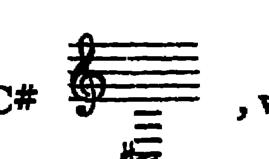
lower than the one in Bb, namely to C# — » which
is of excellent effect. This C¥ represents the actual sound
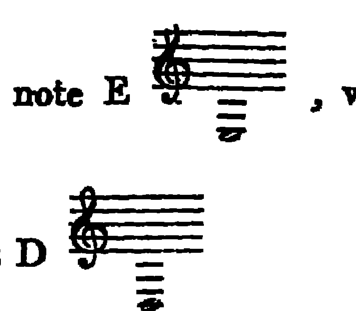
of the written note E — » which on the clarinet
in Bb produces D =
Another habit, just as bad and even more dangerous, is found in many orchestras regarding the use of the valve horns. It consists in the execution as open tones (by means of the new mechanism) of those notes which are intended by the composer to be played as stopped tones (by introducing the right hand into the bell of the horn). Furthermore, horn players now use almost exclusively the horn in F (because of the facility of playing it in different keys by means of the valves), regardless of the key indicated by the composer. This habit causes a great many abuses, from which the conductor should preserve the works of composers who know how to write. As to the works of others, I must admit that there the damage is much less grave..
Furthermore, the conductor must resist the parsimonious custom, existing in certain theaters, of having the cymbals and the bess drum played by the same musician. The sound of these cymbals attached to the bass drum (the only way in which this economy is made possible) is only a vulgar noise fit for dance bands. Moreover, this custom leads mediocre composers into the habit of never using one of the two instruments alone and of considering it their sole purpose to stress the heavy beats very forcefully. This opinion caters to the predelection for vulgar noise and has brought upon us those ridiculous excesses which will sooner or later doom dramatic music unless a stop is put to them.
Finally, I must express my regret concerning the generally poor organization of rehearsals, Everywhere the system of mass rehearsals is retained for large vocal or orchestral works. All chorus singers as well as all instrumentalists are rehearsed together. Deplorable errors, innumerable mistakes, especially in inner voices, are the natural consequence—errors which neither the chorus master nor the orchestral conductor will notice. Once established, such errors grow into habits and become part and parcel of the performance.
The poor chorus singers receive the worst treatment of all with this type of rehearsal. They need an able director, who knows the correct tempi and is proficient in the art of singing, to beat.the time and make critical observations; furthermore, they require a good pianist, playing from a well-arranged piano score on a good piano; and finally a good violinist to play in unison or in the octave with the voices as they study each part individually. Instead of these three indispensable artists they are given—at two-thirds of the European opera houses—a single instructor, a man who usually knows as little of conducting as of singing, who has scarcely any musical education and who is selected from among the worst pianists to be found, or who perhaps canuot play the piano at all; 2 pitiable invalid who, sitting before a battered and untuned instrument, tries to decipher a confused score which he does not know, plays false chords (minor instead of major and vice versa) and—
under the pretext of conducting and accompanying at the same time—teaches the singers a wrong rhythm with his right hand and a wrong intonation with his left one.
One is carried back into the middle ages when he has to witness such an exhibition of barbarism for the sake of economy.
I firmly believe that a faithful, spirited and enthusiastic performance of a modern work, even by outstanding artists, can be achieved only by sectional rehearsals,
- Each choral part must be studied individually until the
necessary security is reached; only then should it be rehearsed together with the other parts. One should proceed in the same fashion in rehearsing symphonies, if they are at all complicated. First the violins should be rehearsed alone, then the violas and basses, then the wood-wind (with a small group of strings to fill out the rests and to accustom the wind instruments to their cues); likewise the brass alone; sometimes it is even necessary to rehearse the percussion instruments by themselves; finally the harps—if they are numerous. The general rehearsals are then far more profitable and much faster, and one is assured of a fidelity of execution only too rare nowadays,
The performances obtained by the old method of rehearsing are never more than approximations of correct interpretations. Yet the conductor puts down his baton, after ruining another masterpiece, with a smile of satisfaction. Should he, nevertheless, feel some slight doubt whether he has fulfilled his task satisfactorily— and who can verify whether he has?—he murmurs to himself: “What of it? Vae victis !”