 Playable Books
Benjamin Cutter · section 7 of 7
Appendix
Read and hear this section in the playable edition →Ten fragments of various natures, carefully analyzed and discussed
Fragment 1 · Lento espressivo. Schumann, Op. 68.
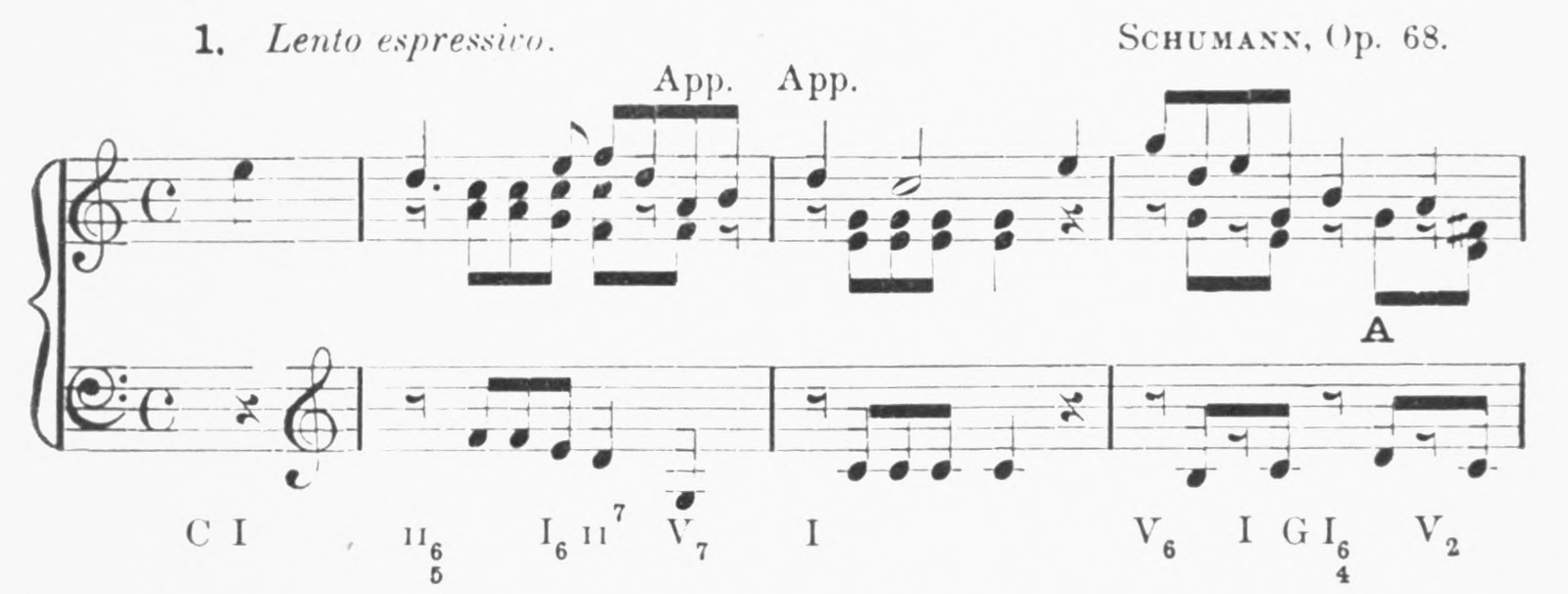
A. Principle No. 8: the impression is that of a change of key followed by a deceptive resolution.
B. Too short for a modulation.
C. Some would call this A minor.
D. “The identity of a chord depends on its resolution;” Principle No. 3. Apply also Principle No. 5.
E. See Principle No. 12.
F. Unmistakably I6/4 in C: especially as it is preceded by an altered ii6/5. The preceding measure may be called C major, for the impression of the F chord is that of unrest, which is never the impression of a tonic. Still on account of the duration of the apparent V7, some analyze this measure as: F, V6/5, I. We regard it as but a step in the movement toward the I6/4 at letter F.
G. The old-fashioned marking would read: d V7, G V7; and the G♯ of the preceding measure would probably be called a passing tone. The impressions are certainly those of dominants, but whether apparent or real, the listener must decide. We call them apparent dominants, and stay in C.
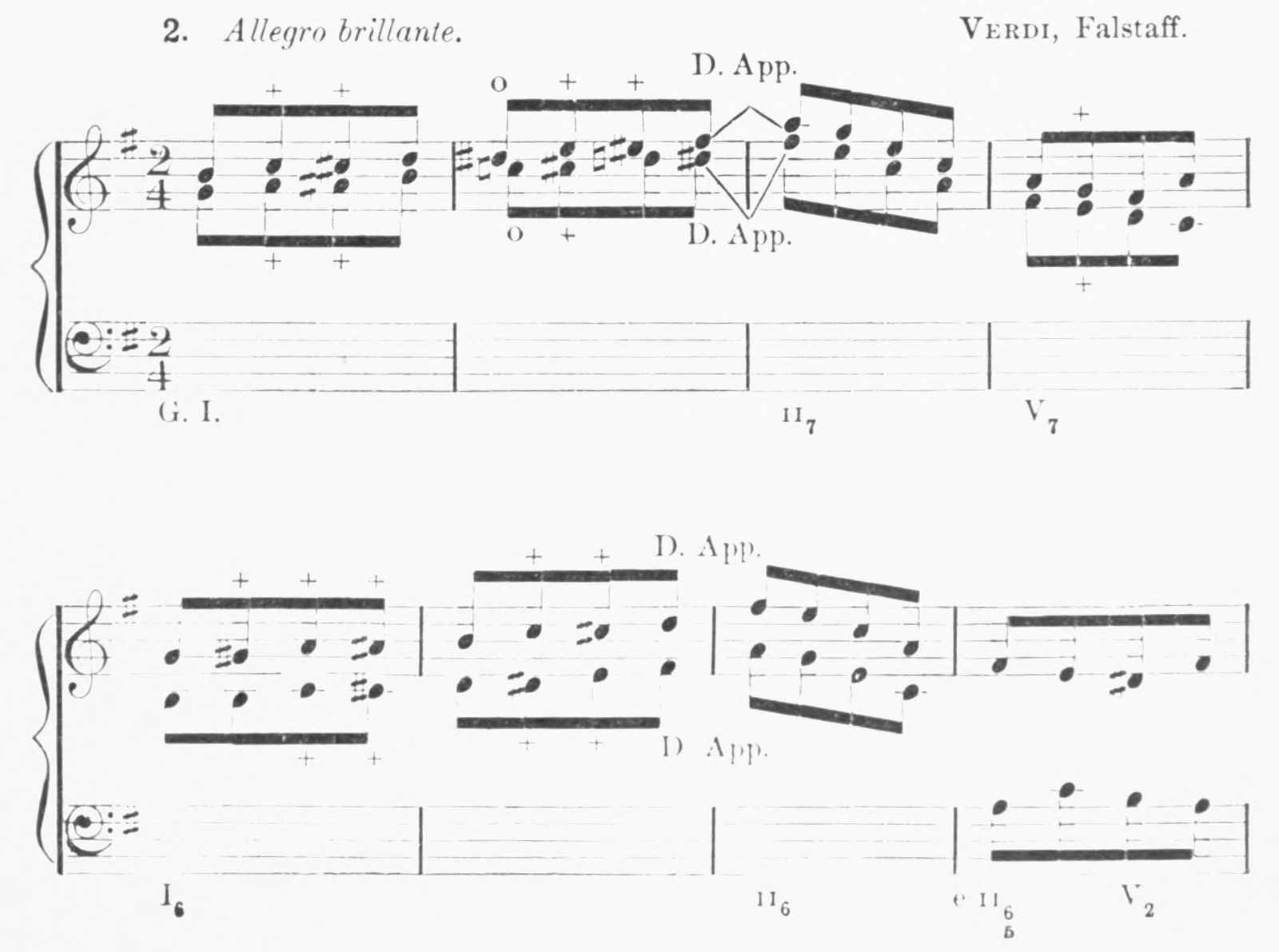
Fragment 2 · Allegro brillante. Verdi, Falstaff.
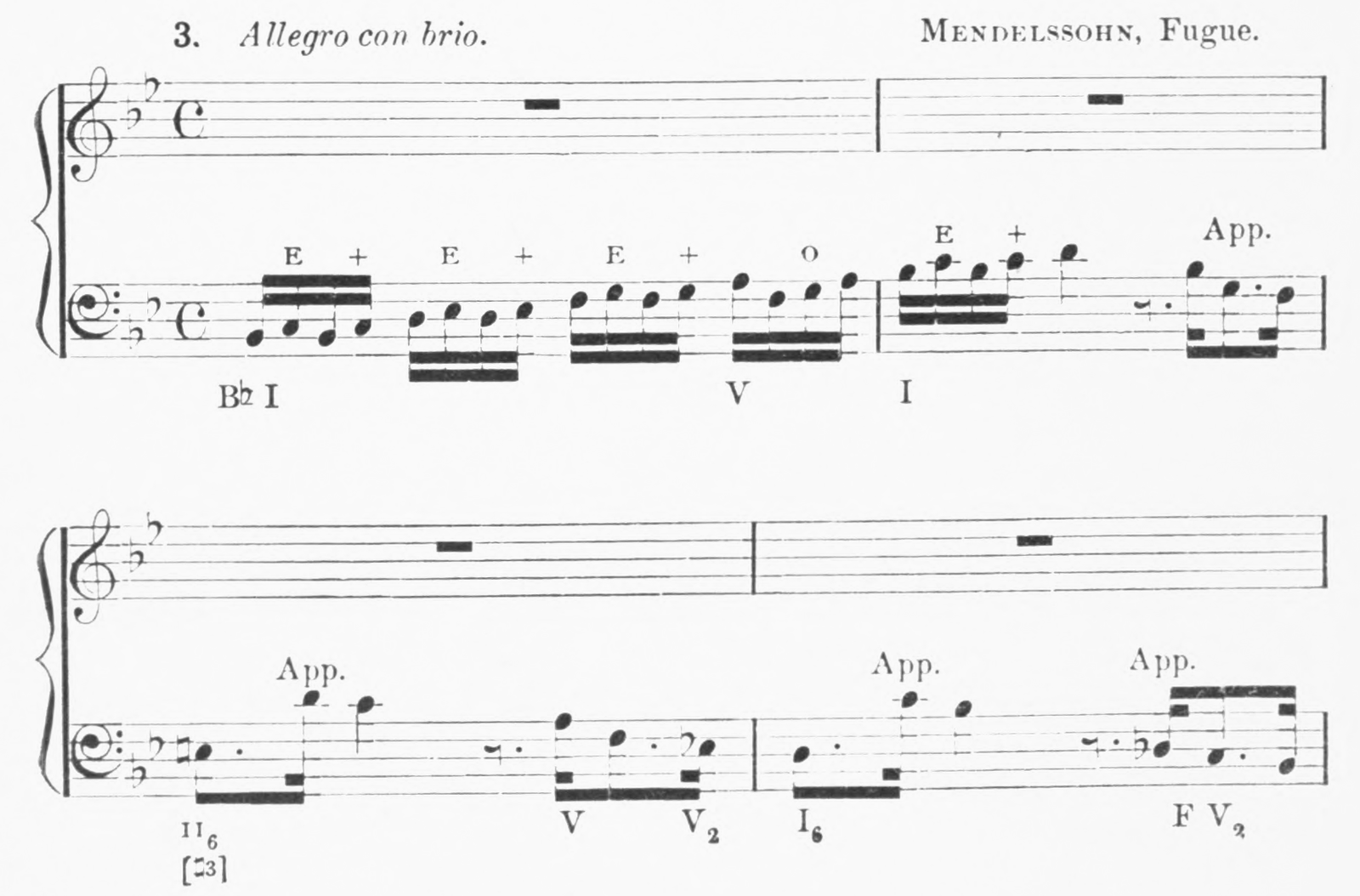
Fragment 3 · Allegro con brio. Mendelssohn, Fugue.
Fragment 4 · Rapido. Prestissimo. Liszt, Rhapsody.
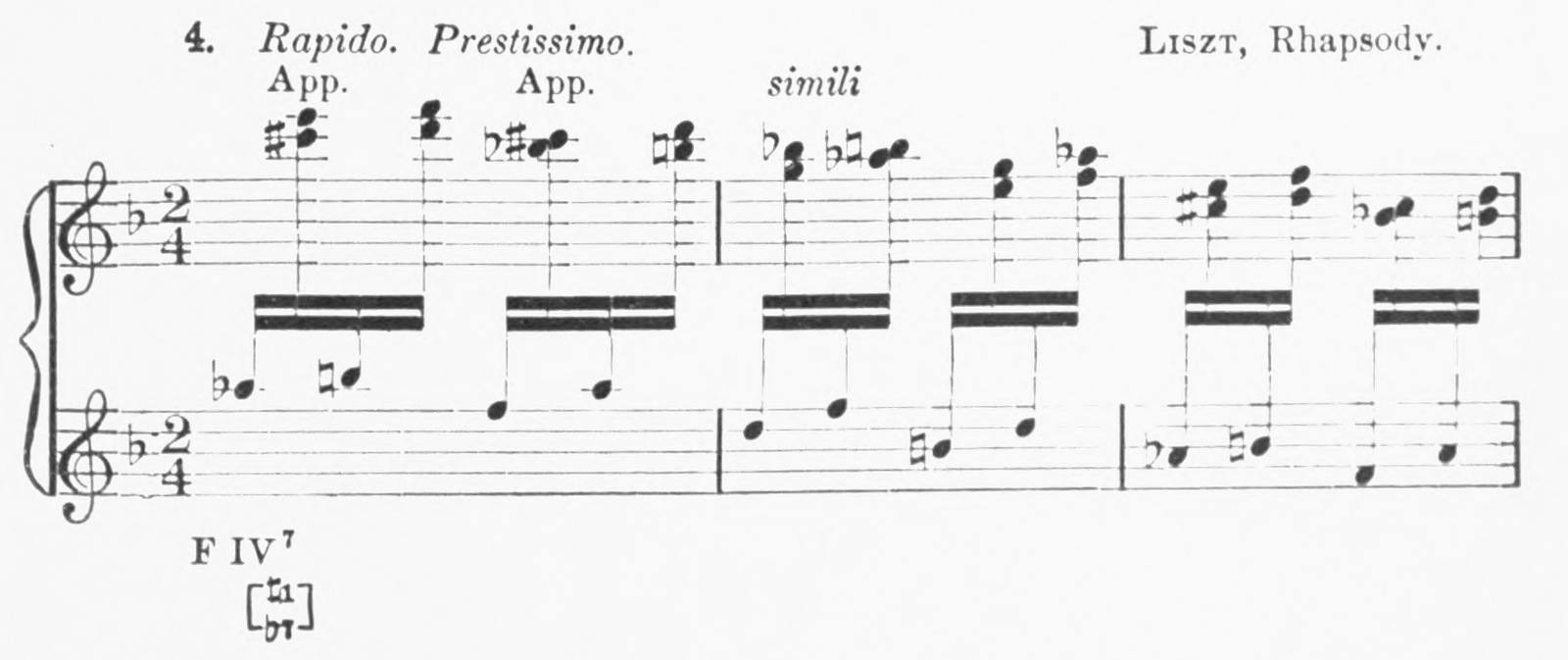
This characteristic passage is built wholly on one chord, the two upper members in each quarter count being preceded by appoggiaturas. It is hardly worth while to figure each inversion.
Fragment 5 · Molto agitato. Chopin, Prelude No. 8.
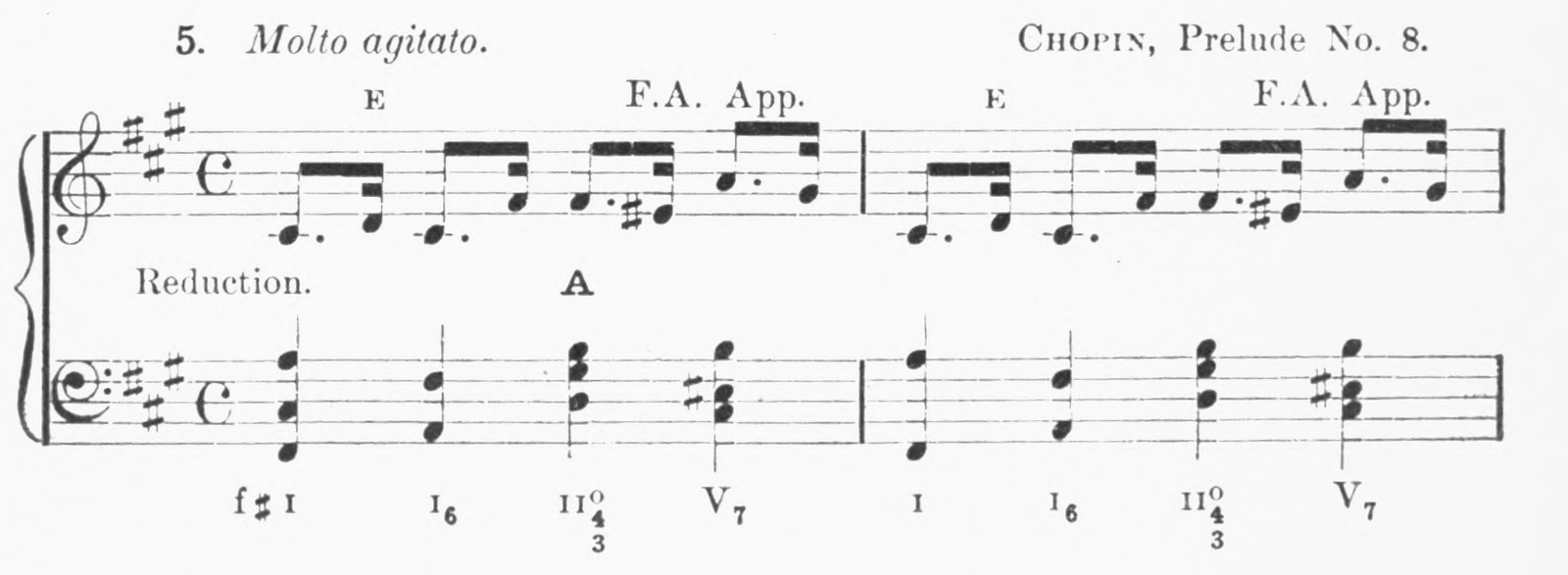
A. The root progression, ii7 V7. is stronger, hence better, than vii°7° V7; furthermore the context—see measure 3—shows unmistakably that the harmonic motive is ii°4/3 V7, and nothing else.
B. Enharmonic notation of e♯ g𝄪 b♯ d♯, the third, fifth, and seventh of which are passing notes moving down to g♯, b, d, with e♯, forming a chord of the reigning key. The notation in flats simplifies possibly for the eye, but is illogical; for no one hearing this piece and knowing it to be in sharps would ever imagine, naturally, one single chord in flats.
C. To call this chord, according to its appearance, the vii°7° of A♭, major or minor, is to break the sequence, which is unwarrantable. This sequence moves down regularly by minor seconds, and at its end is varied and made more interesting by the suspension in the bass; this prolongation of the chord also forms a quasi halting place and makes more impressive the change at
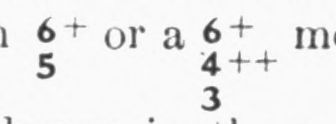
D. A dominant seventh, by enharmonic transformation of its seventh, or of its seventh and root, may become an 6+/5 or a 6+/4++/3 modulating in the first case to the minor tonic a minor second lower, in the second case to a major tonic a minor second lower; thus: from C♭ to B♭, minor or major. The enharmonics in this present case are d♭ f♭, for c♯ e. This harmonic subtlety was very dear to Chopin. See Section 43.
E. The soprano presents a subtlety. B𝄫 sounds A. The main notes of the soprano, then, are B♭ A A♭ G, and the B𝄫 is used to present to the eye a figure like that of the first count.
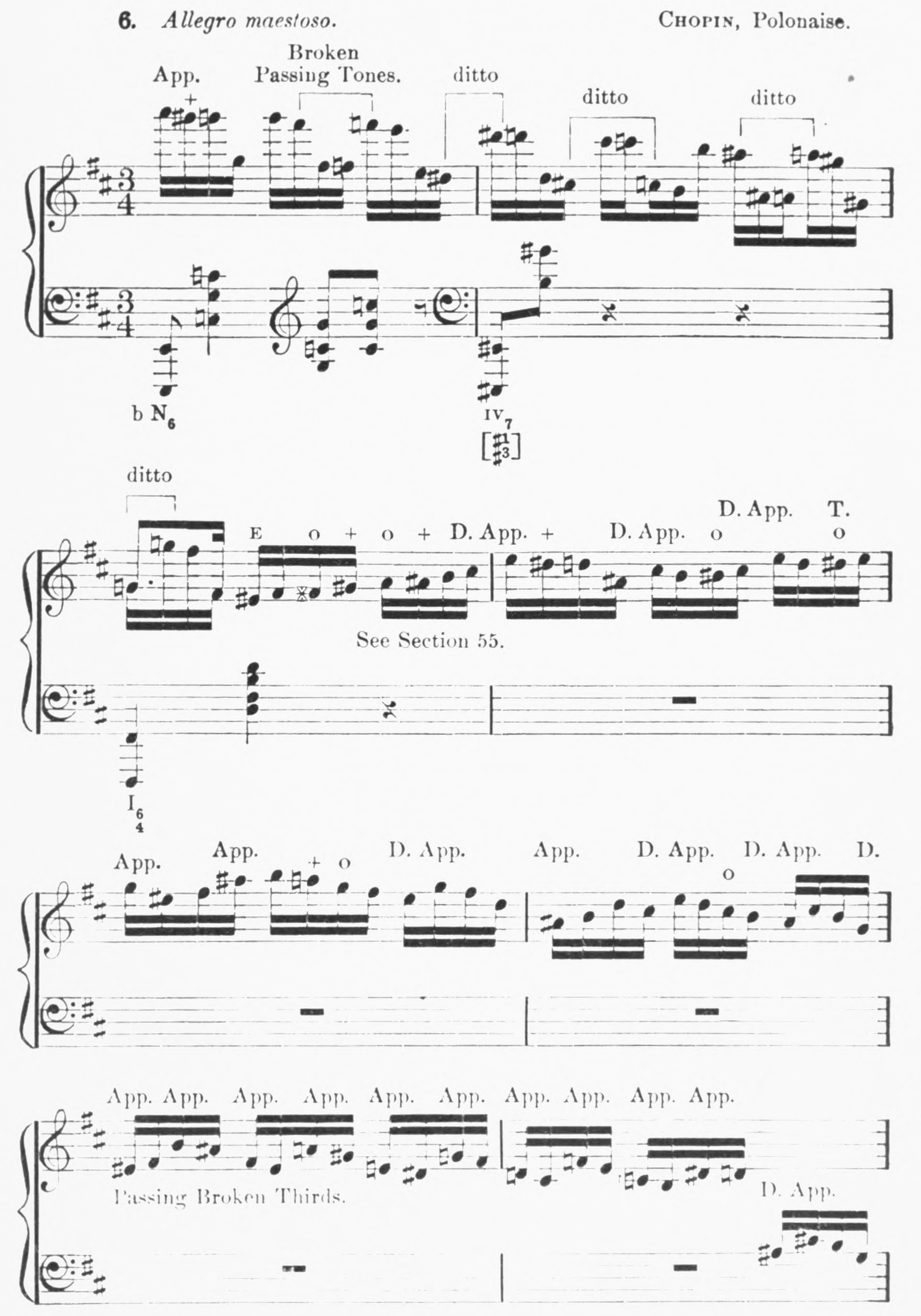
Fragment 6 · Allegro maestoso. Chopin, Polonaise.
Fragment 7 · Andante. Liszt, Fugue on the name of Bach.
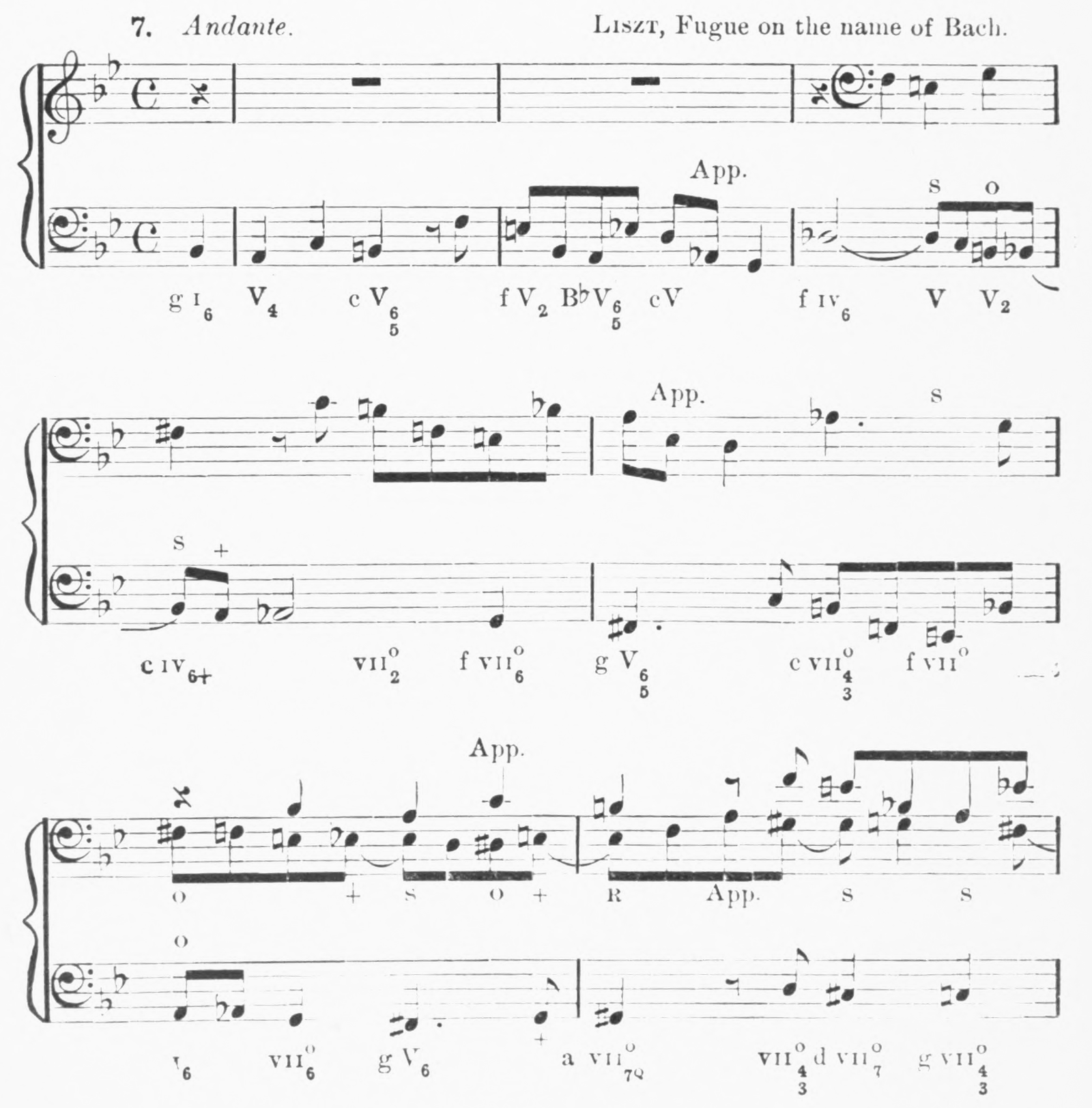
It is impossible to hold any key for any length of time in this example. The impressions of key change constantly, and the figuring represents what the ear hears, and any attempt to use chromatically altered chords instead of shifting tonalities leads one into illogical markings, as the writer found on experimenting. A reduction will soften certain harsh measures; Nos. 3, 4, 5, and 6, on this page, become not only clear, but fairly bland, when the syncopations are omitted.
Fragment 8 · Allegro. Bach-Tausig.
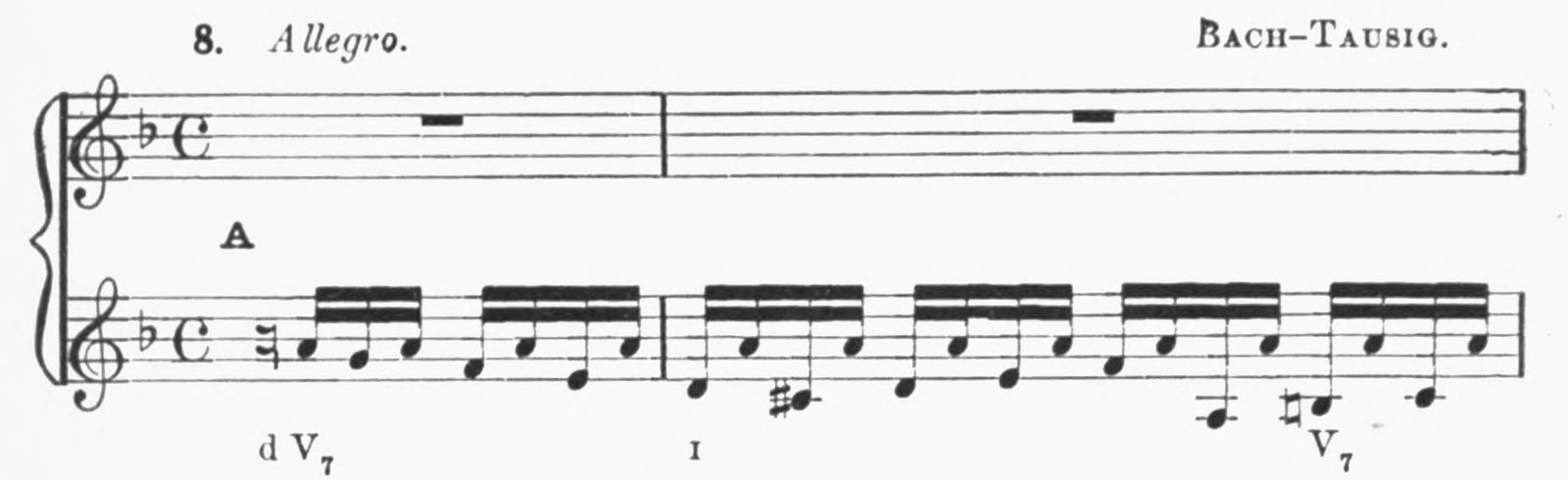
A. Passages composed of rapid and constant alternations of tonic and dominant, as is this, may best be analyzed by judging of the general impression rather than by naming each chord, a procedure which does not agree with what one hears.
B. This whole sequential strain passes so quickly by the ear and has in it so much of the F major character—that is, so many B flats and E’s—that an Extremist would call it throughout, F major. We prefer to regard it as modulatory in nature, as it seems to move up by hitches, and because of the “sham keys” which seem to accentuate the idea of key change, being used for the sake of variety (see Section 50, The Sequence). It is a place very difficult to mark, however one may regard it, and we have chosen it because typical of countless Bach passages. The first sixteenth note on each eighth is a chord; the other sixteenth notes are accidental tone formations, containing Free Tones, Free Anticipations, etc. It will be realized by any one who studies these measures attentively that here, in “old Bach,” are distortions of the key nearly if not quite as great as those practised to-day by the Out-and-Outers.
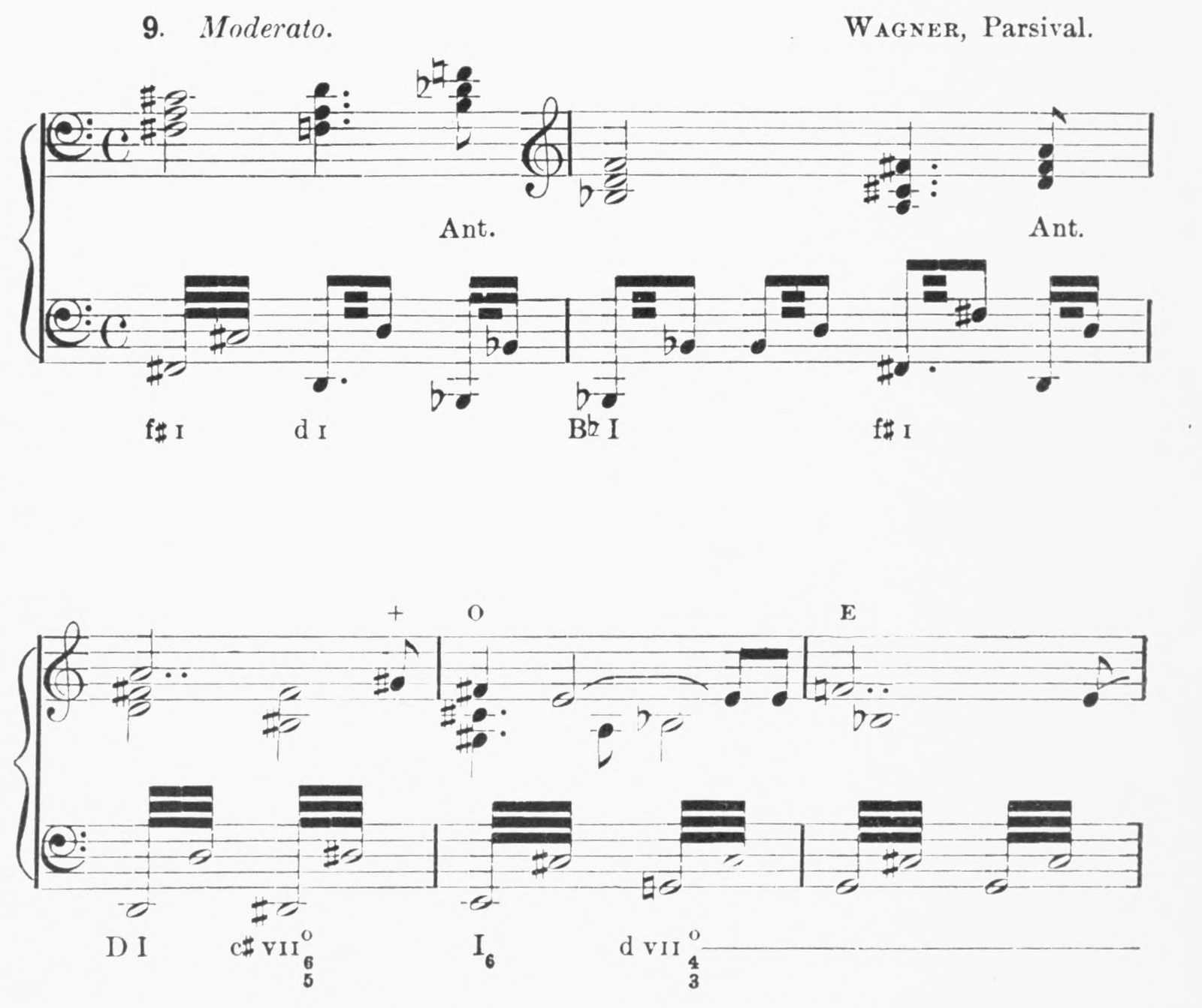
Fragment 9 · Moderato. Wagner, Parsival.
Fragment 10 · Lento e maestoso. Wagner, Parsival.
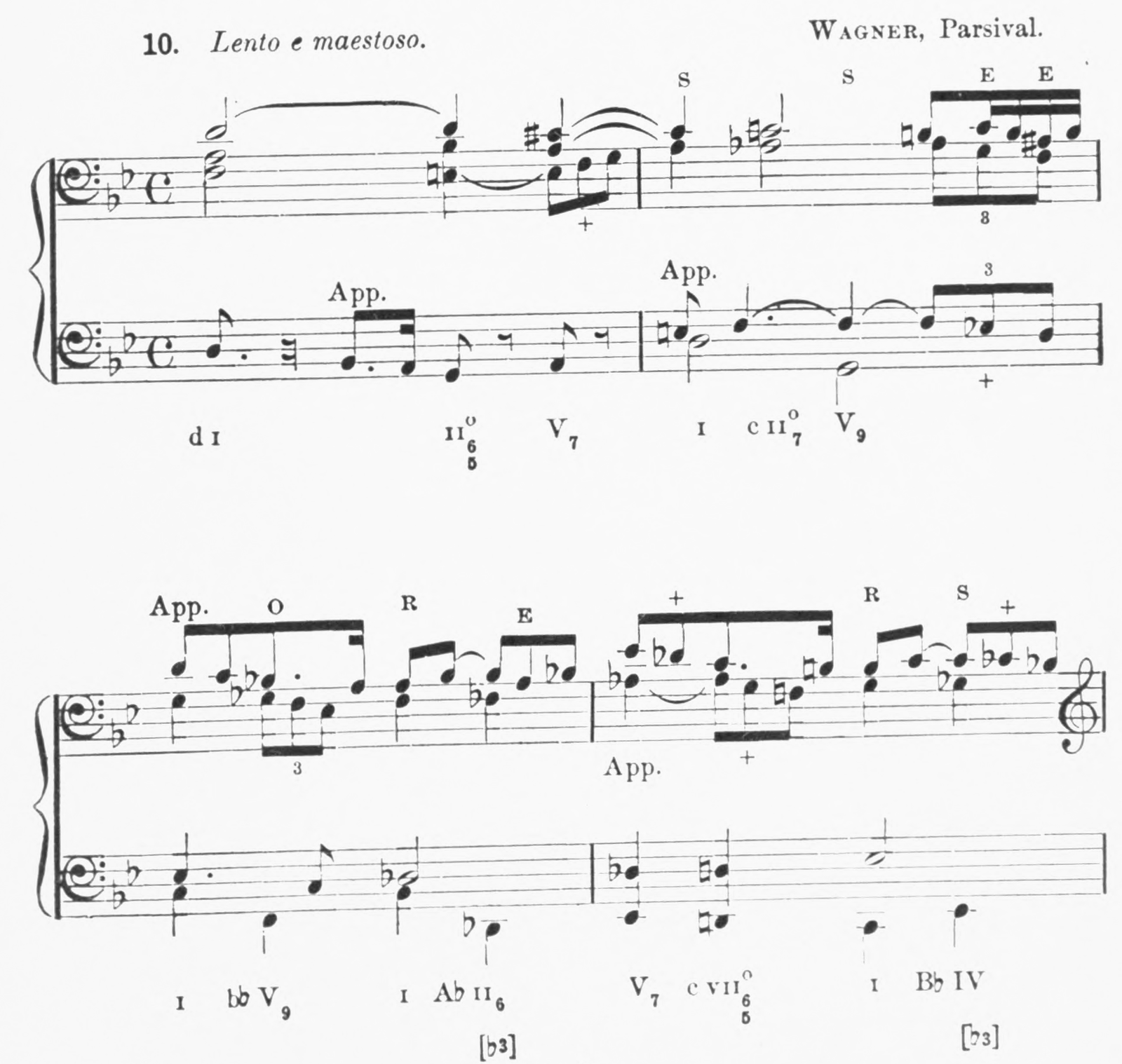
A. A characteristic Wagnerian rising sequence, defined by the essential chords on the second and fourth beats in measures 5, 6, 7. The tone combinations on the first and third beats of these measures offer difficulty, and only recourse to enharmonics will solve the complicated problem. The chord at B is, in reality, d♯ f♯ a c; and at C, e♯ g♯ b♯ d. This interpretation gives two chords in a key—see Principle No. 5—and explains the inconsistent and mind-disturbing notation of a passage which to the ear is very consistent, coherent, and agreeable. Numberless cases of this sort occur in modern music which may be explained only in the above way. The composer hears the chord mentally and employs any notation which seems to him good; to the analyst falls the task of finding the needful enharmonics and of making them clear to his mind.
UNIVERSITY OF CALIFORNIA LIBRARY Los Angeles
This book is DUE on the last date stamped below.