 Playable Books
Fedele Fenaroli · section 3 of 26
Book III: Rules and realizations
Read and hear this section in the playable edition →Fedele Fenaroli (1730–1818)
Partimenti ossia basso numerato
Book III
a translation of his Rules
first published in Naples, 1775
Concerning this modern edition . . .
Fenaroli’s early book of partimento rules refers to musical examples contained in a separate manuscript. That manuscript is lost, so new examples have been provided by the editor for the modern reader. In the nineteenth century, a version of these same rules was republished with expanded examples as Book 3 of Fenaroli’s six books of partimenti.

Each musical example represents just one possible sonic realization of the intended rule. Different but equally fine realizations might have different melodies and more or less elaboration.
Because the concept of the scale degree or scale step is so central to the Neapolitan school of partimenti, and because the welter of numbers for both intervals and scale degrees can be confusing, scale degrees in the bass will be marked by numbers in white circles (e.g., ①) and scale degrees in Above: the uniform Fenaroli would the melody by numbers in black circles (e.g., ❶). have worn as a boy at the Conservatorio di Santa Maria di Loreto, This bilingual edition is based on the orignal Italian version Naples printed in Naples 1775, and on later manuscripts and prints held in the conservatory libraries of Naples and Milan. Below: Fenaroli as an old master Concerning Fedele Fenaroli (1730–1818) . . .
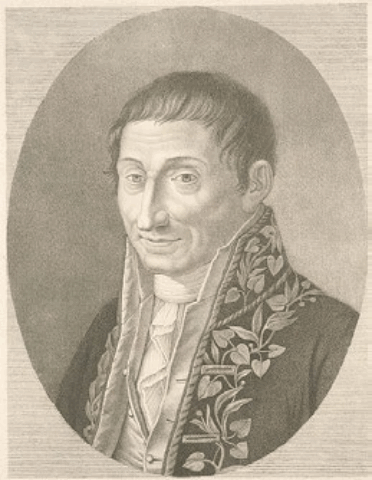
Fenaroli, a composer from the Haydn generation, studied with the great master Durante in Naples. Fenaroli rose through the ranks of teachers to became one of the co-directors of the newly combined conservatories of Naples in the early nineteenth century. Printed editions of his partimenti became common beginning in the early 1800s, and they remained continuously available from many publishers until the twentieth century. Fenaroli’s partimenti were praised by Giuseppe Verdi, learned by the six-year-old Luciano Berio, and widely studied at the Paris Conservatory until the early twentieth century. When the American composer Walter Piston went to Paris in the 1920s to study with Nadia Boulanger, one of his assignments was to write a string quartet inspired by a Fenaroli partimento fugue. Thus for generations of students, mastery of Fenaroli and mastery of the classical tradition were one and the same achievement.