Playable Books
Fedele Fenaroli · section 13 of 26
that Rises by Semitone and Begins said Ascent from ③
Read and hear this section in the playable edition →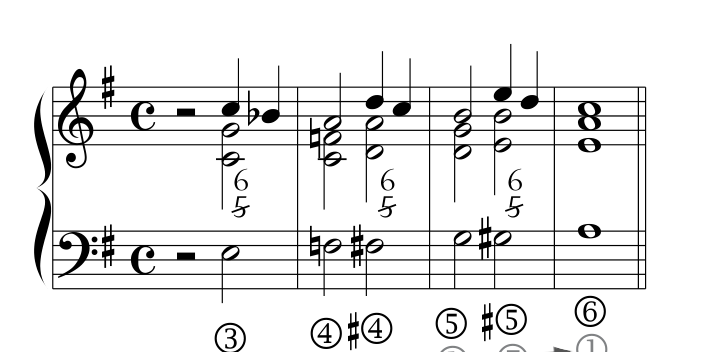
Consider the first note of this partimento, which is ③, like a ⑦ that moves to ⑦. Whence like a ⑦ that moves to ①, it will have the accompaniment of a 3rd and 6th, to which is added the diminished 5th in consideration of [the partimento] being on the leading tone. Consider the subsequent note of
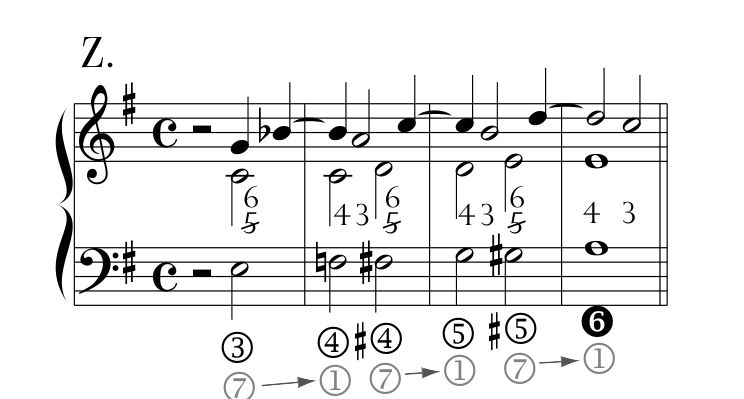
the partimento like a ①, whence it will have a 3rd, 5th, and 8ve. And it continues like that successively.
Observe that over the second note of the partimento one can place, on the first half of its time value, a 4th (prepared by a diminished 5th) that resolves to a 3rd on the second half of its time value. See letter Z.
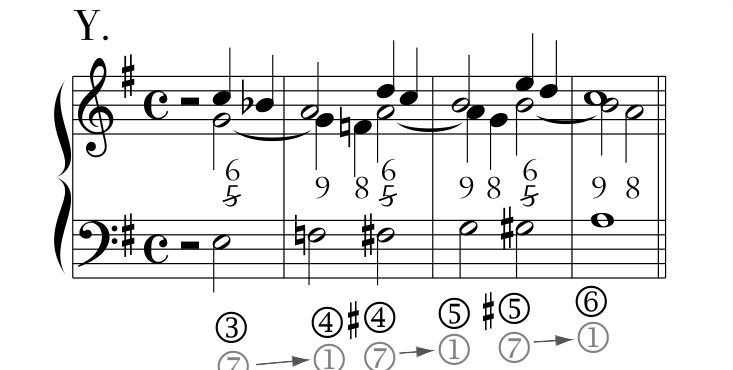
Over this already mentioned second note of the partimento one can also place an accompaniment of a 9th (prepared by a 3rd) that on the second half of its time value resolves to an 8ve. See letter Y.
[Concerning a Partimento in Minor that Rises by Semitone and Begins said Ascent from ⑤.]
Passing on then to a partimento in the minor mode with a move ascending by semitone which, as was mentioned, will begin on ⑤.
[I.] One should observe that the said ⑤ should have a major 3rd, a 5th, and 8ve [above it]. This 8ve will hold over as a 7th above the subsequent note [♭⑥] of the partimento ascending by semitone. On the next note of the partimento [♮⑥] rising similarly by semitone, that 7th will resolve to a minor 6th. On the next note of the partimento [♭⑦] rising similarly by semitone, the 3rd of the preceding note holds over, and will form a suspended 9th to resolve to the 8ve above the same note of the partimento.
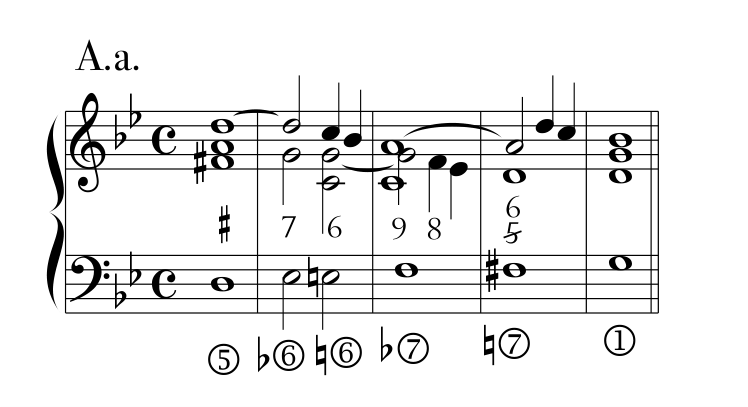
The subsequent note of the partimento ascending by semitone, which will be the ♮⑦ of the key in which this motion began, requires the accompaniment of a 5th and 6th [above it]. The final note of this motion, which will be the ①, is accompanied with the 3rd and 5th. See A.a.
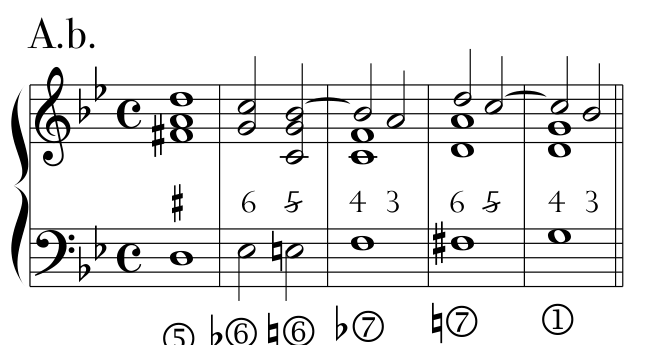
II. On the first note of a partimento that will make the motion of rising semitones, the note which as already mentioned should be ⑤, one will provide the accompaniment
of a major 3rd, a 5th, and 8ve. Above the subsequent note of the partimento ascending by semitone, the note which comes to be ♭⑥, one will provide a 3rd and 6th. Above the next note of the partimento rising yet again by semitone, the note which comes to be ♮⑥, one will provide a 3rd and a diminished 5th. Above the subsequent note of the partimento ascending by semitone, which will be the ♭⑦ of the key, the diminished 5th above the preceding note will form the dissonance of a 4th, to resolve to a 3rd on the second half of its time value. Above the subsequent note of the partimento ascending by semitone, which will be the ♮⑦ of the key, one will set a 3rd and a diminished 5th. And above the subsequent note of the partimento, which will be the tonic ①, the diminished 5th of the preceding accompaniment holds over, and will resolve to a 3rd on the second half of its time value. See A.b.