 Playable Books
Fedele Fenaroli · section 14 of 26
Concerning a Partimento that Descends Stepwise
Read and hear this section in the playable edition →When the partimento descends stepwise, it can accept various accompaniments.
[I.] First, one can consider the notes of the descending scale as follows:
The first of them, which one takes to be the tonic [①], should be considered from that viewpoint, and because of that accompanied by a 3rd and 5th. The subsequent note, having descended a step, should be accompanied (as ⑦) with a 3rd and 6th. The next descending note [⑥] should be newly considered as a ①, and the tone after that [⑤] as a ⑦. And thus one successively alternates between these two accompaniments, one of a 3rd and 5th, and the other of a third and sixth, continuing down until the partimento will arrive at the ③, to all of which the aforementioned rule applies inclusively.
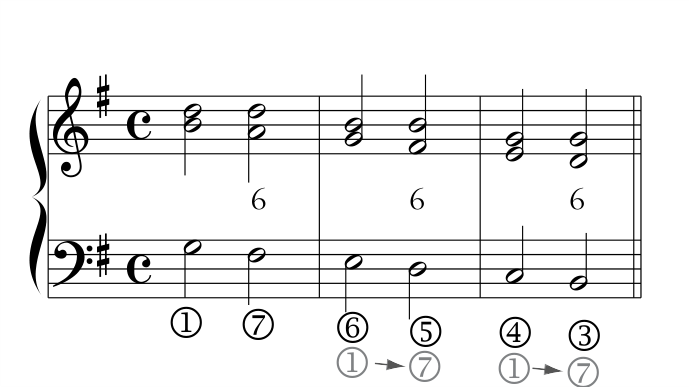
II. Considering the descending scale of the partimento in the same way described in the previous article [I.], that is, with the first note
as ①, the second as ⑦, the third as a new ①, the fourth as a new ⑦, and thus hand over hand inclusively down to the ③, it is possible for this motion to be accompanied as follows:
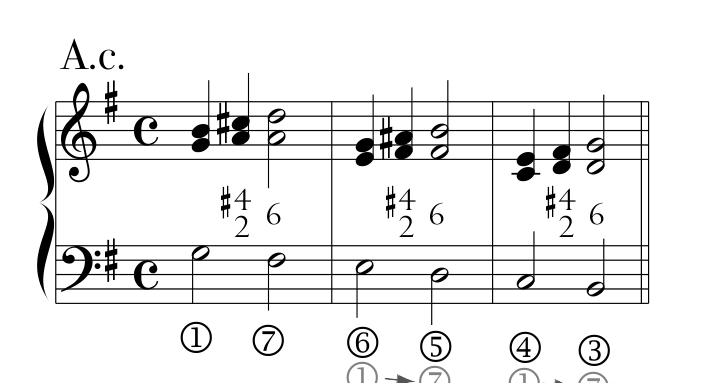
At the start, the ① will have a 3rd and 5th [above it]. And then, with the partimento holding the same note, the accompaniment will take a 2nd and an augmented 4th, after which, with the partimento descending to ⑦, you will see the same accompaniment of a 3rd and a 6th. Above the next note of the partimento, which will be ⑥, one will practice what was described above with respect to the ①. Above the ⑤, all that was said with respect to ⑦, and thus hand over hand down until the partimento reaches ③ inclusively. See A.c.
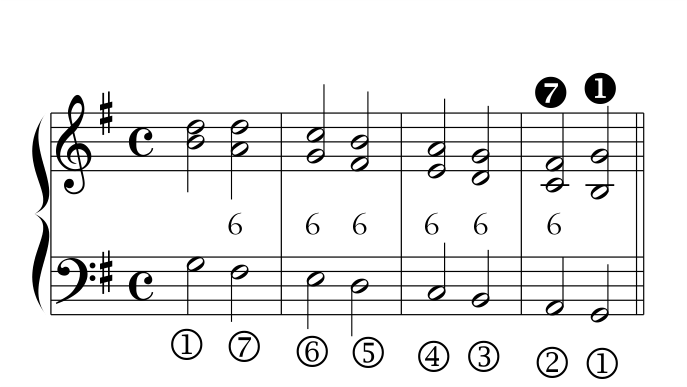
III. All the notes of a partimento that descends stepwise can be accompanied by a 3rd and a 6th, until the partimento reaches ②. There it will have a [major] 6th [❼] that, at the next note of the partimento (which will be ①), will rise to the octave [❶].
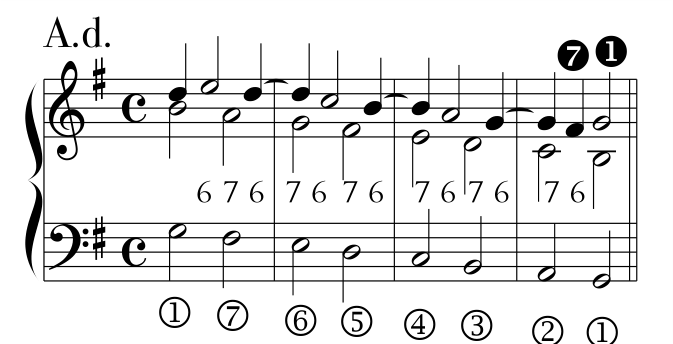
IV. A partimento that descends stepwise, could also be accompanied as follows. With ① initially given a 3rd and 5th, one raises the 5th to a 6th. When the partimento descends a step to ⑦, the sixth placed over the ① holds to form a suspended 7th, which resolves to a 6th. This 6th forms a suspended 7th above the following note of the partimento, and this continues in sequence down to ②, on which the suspended 7th will resolve to a major 6th [❼]. It will rise to the 8ve [❶] to form a consonance on an 8ve on the last note of the partimento [①]. See A.d.
Observe that up to now we have treated the partimento that descends stepwise, but with detached notes. Now it remains to treat the partimento that descends stepwise, but entirely in tied notes.