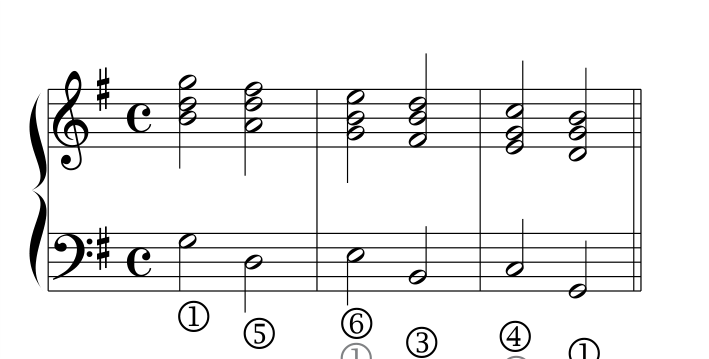
I. Firstly, all of the notes of this partimento can be accompanied with a 3rd and 5th. That is, one considers the first of these notes as a ① that passes to its fifth [⑤]. And thus one considers the third note of the partimenti [⑥] likewise as a ① that passes to its fifth [③].
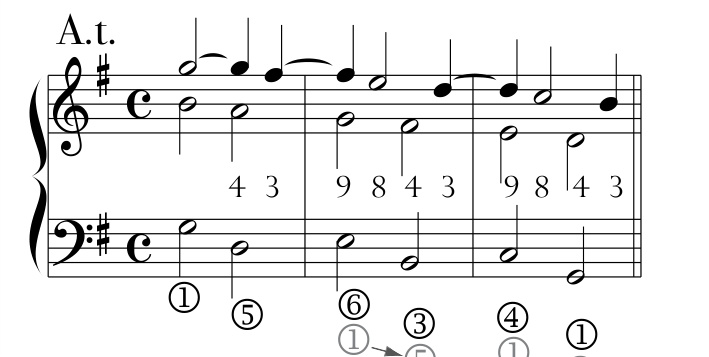
II. The first note of the partimento [①] will have the accompaniment of a 3rd, 5th, and 8ve. The 8ve [❶] will hold over as a 4th above the note of the partimento [⑤] that descended a 4th. And on the second half of the time value of this note that descended a 4th, it [❶] will resolve to a 3rd [❼]. This 3rd will hold over as a 9th above the next note of the partimento [⑥] that ascended a step. And on the second half of the time value it [❼] will resolve to an 8ve [❻]. And thus one progresses until the conclusion of the motion. See A.t.
 Playable Books