This motion can accept various accompaniments. I. If one considers this motion as being from ① and leaping to ④, then each of the said two notes of the partimento will be accompanied with a 3rd and a 5th. See A.q.
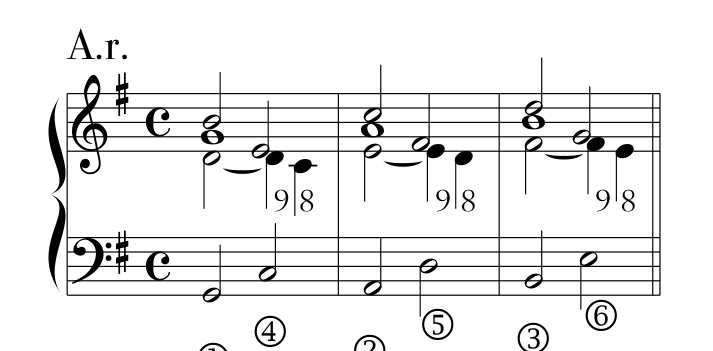
II. The note of the partimento ascending the 4th [④] can have in its accompaniment a suspended 9th, prepared by the 5th. This 9th will resolve to the 8ve on the second half of the time value of the aforementioned partimento [④]. This can continue until the conclusion of this motion. See A.r.
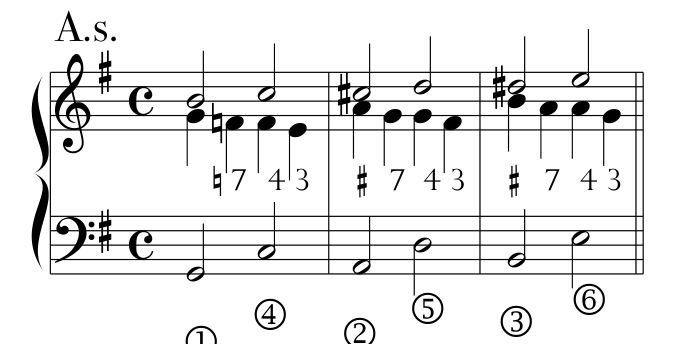
III. Granting that the partimento is in the major mode, on its first note [①] one can make a descent from the 8ve in the accompaniment to the minor 7th, and this tone, staying put above the next note of the partimento ascending a 4th, will form a suspended 4th on the first half of this same note’s time value, which will resolve to a 3rd on the second half.
One can procede thusly until the conclusion of this motion, provided that all the notes of this same partimento, having descended a 3rd, will have a major 3rd. See A.s.
 Playable Books