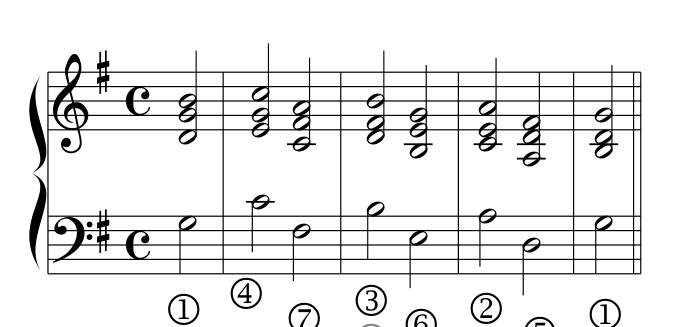
I. Each and every note that forms it can be accompanied with a 3rd and 5th, considering the first and third of these notes [①, ⑦] almost as ①s that pass to their respective ④s. And thus one progresses.
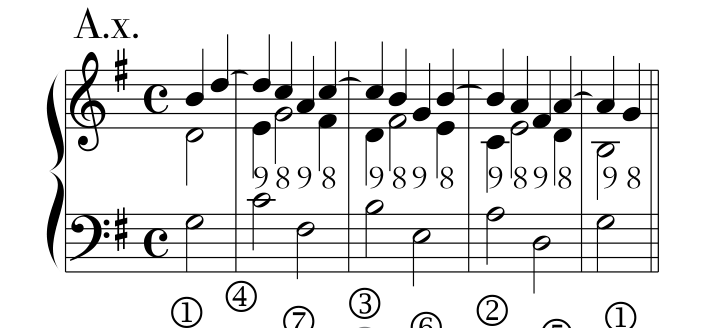
II. Considering each and every one of the note that form the said motion as almost ①s that pass to their respective ④s (as was mentioned above), they can (with the exception of the first, which requires the simple accompaniment of a 3rd, 5th, and 8ve) be accompanied on the first half of their time value with the dissonance of a 9th prepared by a 5th and resolved to the 8ve on the second half of the time value, and thus progressively. See A.x.
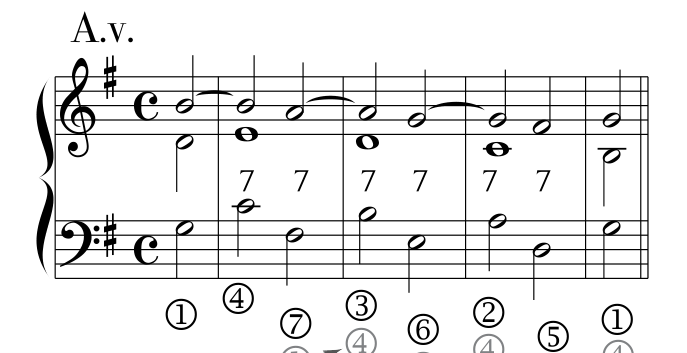
III. Considering the notes of the said motion in the same way [as above], it is possible for each and every one of them (with the exception of the first, which requires the
simple accompaniment of a 3rd, 5th, and 8ve) to be accompanied on the first half of their time value with the dissonance of a 7th prepared by a 3rd, and thus progressively. See A.v.
 Playable Books