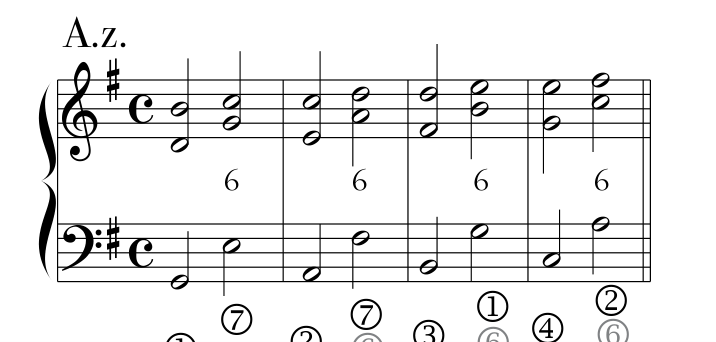
I. On can consider the first note of the partimento as a ① that passes to ⑥, hence it [①] will be accompanied with a 3rd, 5th, and 8ve. The second note, considered as ⑥, will be accompanied with a 3rd and 6th. And thus one progresses until the conclusion of the motion. See A.z.
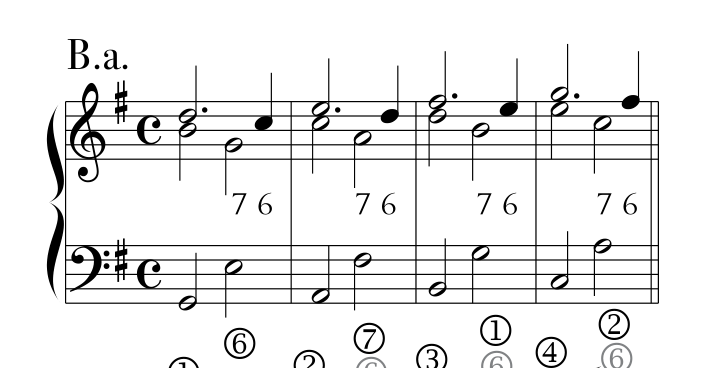
II. The first note of the partimento, considered as a ① that passes to ⑥, one can accompany with a 3rd and 5th. The second note, as ⑥, will be accompanied with the dissonance of a 7th prepared by a 5th that resolves to a 6th on the second half of the said note’s time value. And thus one progresses until the conclusion of the motion. See B.a.
Observe that this motion is equivalent to one that descends a 3rd and rises a 4th.
Learned masters will see to it that their scholars study carefully in all keys, and not only scales but also the dissonances and moves, this being the only path to arrive at the fine playing of a partimento. Should masters find missing rules, or errors, they may supplement and accommodate [the text] to their liking. For here nothing else was done than to place in order the rules well known by masters, and to give beginners a lamp to guide them away from careless playing.
[variant, Florence, Gio. Canti, 9th ed., 1863:
... to guide the fine playing of a partimento, and thus to learn counterpoint with greater facility.]
 Playable Books