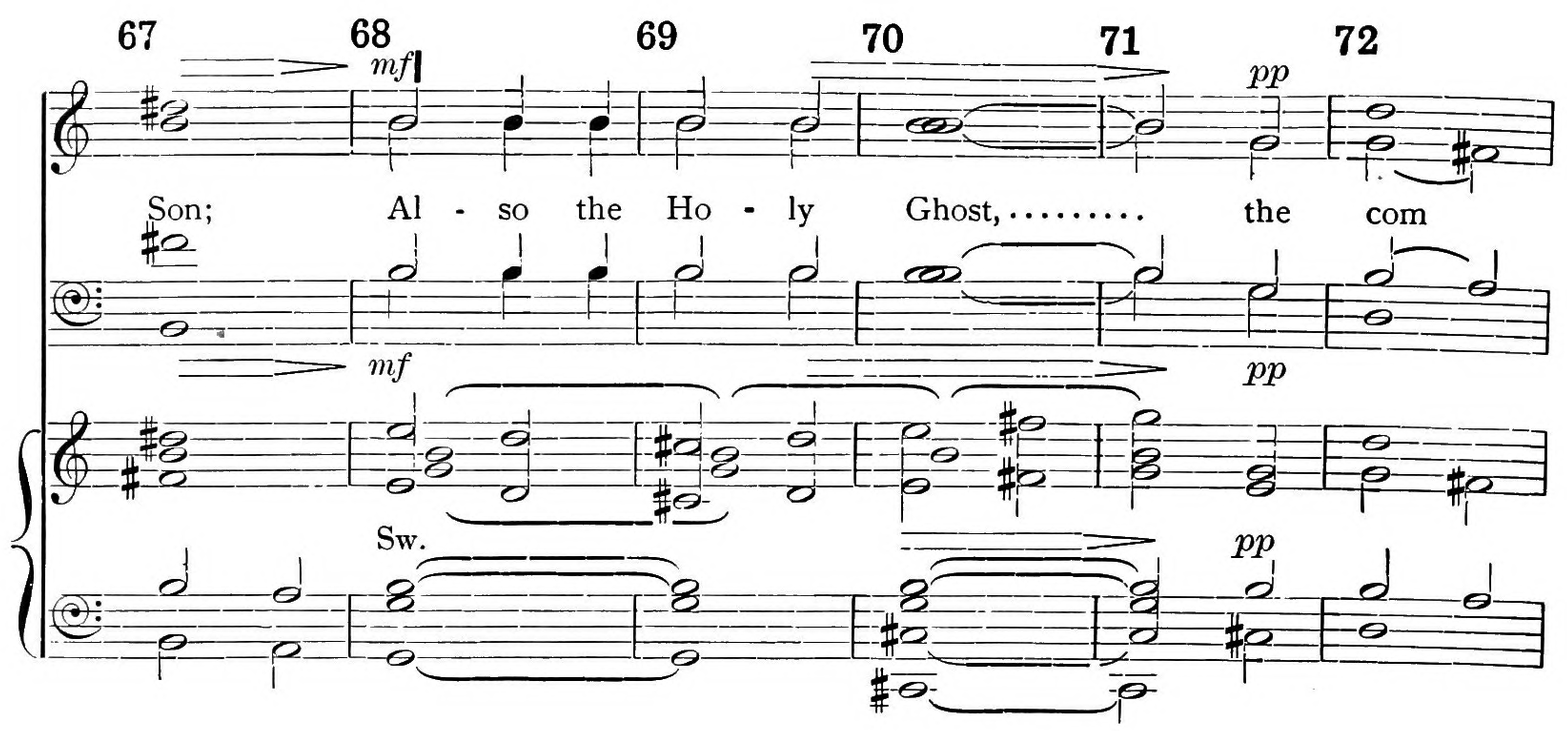
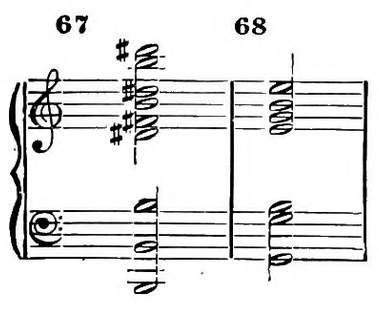
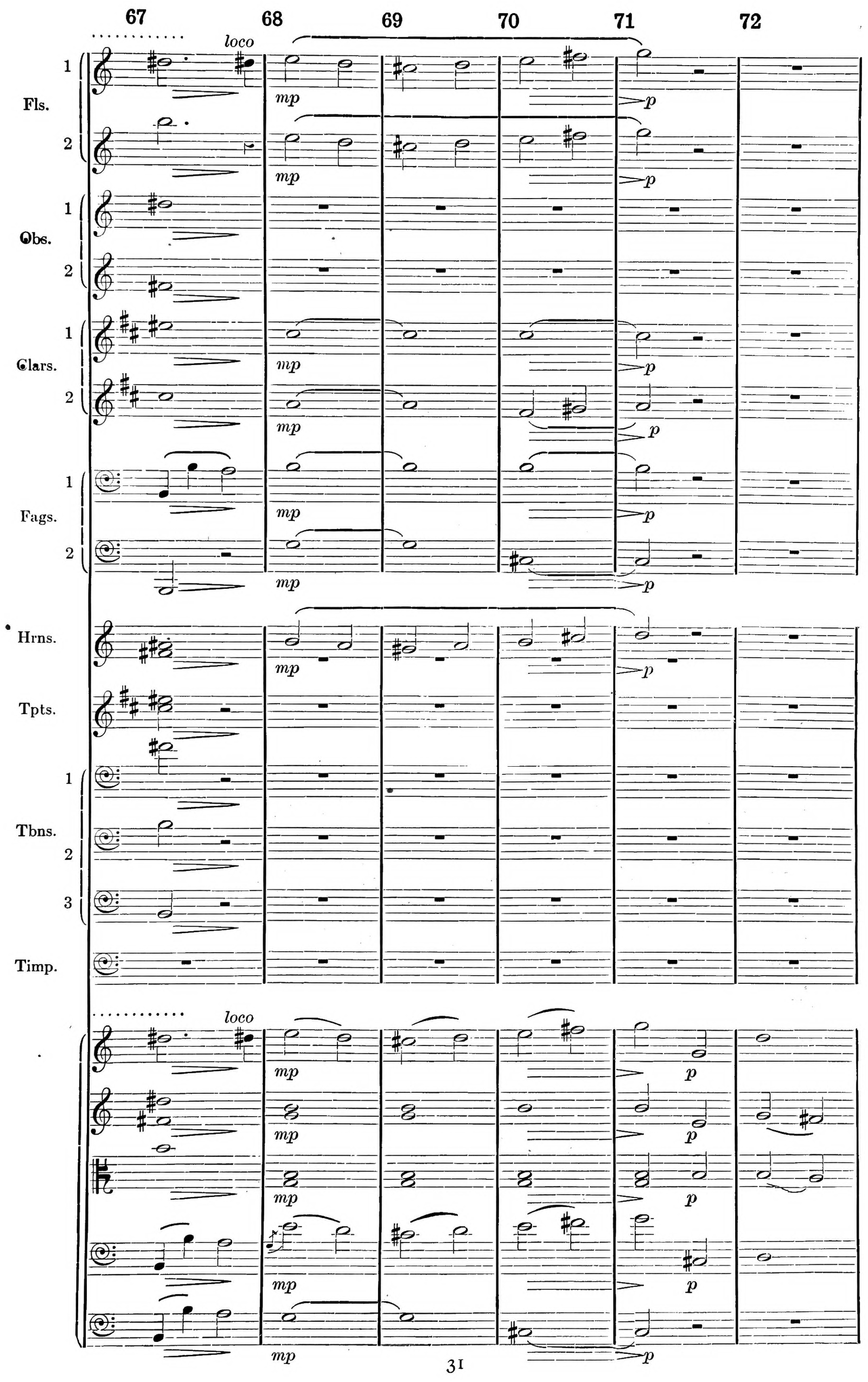
The diminuendo occurs at bar 67. It is not marked in the organ-part, but of course it is absolutely essential in the orchestra, particularly in the brass department. The shrinkage is from ff to mp. But that is not all. In order to give effect to the sudden solemnity of the words “Also the Holy Ghost” we telescope the outside limits of the orchestra from four octaves and a major third (on the down-beat of bar 67) to two octaves and a major sixth (on the down-beat of bar 68):
However, we have to provide for a still further dynamic drop in the passage that is coming, viz. the pianissimo in bar 71. We shall be wise to contrive this, not merely by a diminuendo in bars 70 and 71, but by an actual suppression of tone-colour when the drop comes. On the other hand we must exercise our taste is not making bars 68, 69, 70, and the halfbar of 71 too heavy. Now, after all has been said on the subject of fancy tone-colours, the sweetest and most perfect sound in the orchestra is the four-part string-quartet without basses. Let that, then, be our choice for the second half of bar 71. It will be unnecessary to mark it pp, the change is so great from what has gone before. But what are we to subtract from the forces that we have been employing up to bar 67? It must be enough to reflect the change of mood adequately, and yet leave us sufficient tone-colour to make the further drop in bar 71. All the heavy brass must go of course. Both the horns might be taken out; but perhaps, for the sake of bar 71, we will keep the first. His little bit of smooth melody will undoubtedly sound delightful in unison with the cellos. The first violins can be reinforced in the octave above by two flutes in unison. The held chords, in two octaves exactly as in the organ-part, are given to second violins and violas, in unison respectively with the clarinets and bassoons. This is more than ample. The oboes are omitted. Query: is this judicious? Answer: it is a matter of taste. But one may add that, were the chorus not singing, the upper octave of the melody would sound better if assigned to a unison of one oboe and two flutes. In that case the first violins and either the second violins or the clarinets would be omitted,
 Playable Books