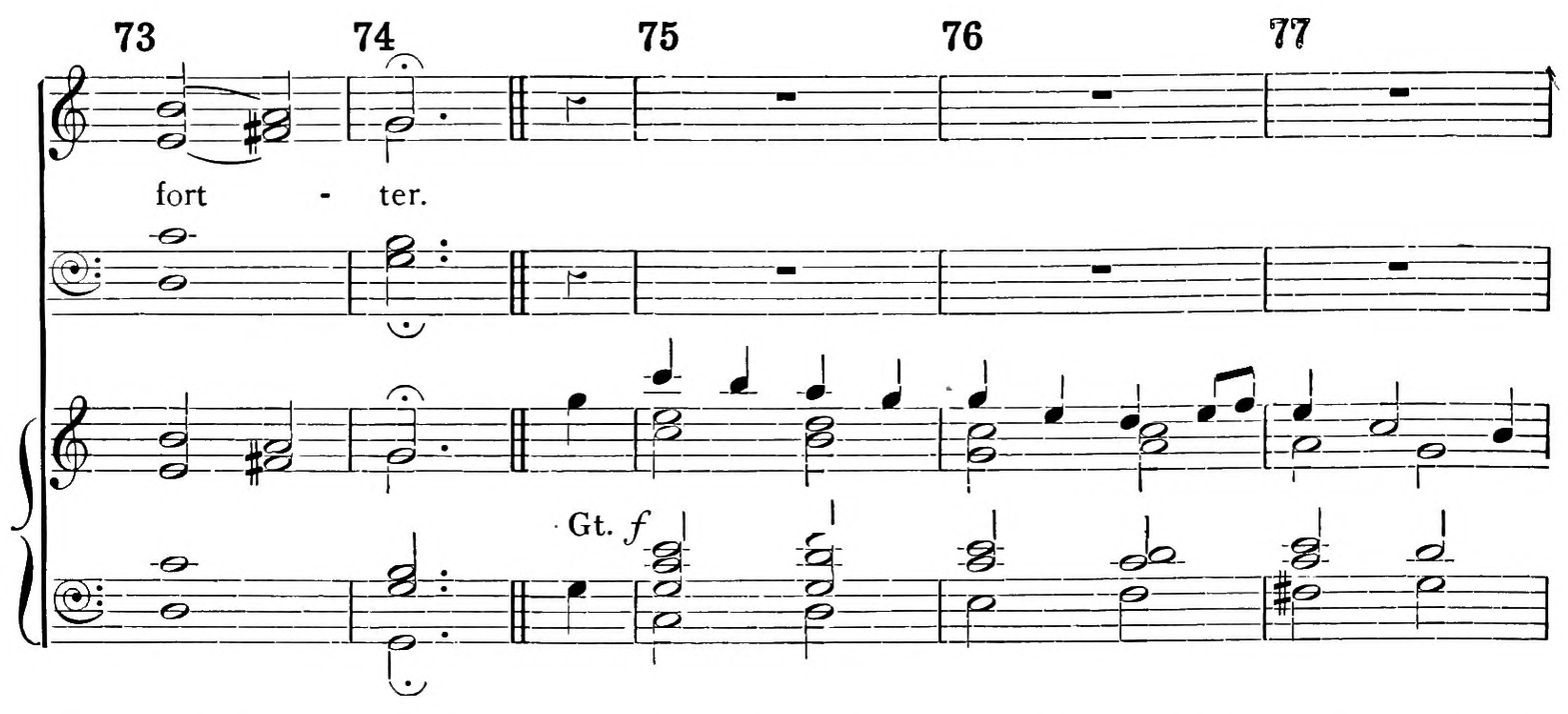
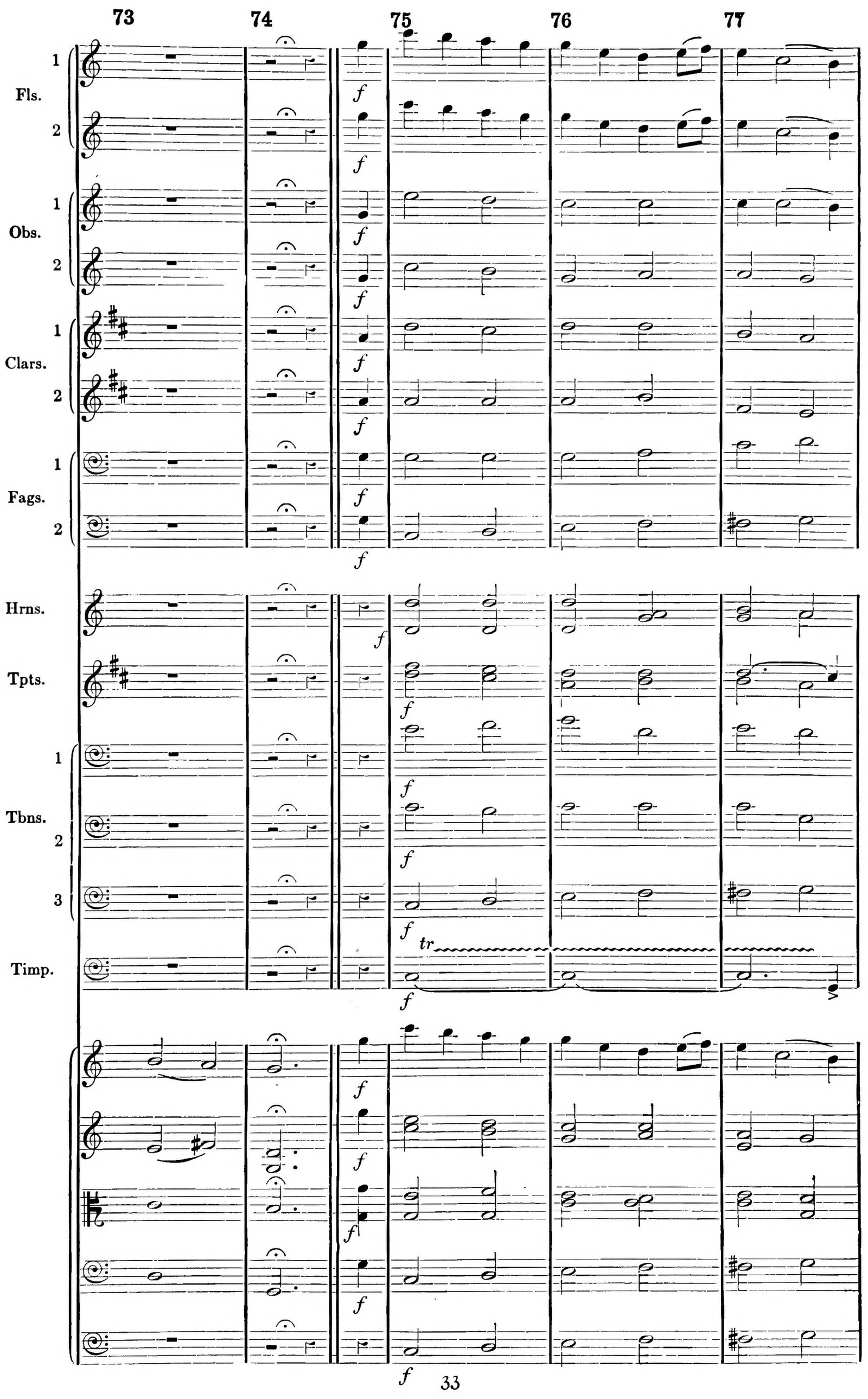
Bar 75 brings us to the return of the introductory subject, which, we have already agreed, is not to be re-scored. We can, then, put reference numbers 1, 2, 3, in blank bars 75, 76, 77. This is done in one minute, and we pass on to the entry of the chorus in bar 78. Doubtless this will be brass tutti, as before. But let us pause for a moment and look forward. Bars 78 to 88 are by no means the same as bars 5 to 15. And their difference introduces us for the first time to an unsolved musical problem—the orchestral translation of a steadily moving pedal-bass. This form of musical expression, so tremendously effective on the organ, is practically unobtainable in the orchestra. However much we add to the bass-octave—bassoons, double-bassoon, trombone, tuba, cellos, and basses—we never get the true effect. We can indeed substitute something as loud; but the solidity and the fateful determination of the moving pedals are beyond the reach of the orchestra. There is an orchestral effect somewhat similar to it. And that is obtained by putting the moving passage on strings tutti in three octaves, with perhaps the addition of bassoons.
But, the reader may ask, is not that the very thing for us here? The brass and woodwind will play the upper harmony, and the strings will give the motion. Well, there are two objections to such a course. In the first place this sort of passage, to be effective, needs a certain regularity and narrowness of compass, neither of which is to be found between bars 78 and 88. No regular figure is established; and the actual scale-length between bars 79 and 83 is nearly two octaves. It is of course possible to jump the strings up a seventh, as opportunity occurs, in order to pin them down to one register. But if we do this with such a heavy weapon as tutti strings, we cannot help stultifying the passage itself. And moreover the jumps that suit one instrument do not suit another. The violins in particular, chained down as they are forced to be to their lower register, are bound to suffer.
 Playable Books