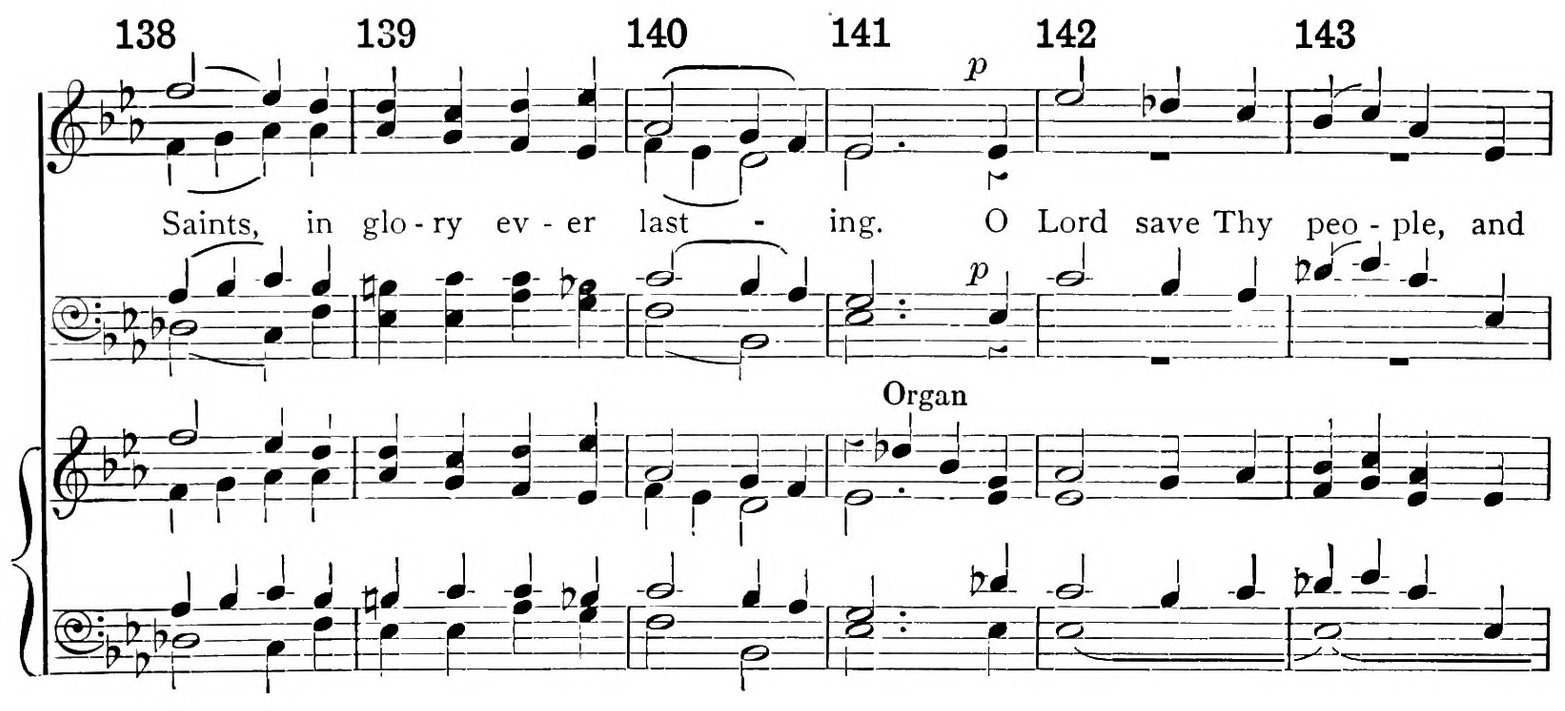
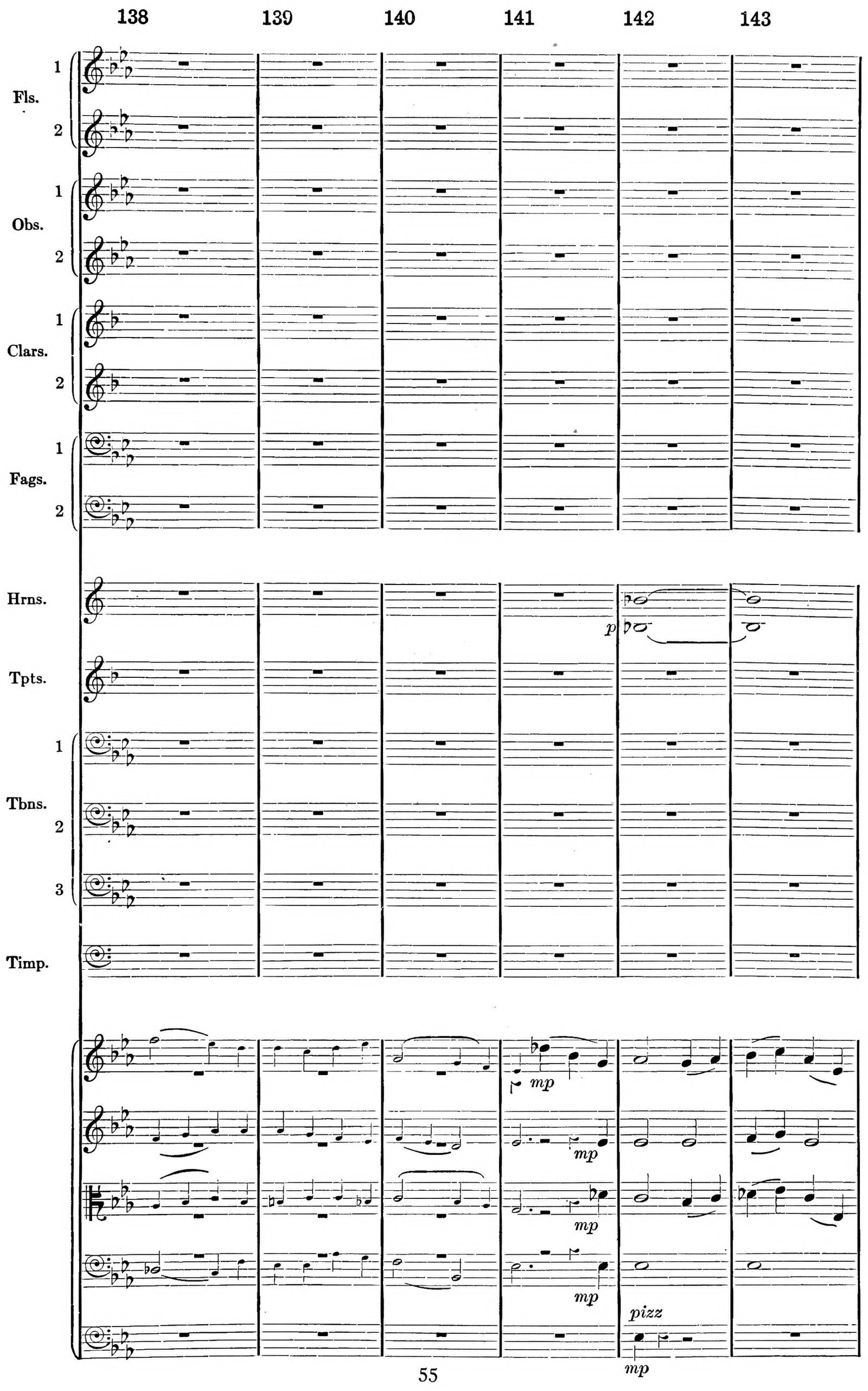
The above few paragraphs will give the reader a rough working idea of what the cueingin system is. But, in order to see it in full flower, he should examine some of the modern commercial arrangements of popular music. The stunted growth of our own cueing-in ends at bar 141 of the Te Deum. One's natural tendency would be to let the violins steal in pp in that bar. But we had better look forward. Bar 146 brings us to an energetic phrase marked “Gt. ff”; then we have two bars (150 and 151) of a distinctly crescendo-like character, followed by an undoubted orchestral climax at the change of key. Finally, at bar 155, there is a bold soaring melodic passage which must be treated in the grand style. All this presumes a good deal of brass. Yet we do not wish to use more than is necessary.
Let us work backwards. The tune at bar 155 can be painted-in in strong colours over a background of trombones p. We must have a full brass chord f at the down-beat of bar 152. But the pitch of the two preceding bars suggests the omission of trombones and basses. The least we can do with our two two-bar phrases (bars 146 to 149) is to use a smallish orchestra f with as little heavy brass as possible mf. That practically makes it necessary for us to begin, after the unaccompanied chorus, with strings mp and horns p. But we shall treat the whole of these eleven bars (141 to 154) as economically as possible. Here, then, is our scheme:
Strings and horns (141 to 145) Small orchestra f, with some brass mf (146 to 149) Crescendo in the higher register (150 and 151) Orchestral forte at the change of key (152 to 154) Tune in octaves f, with trombone tenuto p (155 to 164)
 Playable Books