There are two main facts to keep in mind when cueing-in orchestral parts. First there is what I may call the “scale of probable presence” of the various instruments. Unfortunately on this point publishers are by no means at one, except with regard to their own individual catalogues. However, they are all agreed as to the rarity of oboes, bassoons, and violas; and the comparative abundance of pianos, drums, violins, cellos, cornets, trombones, and even flutes and clarinets. The second fact is the undeniable axiom that if an instrument is playing one set of notes at a given moment, it cannot also be playing another set at the same time. The importance of this general statement lies in its application. That, however, does not forbid the occasional writing of the true part and of the cued-in part on the same staff. Indeed in first violin parts this is normal; and many orchestrators contrive a special two-staff violin-part which gives the leading violinist a pleasant and continuous survey over the whole musical field, as well as the opportunity of unlimited activity during a performance.
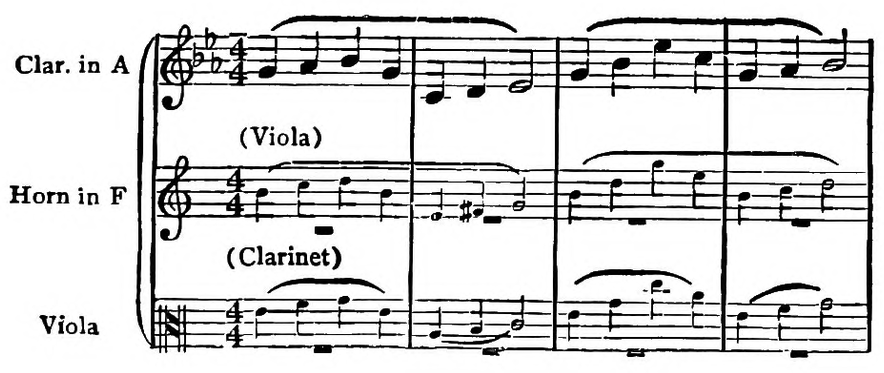
The technique of cueing-in is remarkably simple. The first-choice notes are written large: the others—second, third, fourth, and so on—small. Above the second-choice notes the name of the first instrument is placed: above the third-choice notes the name of the second, ad infinitum. Were this not done—that is to say, if the name of the firstchoice instrument were placed above the parts of all his less-favoured brethren—the latter would all play the passage in the prodigal son's absence. In a word, the following tabloidscore means: First-choice, clarinet; in default of clarinet, viola; in default of both, horn.
 Playable Books