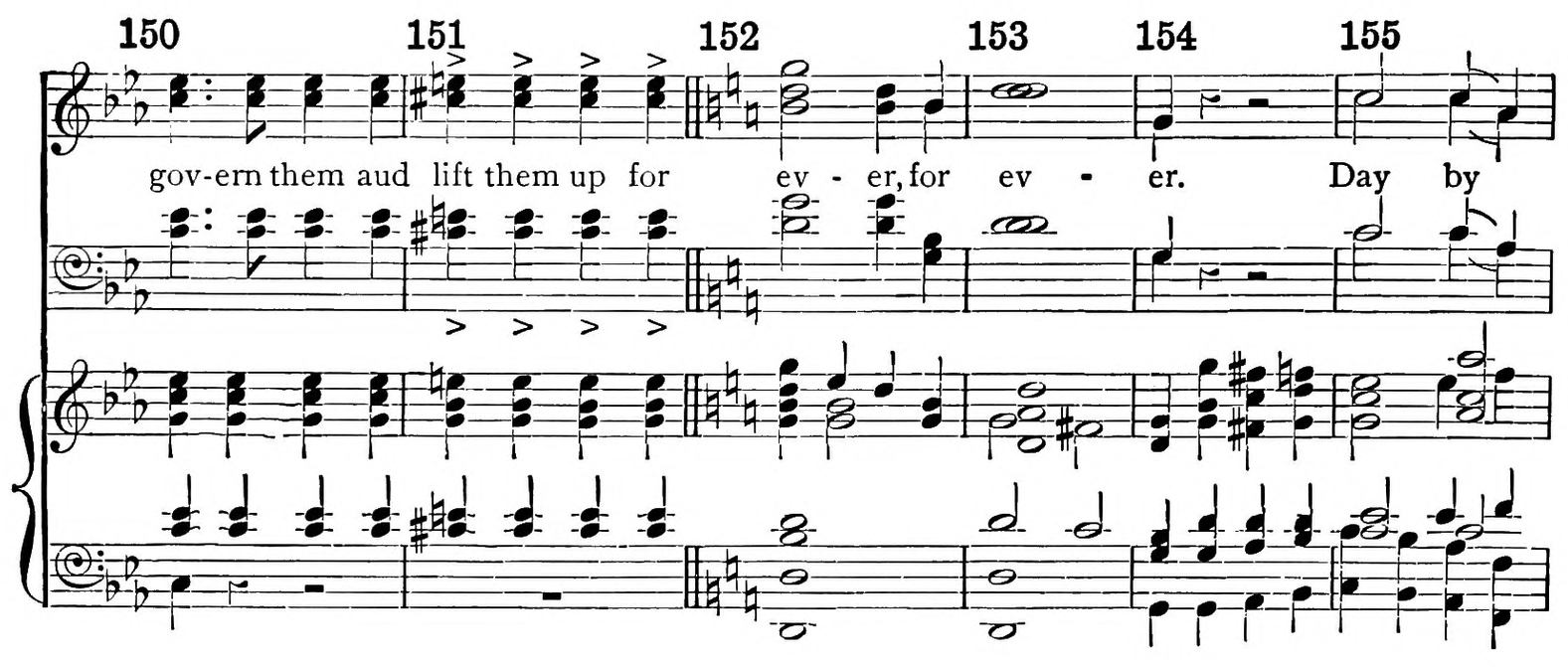
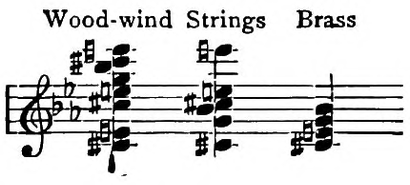
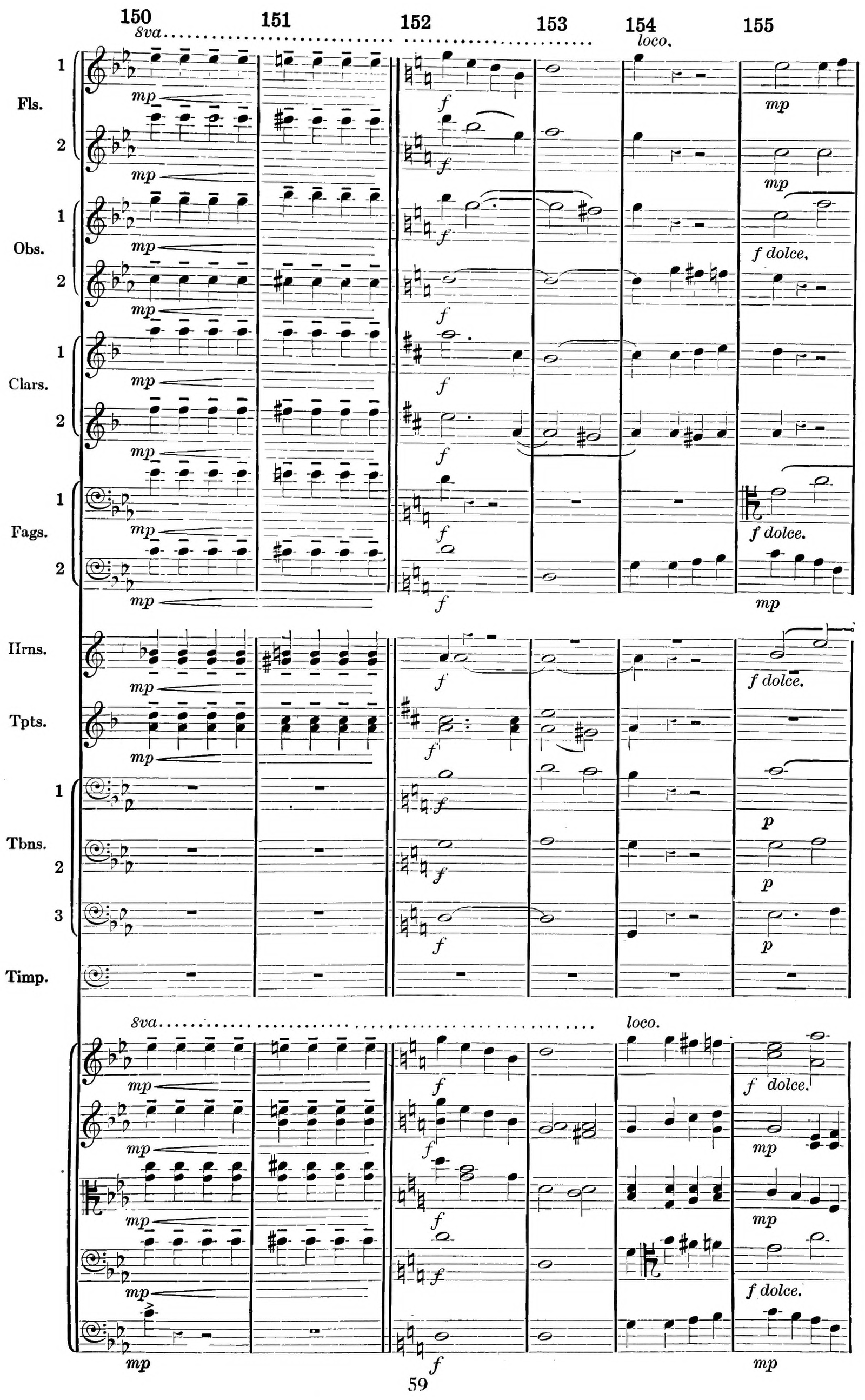
The crescendo bars (150 to 151) poised as they are in the upper air, come out with a sort of surging vigour. Here the E- and A-strings have an opportunity to assert themselves; while the wind is all well paced for this sort of effect. If we group the notes of bar 151 together on a single staff for purposes of easy inspection, thus,
we cannot fail to observe that, though this is—and sounds like—a very high chord, the actual thickening is downwards. Between the two fiddle E's there is nothing but woodwind, not a twentieth part of the orchestral tone-mass in this particular bar. The orchestral forte at bar 152 does not call for any particular comment—its main effect is gained by means of the six-part brass-chord on the down-beat—but the treatment of the tune three bars later does. Here we have a broad melody, a solid harmonic accompaniment, and our tantalizing old acquaintance the moving pedal-bass. The tune is quite satisfactory as an octave-combination of first violins and oboe plus cellos, horn, and bassoon, all marked f.
 Playable Books