Playable Books
Cecil Forsyth · section 37 of 39
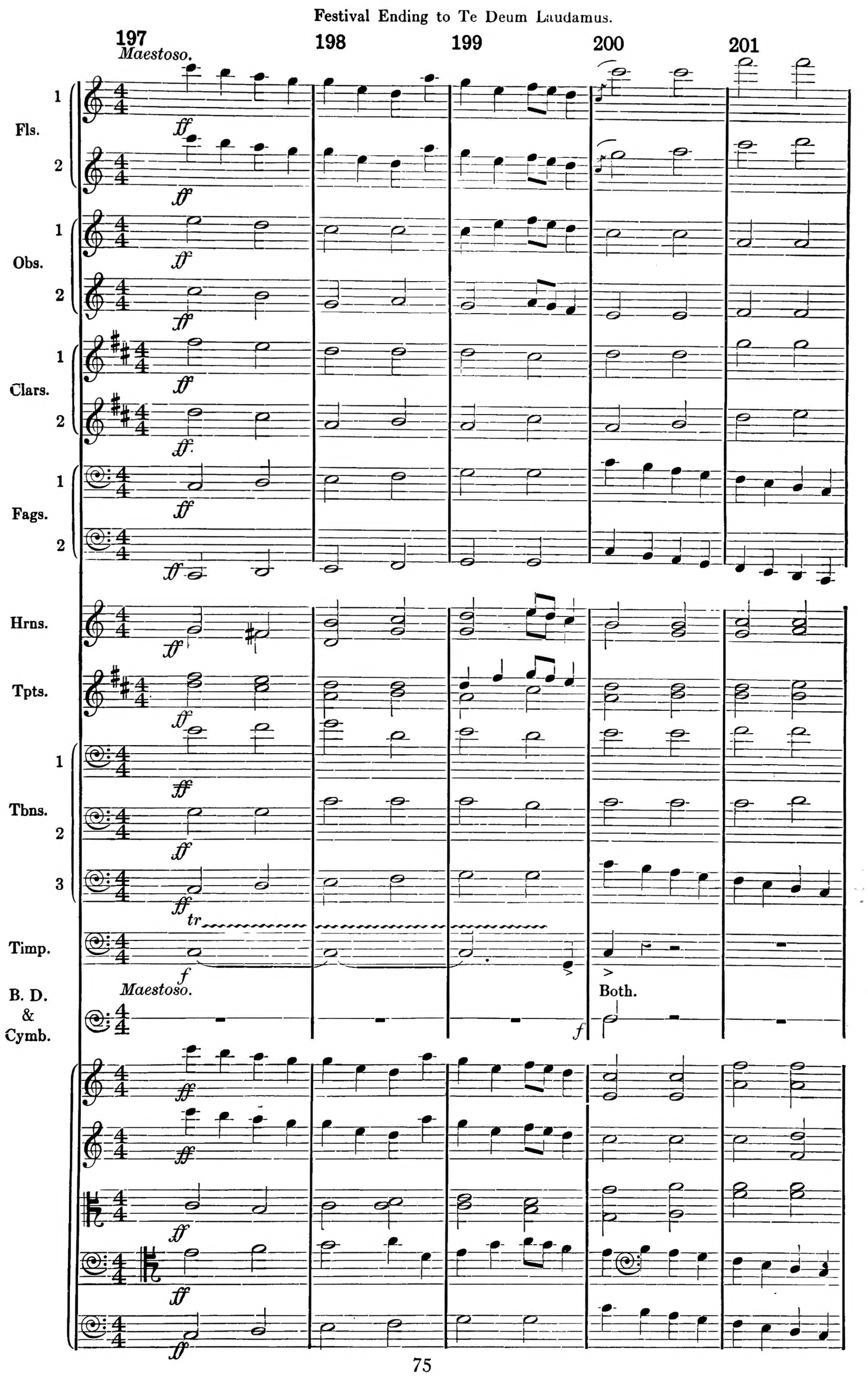
[Bars 197–201]
Read and hear this section in the playable edition →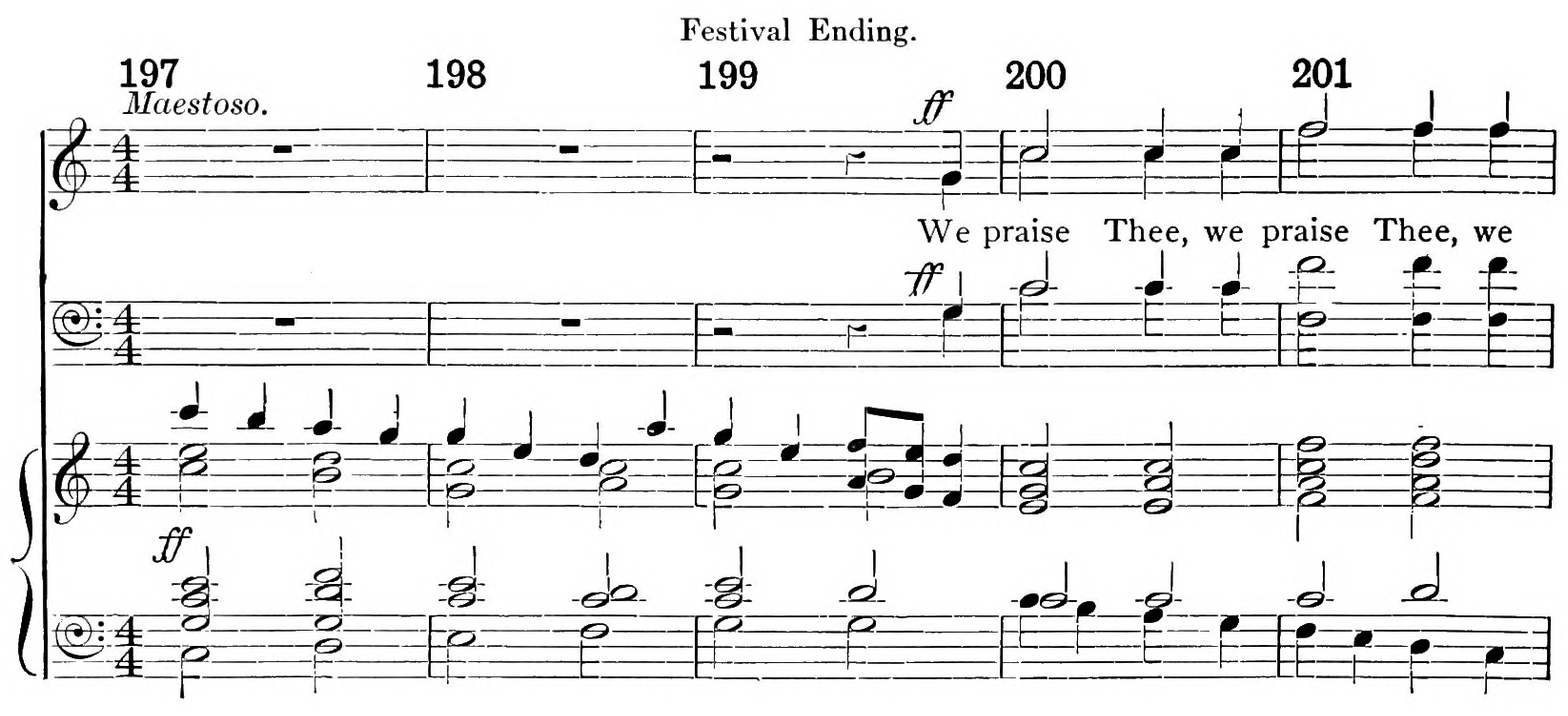
The “keynote” of the Festival Ending is solidity. All our forces will have to be marshalled and evenly distributed over the ground. There will be no resting for anybody but the drums, and in that department we shall for the first time use our blank line for bass-drum and cymbals. That is our general strategic plan. Furthermore, as both chorus and organ are marked ff, we shall transfer that marking to the orchestra. There will be no dynamic “saving up” for a rush at the end, except that we shall try to carry out the composer's evident wishes by giving him a high well-placed chord of C major at bar 211. As we have already hinted on page 34, we might use our strings here tutti in a threeoctave combination to enforce the plump pedal-bass. But strongly against that plan is the fact that, down to the middle of bar 205, the chorus is singing in unison and not in harmony. Its unison moreover, on the accented beats, is practically identical with the moving-bass. We shall therefore do our best for the pedal-part with cellos and basses reinforced by bassoons and third trombone, regretting the absence of tuba and doublebassoon for the lower octave. We have to make up our mind here whether we are going to take our first flute and first violins right up to the top C at the end, an octave above the written note of the organ-part. There is no reason why we should not, and every reason why we should. The question then is: Are we to keep the first violins in the upper octave throughout these sixteen bars? On the whole it is better not. It makes the opening (bar 197) unnecessarily high, and also sounds over-insistent if continued too long. The latter point, however, is only of importance when the violins have nothing to play but tenuto notes, as here, instead of brilliant figures and passage-work. Our best plan then will be to leave bars 197 to 199 much as they were at the beginning of the Te Deum; to write the first violins from bars 200 to 205 in the lower octave, placing the flutes above them in order to add resonance to the tutti; and then, in the middle of bar 205 where the chorus begins to sing in harmony, to jump the first violins up an octave into unison with the first flute, and leave them so to the end.