 Playable Books
Cecil Forsyth · section 39 of 39
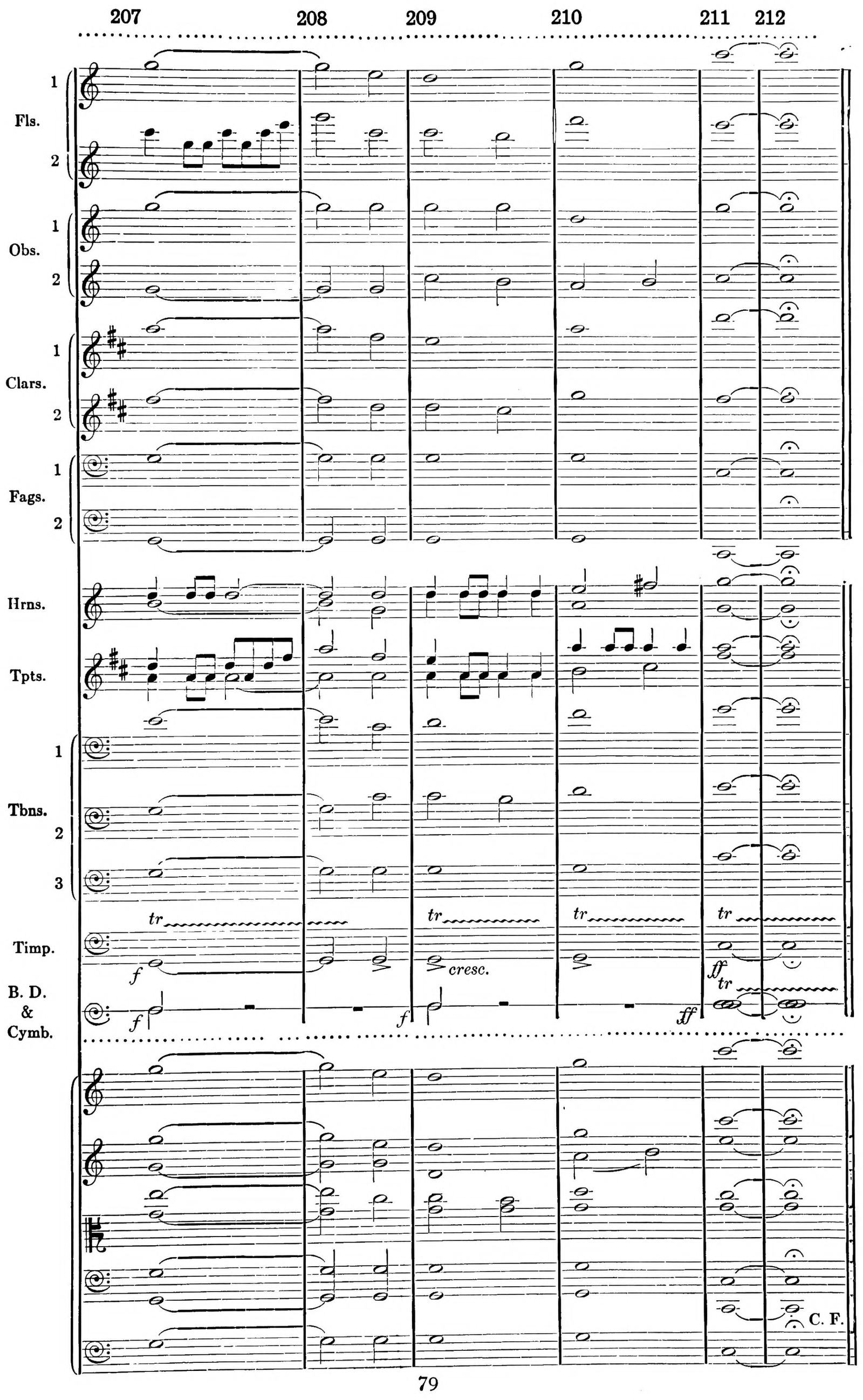
[Bars 207–212]
Read and hear this section in the playable edition →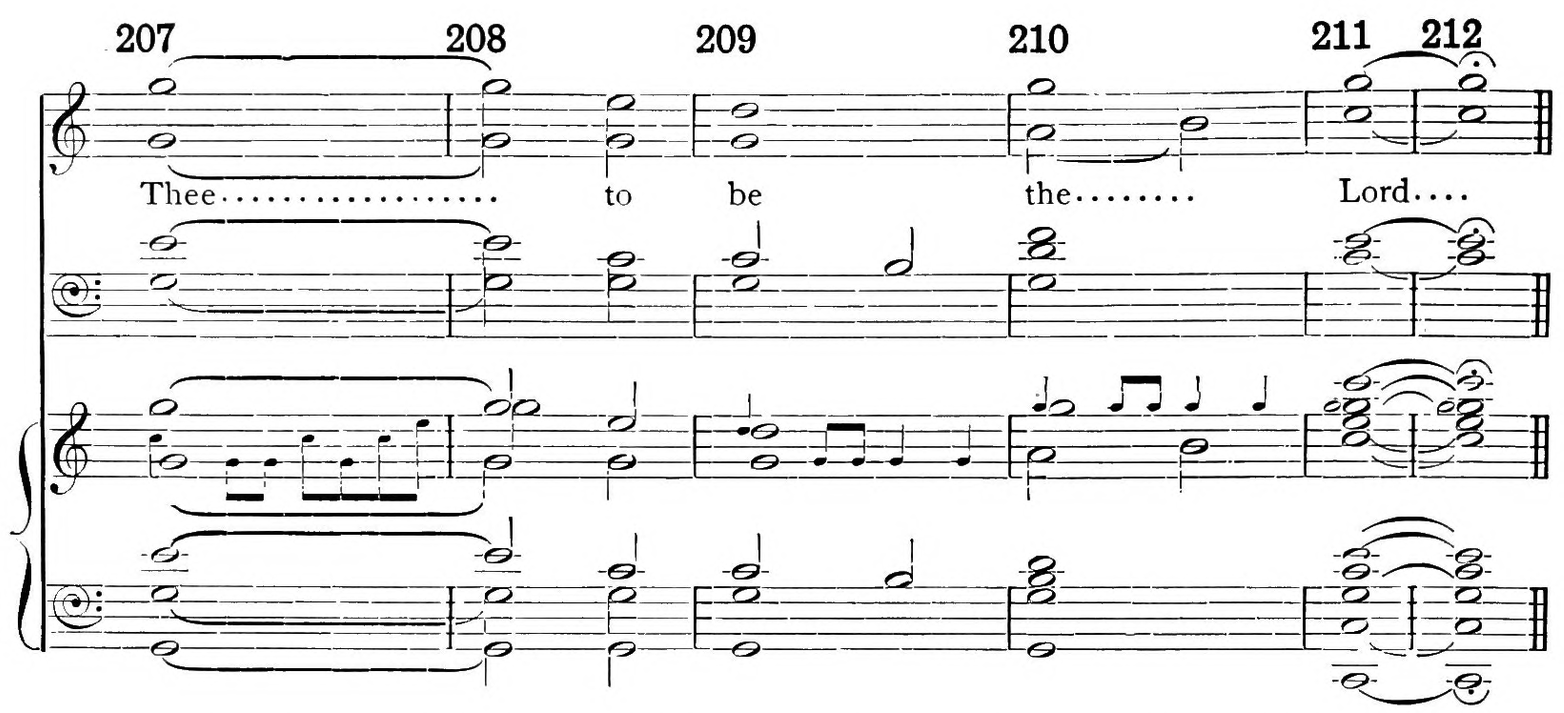
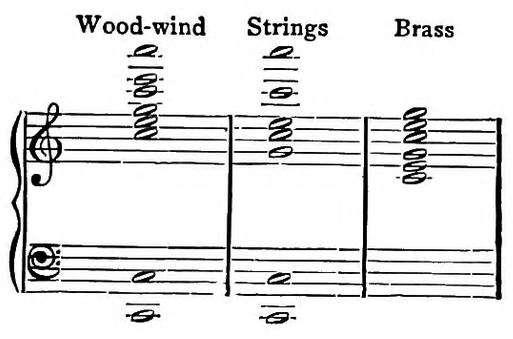
One word with regard to the ad libitum part for bass-drum and cymbals. The beginner may not think so, but there are rather too many than too few notes in the part. However, as the Festival Ending is meant to thrust its head triumphantly in the air, they may be left as they are. In bar 210 a seventh has been added to the orchestration (second flute, second clarinet, and first trombone). This is allowable, as it appears in the chorus. Its omission from the organ-part may be a misprint or an oversight. The actual final chord of the whole work (bar 211) is “placed” for extreme brilliance. From the “placing” of the choral parts this is apparently the composer's intention. The brass in the orchestra practically reduplicates the chorus with the addition of the two missing notes of their chord. But all the brass notes are written in what may be called a “position of maximum efficiency.” Here are the three sets of notes, wood-wind, strings, and brass, side-by-side:
As we have now completed the scoring of the Te Deum, let us cast a Parthian glance backwards over the work and its orchestration. In a general way it may be admitted as a solid work that needs solid forceful treatment. So far as that goes, it is an excellent example on which the student can build. It provides him with the material for making those “broad decisions” of which I spoke at the beginning of this volume, and also with the detailed “dog-work” which is necessary to carry out those decisions. The scoring, if anything, is a little bit on the emphatic side. But the total effect in performance is rich, robust, and brilliant where it is meant to be so. These qualities, though not the subtlest in the world, are worth keeping in mind when dealing with the chorus. For the attitude of the chorus is often one of vigour and determination. And, when this is so, its junction with a poor threadbare orchestral ensemble is miserably ineffective. True, the chorus will be heard better, the less we put into the orchestra. It will also be heard better still with no orchestra at all. But, not to split hairs on this matter, one is throwing away one's sharpest weapon, unless one regards the two forces, the vocal and the instrumental, as a fusion, out of which may come a metal stronger and finer than either of its component parts.
That does not mean necessarily that one is to be constantly on the lookout for orchestral “effects”; though even that seems to me to be preferable to the more common custom of pinning the first violins down to soprano parts on their A-strings. One must be ready for anything, according to the character of the music—loud and soft, high and low, bright lights, half tones, and shadows. The orchestra can face all these problems and solve them. But their solution must be in terms of the orchestra plus the chorus, not in terms of the orchestra alone.
And here it is well to remember one fact. The chorus so often makes its final appeal by means of an overwhelming mass of sound that we are apt to forget that, as far as dynamic range goes, it leaves every department of the orchestra far behind. At one moment it may be nearly lifting the roof off a concert-hall with its mighty shout. At the next, perhaps only altered in pitch by the interval of a fifth, it may be whispering so tonelessly that a mezzopiano pizzicato in the orchestra sounds to the audience almost shockingly loud. And between these two limits there are a dozen others; there are endless distinctions of shading and expression; there are all the manifold differences that come from variations in the spread and placing of the parts.
Naturally we cannot expect all these fine things in a single setting of the Te Deum. This Te Deum, in prticular, has no striking example of solo accompaniment; nor of fugal writing; nor of what may be called the pitting of the orchestra against the chorus. Each of these styles offers problems and opportunities to the orchestrator. So that a few more pages may well be devoted to their consideration.
It is difficult to lay down any precise rules as to solo accompaniment. Obvious generalities—such as the fact that contraltos are not well heard against a ff background of brass, or that a dapper little passage for strings will not blot out the high notes of a soprano—are scarcely worth putting on paper. The modern orchestra, with its marvellous pianissimos, makes one hesitate before trying to embody its laws in a new set of musical commandments. Almost everything, one may say, is possible; provided the composer has an understanding of the wonderful instrument that he is employing—the human voice.
From individual singers little, I fear, is to be gleaned on this general topic. For two artists, almost identical in vocal strength and in the power of sustaining the pitch, will express diametrically opposed views on the subject; one calling for constant orchestral support with brass at every climax and semi-climax, the other rejoicing to stand before the audience almost unclad harmonically. It would be a great deal more than surprising if singers were to be found to agree about anything: indeed such an extraordinary state of affairs would probably foreshadow the end of the vocal art. Therefore the discovery, or supposed discovery, of any such agreement should certainly be put on record. As I understand, or think I understand, them, they all dislike harmonic or contrapuntal movement in the neighbourhood of their voice or above it. Not mere backgrounds, let it be understood, nor melodic octave-combinations; but actual movement, harmonic or contrapuntal. Even those singers who are loudest in their call for orchestral support are keenly resentful if the buttress is carried too far up the tower from which they are singing.
Good modern singers, however, are quite well aware that music cannot always observe these restrictions. They are necessarily great specialists in the psychological study of mass-emotion. (This is a polite way of putting it.) They have no difficulty, therefore, in “sensing” the effect on an audience of the modern orchestra, with its big brass passages, its spread tuttis, and its terrific violin-onslaughts in the top octave. They do not desire to shirk their part in these orgies of sound. But they do ask—and very naturally—two things for the sake of their voices: first, that their parts shall not be all climax from beginning to end; and second, that when the climax does come, the composer shall take as much trouble in writing the most effective notes for them as he does in the placing and grouping of his orchestral instruments. Only by doing this can the composer avoid stultifying himself. But it presumes a good deal of study and observation on his part, both of which have to be undertaken in the theatre and the concert-hall, not at his desk. It is really astonishing how ignorant many clever men are on this point. So much so that one might almost classify composers according as they like or dislike singing.
This is, however, a little bit removed from our main topic. Most singers of experience will say that the only people in the orchestra of whom they are afraid are the woodwind. As a matter of hard scientific fact, the only orchestral instruments that have the same tone-producing mechanism as the singers—that is to say, the vibrating double-reed—are the oboes and bassoons. Hard scientific fact, however, though a good guide towards the promised land of music, is a poor camp-master when we arrive there. We may therefore accept the singers' general statement as true. And I would add to the caution in two particular ways. First with regard to the upper wood-wind, and especially the flutes when they are actually pitched above the voice. This tone-colour, though not of great importance in the orchestral ensemble, is terribly hard to struggle against vocally. It sets adrift a sort of orchestral fog round the singer's notes. The reason is certainly not to be sought in the fact that the mind is drawn away from the vocal-line to whatever sound happens to be uppermost at the moment. There are many good arguments against that view. More probably the fog is caused by the unhappy prominence of upper-partials which are useless or noxious, not to the chord of which they are a part, but to the individual note which the voice is singing. This is made the more likely by the fact that the woodwind are much more congenial to baritones and basses than to sopranos and contraltos. Indeed it has often been noticed that, if a basso profundo is singing the true bass of a chord, the addition of the upper-partials on the wood-wind adds enormously to his bassic profundosity. But, of course, if music had to be written with a text-book of acoustics open on the piano, it would not be written at all. At any rate, it is an undeniable fact that, when an injudicious vocal accompaniment has to be lightened for public performance, nine times out of ten the best way of doing so is, not by cutting out the horns and trombones, but by blue-pencilling the flutes and oboes.
The second caution is founded on a fact which was, I believe, originally pointed out by Professor Corder—the fact that the dynamic temperature (maximum and minimum) of the wood-wind instruments is inside that of the other orchestral groups. If they blow hot you won't be scorched; and if they blow cold, you run no risk of freezing. I am not concerned here with the maximum side of the comparison, as orchestral noise is always an easily purchased commodity. But the minimum side is of particular importance to the matter in hand. It comes to this: that sixteen good fiddlers can shade down a note through all the degress of p, pp, and so on, until it sounds no louder than the last breath of a butterfly. But set the same task to sixteen flautists, or oboists, or clarinetists, and see the result! There will indeed be a diminuendo. But, long before the “butterfly's breath” stage is reached, the vibrations will refuse to be further reduced in amplitude by the lips of the players. The choice then is either to play no softer or to stop playing altogether. And even if you divide sixteen by sixteen and make the answer “one,” the remaining player has no chance in this particular competition against his brethren of the string.
Hence for purposes of accompaniment, incidental obbligatos, and so on, one has to face the fact that the wood-wind are not only similar to the voice in their tone-colour, but also are never reducible, as the strings are, to vanishing point. They always remain something more of a “fact.” They are playing or they are not. But there is none of that delicious border-country which leads one from the workaday world to fairyland.
In the brass department these cautions are scarcely necessary—the dangers of overemphasis are so obvious when accompanying a solo voice. Not that the brass, alone or in combination, cannot be used occasionally with perfect safety. In the theatre particularly, that method of accompaniment has been a commonplace since Mozart's time. But it needs a special character in the music; and, if it is to sound p, a specially low-placing. The treatment of the brass in the Te Deum must by no means be accepted as normal. The intention of the work is loud and jubilant. It gives no opportunity at all for any of those mysterious low-pitched tenutos or those sudden unexpected outflarings which are to be found in some modern music. As the brass is treated in the foregoing pages, it is effective for its particular purpose, that of solid choral support. But it has many other uses, running through the whole musical gamut from the light pizzicato style of comic opera to the tremendous harmonic passages and melodic unisons of tragic music-drama. One last word about the brass: in the brassiest work ever written the majority of the bars in the brass-parts are silent bars. And in the average work two-thirds of the brass playing is p and mp. Were that not so, it would mean that the composer was throwing away one of the strongest weapons in his armoury, the power of crescendo from the heavy brass. Occasionally, it is true, in opera one finds long scenes in which the brass pumps away f and ff from beginning to end. I do not know who enjoys these scenes. The players certainly do not. Nor does the wretched audience. And as for the singers, it reduces them to the level of a lot of animated dolls, gesticulating, open-mouthed—and silent.
However, it is to the strings that the largest share in the vocal accompanying must fall, the strings either used alone as the whole body-musical, or in combination with other tone-colours as the spinal column thereof. This is but natural. Their sound is so beautiful in itself that one never tires of it. In flexibility, dynamic range, and especially variety (to be secured by phrasing and bowing), they are in a class by themselves. Finally it must not be forgotten that the voice is a wind-instrument and they are not. These are almost musical truisms; but, as Edward FitzGerald said about the common chords “like other truisms so little understood in the full.”
One word of caution may be added here for the benefit of those who are not as familiar as they might be with string-quartet writing. String-parts often look remarkably thin as compared with the serried masses of notes in the brass and wood-wind departments. The beginner is therefore tempted to think that it would be better and safer if he filled up all his chords with divisis and double-stoppings. Now, the string divisi has been a legitimate orchestral effect ever since the days of Lohengrin. For its special purpose in the high, middle, and occasionally even low registers nothing can be more exquisite. But it is precisely that—a special purpose tool, involving the subtraction of half your players for each additional part that you write. Double-stopping, again, is a very useful and necessary portion of the orchestral routine. In the second violins and violas especially it has to be used continually, sometimes as mere padding, but more often with the object of including notes that are vital to the harmony. And this leads us back to our original theme: that if the part-writing in the strings is contrapuntally and harmonically correct, the constant addition on every chance chord of divisis and double-stoppings not only does not help matters, but takes away the elegance and distinction of the music, and substitutes for it indistinction and muddle.
We now come to the topic of fugal accompaniment, not so much in its full-dress aspect—for that is too vast a subject—as in its easy modern undress, the fugato. Here the beginner's difficulty always is that he fears that he is not doing as much with his orchestra as he might. On the other hand he feels in his bones that fugal writing is fugal writing, and that the addition of any of the thickening-sauces from the modern orchestral recipe-book is pure musical blasphemy. What is he to do then with his big score-paper?
Well, the answer is very simple. His musical instinct is sound. If a fugue or a fugato cannot make its proper appeal to the audience by means of its contrapuntal parts, then it is not worth writing. There is only one way of scoring it: by doubling the vocal parts in the orchestra, distributing them solely according to the pitch and force required, with only the occasional license of an octave-doubling at discretion in the outside parts. Elementary as this sounds, if he will try to put it in practice once or twice, he will see that it gives him ample opportunity for orchestral planning on a large scale, even of dynamic-engineering.
If he is afraid that this is “going back to Handel,” he may be reminded that on this matter—contrapuntal expression—Handel had a particularly forceful mind; and also that he was by no means a fool on the subject of public performance. Strictly, however, it does not mean going back to Handel, but going back to Handel plus all the nineteenth century improvements in the mechanism of the wind-instruments. One must not forget that, in Handel's day, even such a simple procedure as doubling a tenor-lead by four horns in unison was practically out of the question. No doubt, had the nineteenth century instrument-makers preceded Handel, we should have records of fine noisy doings at Marylebone Gardens.
The last of the three topics mentioned above is that which, for want of a better name, I have called the “pitting of the orchestra against the chorus.” By these words I do not refer to that type of musical expression in which the two are used antiphonally. Such passages, when conceived with boldness and simplicity, seem to respond to something abiding and fundamental in our nature. But their technical treatment is generally fairly obvious. We only need to ascertain the psychological candle-power, so to speak, of the chorus, and then to answer it with our own lamp—whether it be the lamp of night, of light, or of the half light.
These musical equations, important in themselves and wonderful in their effect on the human mind, do not call for any comment here. But when we come to the vocal-instrumental combination, in which the instrumental half is asked to speak aloud and to say something intelligible while his partner is talking, then all sorts of difficulties begin to crop up. This is not a question of any mere decorative whigmaleeries, but of additional musical structure which is in the orchestra and is not in the chorus. Musically it may be anything. A single note, held as a pedal in the bass, tenor, or treble, might come under this heading. It might be an orchestral unison against a group of choral chords, or a group of orchestral chords against a choral unison. It might be a persistent figure, an elaborately worked ostinato which requires instrumental treatment for its proper expression. It might be a theme, incomplete in itself, and needing choral harmony for its completion. Finally it might be one of those instrumental organisms which preserve a semi-independent existence, acknowledging at the same time the sovereignty of their suzerain, the choral fugue.
These problems, to which many others might be added, are only sketched-in here to give the reader food for thought, food on which his imagination can flourish. But indeed the theme is endless. Had we any of the problems actually before us, it would be delightful to suggest solutions for them. But space forbids; for it would mean the printing of many more pages of full-score. This, however, can be said: that, whatever the vocal-instrumental problem, it must be solvable by study followed by experiment. And this method—analysis and synthesis, if one pleases to put it so—is exactly the plan that has been pursued time-out-of-mind in teaching the simpler subject of orchestration.
Let the reader then study the scores of the great masters with a cool mind. Let him afterwards visit the concert-hall with as much of the score in his head as he can carry, but with none of it in his hands to distract his attention from the music. In this way he will learn much from their successes. From their failures too he will be able to glean something, if he keeps his judgment sanely balanced as between the orchestral methods of the past and of the present.
Felix quem faciunt aliena pericula cautum
Happy the man made wary by the dangers of others.