 Playable Books
Cecil Forsyth · section 6 of 60
No. 2. The Bass-Drum
Read and hear this section in the playable edition →

Fr. Grosse caisse; It. Gran cassa, cassa grande, or simply cassa;? Ger. Grosse Prommel.
inste Be BuDit for asies considerablect te freel sinse. headed drum which does its humble offensive duty in the Music Hall.
In the standard military and concert pattern, the wooden shell is cylindrical in shape, and its depth is narrow in proportion to it diameter. The parchments are stretched at both ends over hoops, and an arrangement of leather tags or braces working on an endless cord
13rd Royal Fusiliers.
" In old Scores sometimes Tamburo grande or Tamburo grosso.
gives the player some latitude in tightening and loosening the heads. There are no snares.!
The stick used is heavy, with a large knob padded with felt or some other soft material.
The Germans had, or have, a sort of birch-broom, called Ruthe, with which to beat the Bass-Drum. There is a part for it in Mozart's Il Seraglio, where a good deal of this sort of thing is to be found:
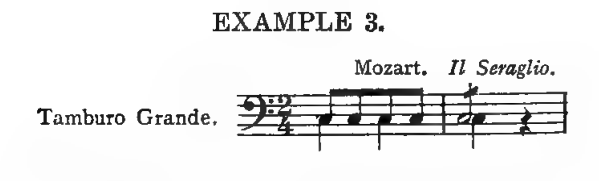
The player is evidently meant to beat the quavers with the Ruthe and the crotchets with the ordinary Bass-Drum stick: Mahler has revived this method of beating in the 3rd Movement of his 2nd Symphony. Just before "No. 34" a passage occurs in which the Strings, Piccolo and Kettle-Drums (off the beat in a § movement) are combined with reiterated semiquavers for the Bass-Drum played with the Ruthe.
When the instrument is struck in the ordinary way, slow irregular vibrations are set up which have something of the effect of the deepest 32 ft. pipes of the Organ. In the pianissimo they strongly resemble and have often been used to imitate distant artillery and thunder. instrument has, of course, no definite pitch but it is matter of general observation that the rest of the orchestra and especially the heavy Brass tend to give it definite pitch. This is no more than an illusion and, as it is not of constant occurrence, it is probably explained by the chance coincidence of its strongest vibrations with those of the fundamental bass. Every time the Drum-head is struck it sets in motion sound-waves of various sizes. At any moment some of these may happen to be identical with the definite sound-waves of the more prominent orchestral instruments. The resuit is an increased sympathetic vibration and a reinforcement of tone which appears to come from the Bass-Drum. We may note in passing that this sympathetic vibration of the partially-slack Drum-head is a matter for consideration in the concert-room. No one who has stood near the Bass-Drum during a concert performance can have failed to notice the places where it begins to sing apparently of its own accord. The result is always unpleasant. To obviate it a cloth should be hung over the head of the Drum when out of action.
The Bass-Drum is muffled by drawing a cover over it, by slackening the head, or by a combination of these two methods.
On such a ponderous instrument, quick rhythmical figures are quite out of place. Indeed, though playable, they are unpractical, for each succeeding note of a quick series merely damps out the preceding
refinement at as says Mr. Gain had as sis which cared a der instrument. * note before it has had time to sound. Single strokes can only follow each other at a moderate speed
On the other hand, the roll is both practicable and effective. played either with the ordinary stick, with a double-headed stick, or, less effectively, with two Kettle-Drum sticks. The Bass-Drum roll has been a favourite pianissimo opening with composers for two generations. An early example can be found in the long roll that accompanies the Strings in the opening of Liszt's Ce qu'on entend sur la montagne. A similar use of the Bass-Drum roll is quoted below from Strauss's Also sprach Zarathustra.! In this example, the Bass- Drum is combined with a deep C for Double-Basses divisi, Double- Bassoon, and Urgan. In both these examples the player is directed to make the roll with two Kettle-Drum sticks.
The Bass-Drum part is conventionally written on a stave in the bass-clet. Ihis is, however, only matter of convenience. A single line may be employed. The Cymbals are usually written on the same stave as the Bass-Drum. The two parts must be distinguished by two sets of tails to the notes. Each entry should be marked with the name of the instrument and its exit by a rest. All that was said above with regard to the notation of the "roll" applies here. There is, however, no necessity to end the roll with a detached stroke. It is as well to remember that the Drum-head vibrates for some little time after a mf or f stroke. The written note should therefore represent the actual length of sound required. In cases where a specially short note is wanted f, the word "damp" should be added to the part
Apart from the use, or rather the abuse, of the Bass-Drum and Cymbals in Ballet and March music, the former instrument has two main orchestral uses:
(1) To mark the high lights, or the progress and climax of an extended crescendo.
(2) To convey a feeling of awe and solemnity by means of its pP notes.
In both cases, the instrument is used in a very simple and obvious way. In the first, the Bass-Drum part is confined either to a small series of notes spread out over many bars, and all marked in a carefully calculated crescendo, or to a single stroke or group of strokes at the climax of the crescendo. This would be difficult to illustrate without somewhat more extended musical quotation than is possible Quotation, however, is scarcely necessary. The idea itself is so simple. The student may, however, be warned that he should go through the dynamic scheme of a movement, and select only those few essential places for his Bass-Drum strokes where he feels that the great weight of the instrument is a necessity. In a long concert movement the part is probably right in the one case if there are rests in all but about four bars, and in the other case in all but one.
The piano of the Bass-Drum is on a higher artistic level. The mind perhaps from centuries of custom appears to respond instantly to its
1 See Ex. 274.
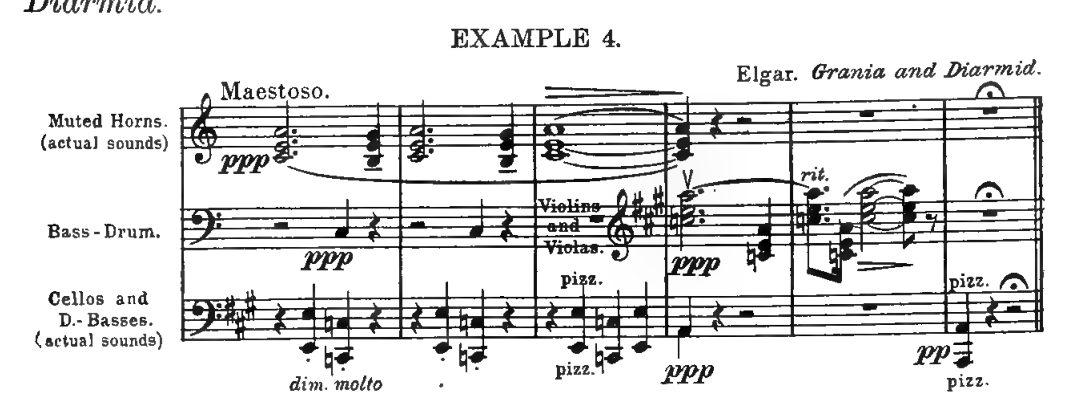
appeal as to something fundamental in human nature. booming stroke is sufficient to produce a sense of farawayness, of solemnity, even of hopeless desolation. It is scarcely possible to find an orchestral Funeral March which would not illustrate this point. Here is a particularly happy example of two cunningly placed Bass-Drum It is quoted from Elgar's incidental music to Grania and notes.
The Bass-Drum, Cymbals, and Triangle-known tamilarly In France as the "Batterie," and in England as the "Kitchen"—were first introduced into Operatic music in the eighteenth century. They were originally used merely as what we should call "local-colour instruments." That is to say, they were employed only in distinctly Eastern or Asiatic scenes. As often as not their "parts" were not written out at all. The composer indicated the instruments which he wanted in the Score, and then trusted to the fancy and the muscular development of his players. Even Weber' and Beethoven' were sometimes content with this haphazard way of doing things. latter composer uses three Bass-Drums in his Battle of Vittoria, one tor the orchestra and a couple to represent the cannonade. A paintul tribute to the Duke of Wellington, when one thinks of the Eroica.