 Playable Books
Cecil Forsyth · section 5 of 60
No. 1. The Side-Drum
Read and hear this section in the playable edition →
Fr. Tambour (militaire) or Caisse claire; It. L'amburo militare; Ger. Alerne Irommel.
This, the smallest orchestral drum,? is cylindrical in shape. The
"shell" is made of brass. At each end of the shell is a parchment
1 The Anvil is sometimes musical, at other times unmusical. See page 40.
" It is curious that the English word drum, which one might imagine to be as old as It first occurs in the Nottingham Town The date of
"head," that is to say, a circular sheet of prepared sheep-skin. The parchment "heads" are lapped over small hoops, which are themselves pressed down and held in place by means of larger hoops. An arrangement of brass rods and screws or of cords and leathers keeps the "heads" taut. The upper head-that on which the header beats is called the "batter-head": the lower, the "sure
Underneath the snare-head—that is to say, at a distance of two

parchments and a layer of air from the place where the drum-sticks hit the batter-head—are the snares. These are thin pieces, or a single long thin piece, of catgut, not unlike a rough Violin-string. They are stretched to and fro across the snare-head, from a nut on the one side to a screw-hook on the other. The number of snares varies according to the player's taste. They may be only two or three, or as many as a dozen." It is found, however, that the most brilliant effect is to be obtained with a fairly large number of snares. However many are used, it is essential that they should be screwed tight down into close contact with the snare-head
Iwo sticks are used. These are made of hard wood, with a small olive-shaped knob at the end. When the player attacks the batterhead its vibrations set up waves in the air which is contained in the shell. These waves are communicated to the snare-head, and so to the snares themselves. The immediate effect is to alter the character of the air-waves and to double the number of the vibrations. explanation of this "doubling" seems to be that the snares continually impinge on the parchment, and so set up a constant series of "points of nodal contact. In this way the pitch of the snared drum appears to be about an octave higher than that of the same instrument when unsnared. The student should note that it is on these snares that the peculiar quality and brilliance of the Side-Drum depend
Side-Drum playing is an art in itself, and a very difficult art to acquire. It ditters trom all other Percussion instruments in that its * on Thus: technique is founded not on a single stroke, but on double alternate strokes with each hand. Thus, in the "Long-roll" or "Daddy- Mammy," the player strikes the batter-head not Left-Right Left-Right, but I-RR-uL-RR. In each pair oi strokes the latter becomes, by incessant practice, a sort of controlled rebouno stroke.
A word must be said with regard to the notation of the "roll." Two methods are in use, one inaccurate and the other accurate. The in-
this entry is 1541. . The word Drumslade, with various spellings, is found earlier and is a commoner form in the first half of the 16th century. Drumslade is an Anglicized compound-word from the Dutch or Low-German meaning Drum-beat. It occurs continually in the State Papers of Henry VIII. For instance, —Under date 1532, «The dayly retinue of totemen of this towne...wel trymmed and furnished with their drom. slades, trompettes, and banerettes"; Under date 1532, «Paied to • Hans Pyper and Bartholomew his ffelawe Dromslade ; Under date 1532, • Paied to Xtofer Dromeslade and his ffellawe last two quotations are from the Privy Purse Expenses.
accurate way is to write out the length of notes required, and to add semiquaver or demisemiquaver strokes, thus,—
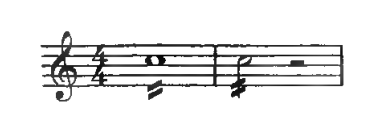
This is bad; first of all, because, however many strokes are used, it does not represent the sounds correctly: second, because it sometimes leaves a doubt as to whether the final note should be detached or not. Besides that, the inaccurate way is also the most tiresome to write.
'The accurate way to indicate a "roll" on any percussion instrument is to write out the length of notes required, slur them to each other for as long as the roll continues, and add an unbroken "trill line" to
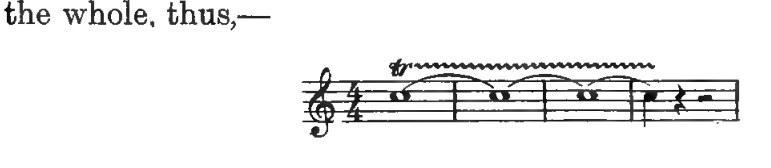
Do not write it in this way,-
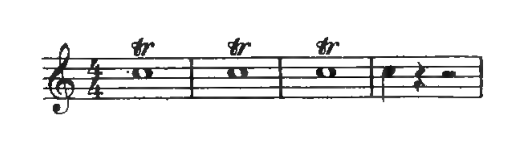
as it looks like a fresh attack on each bar. If you do not wish a detached stroke at the end, slur right on to the last note. If you do wish it, omit the last slur and see that the--.. comes short of the last note. If you wish a specially strong accent on the last or any other beat, omit the previous slur and mark the accent in the ordinary way, thus,—>.
The above remarks apply generally to all the instruments of the Drum family and will not be repeated. • Note, however, that in Side- Drum parts it is practically always necessary to write a detached note on which to finish the roll. The sudden cessation of the roll, except in the faintest pianissimo, sounds untidy and does not suit the genius of the instrument. Even if there are musical reasons for not wishing the sound to continue for the extra quaver, it is still better to write the "finishing note" to the roll. In this case, put it back a quaver or a crotchet, according to the rhythm of the piece.
the note ry he drum, it wil nobel tely beds ry to add sin at all
provided the sign.. .... is continued. If you actually want a
fresh attack anywhere, end the roll with a detached quaver or semiquaver, followed by a rest. Then begin a new roll.
In addition to the roll there are two other strokes commonly used on the Side-Drum. These are
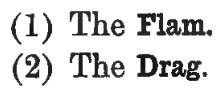
The Flam consists merely of two notes in this rhythm dd.
When the first note is on the accented beat of the music it is called an open fiam.
When the second note is on the accented beat it is called a closed flam.
The Drag is a series of two, three, four, five, or six strokes fused into a sort of instantaneous roll, and preceding an accented note,
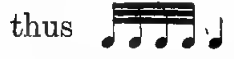
The Paradiddle is not really a rhythm, as is often supposed, but a method of arranging the strokes of a rhythm so as to secure an alternate left-banded and right-handed attack on successive principal beats. Thus, if the following simple rhythm|..../occurred
in one single bar only of a side-Drum part, the player woula pro ably perform it,—|L-R-L-R-L-R-L-RI But if the eight-quave rhythm were persistent through many bars he would probably play it as a paradiddle, so that the attack of any two successive bars would read thus,—|L-R-L-L, R-L-R-R|L-R-L-L, R-L-R-R| In this way he would keep his attention on the alternation of Left and Right, and so secure a stronger rhythmic impulse.
Side-Drum parts are written either on a single line or, conventionally, on a stave in the treble-clef. If the part is combined with any other, such as that of the Bass-Drum, the tails of the Side-Drum Perre sall be turaed upwards, its entry clearly marked with the .," and its exit with a rest.
The quality of the Side-Drum is hard, dry, and bright, with something " perky, " obstinate, and combative about it. In the Theatre it has been in continual use since the time of Meyerbeer and Rossini. The opportunities for its employment in Concert-music are fewer. pieces where some strong characterization is wanted, or where it is desired to call up by association the ideas of war, or of the bustle of miltary preparation, its use may be appropriate. But even here, unless it is merely intended to keep up a sort of frenzied excitement,
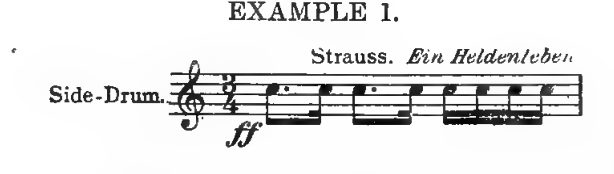
the composer must remember that when once he has " shot his bolt " with it there is nothing lett to be done. Like almost all the other Percussion Instruments its principal effect is it entry. In writing Side-Drum parts, remember
too many notes.
(2) That the genius of the instrument is totally opposed to single detached notes. In fact, they should never be written.
3) That the drag and the flam are only technica. ways of accenting effectively a single beat
(4) That practically any rhythmic combinations which you can think can be made intelligible on the instrument.
(5) That the long-roll continued either for a few beats or for many bars is equally effective p or f, but that its crescendo cannot be spread out over so many bars as that of the Kettle-Drums.
(6) That, in orchestral work at any rate, the composer shoula write out in tull the notes which he wants played. In military bands this is matter partly of tradition, partly of the Drum-major's discretion.
Like the other Drums, the Side-Drum can be muffled. The essential part of the muffling is to remove the snares from contact with the snare-head, and so destroy the peculiar "crackling" tone of the instrument. In tuneral-processions this is generally done by means of the "cords" which hang loose from the shell. These are pushed in between the snares and the snare-head. This puts the snares out of action and at the same time damps the air-waves as they reach the lower parehment. Another, but less effective, way is simply to slacken the snares.
No one who has ever been present at a military funeral can have failed to be struck with the indescribably solemn effect of the muffled Side-Drums. The "Drums" that precede the Slow March are usually entrusted to them and to the muffled Bass-Drum. These opening bars are arranged in different ways in different regiments. One of the simplest and most effective is as follows:
Example 2
