 Playable Books
Cecil Forsyth · section 8 of 60
No. 4. The Tabor
Read and hear this section in the playable edition →Er. Tambourin (de Provence); Ger. Tambourin.
The shell of this Drum is very long in proportion to its diameter It is usually made of walnut-wood carved and ornamented with conventional pattern. At each end of the shell is a "head" made from the softest calf-skin obtainable. A single snare of catgut, silk, or, more correctly, rough hemp, is passed across the parchment, with whiel it is kept in close contact by means of a hook. Apparently the snare is not passed across under the snare-head, but above the batter-head. The Drummer plays directly on to the parchment where it is in contact with the snare. Some doubt exists on this point. Widor says categorically that it is "a very long drum, without timbre," i.e. snare, 'used in Provence." The best authorities seem to favour the other view, and a tine specimen of the instrument 1 now in London has the hempen snare and the hook for its attachment.
A single Drum-stick is used with a top-heavy knob of bone or ivory. In Provence the player generally beats strokes of one timevalue with his left-hand while with his right he performs on a sort of primitive Flageolet called Galoubet" or Chirula.
The French always speak of the Tabor as having its origin in Provence. It is however more probable that the universal " pipe and tabor" of the middle-ages had merely found a last refuge there when it was resuscitated and put on the stage by the French composer, Berton, in his opera, Aline (1803). _However, the instrument is now acknowledged as characteristic of Provence," and at Aubagne (Marseilles) there exists a Society or Guild of Taborers who not only tap ungstentatious rhythms with their left hands but also prescribe the
1 The property of William Wallace, who has introduced the instrument in his symphonic poem Villon.
2 In Béarn the Galoubet is accompanied by the Tambourin du Béarn. See page 290.
3 See the delightful account of the drummer Buisson whom Mistral sent up to Paris from Provence with letters of introduction to Théophile Gautier, Alphonse Daudet, and Félicien David, in Daudet's Trente ans de Paris.
"ton de Si bémol" as the only legitimate key in which to play with their right.
Bizet has introduced the Tabor into his second Suite L'Arlésienne. In the Pastoral (Andantino) of that work it plays the simple rhythm
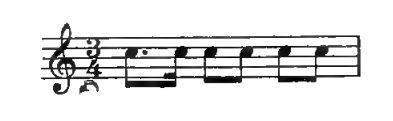
for 62 bars on end, while in the Farandole it repeats the rhythm
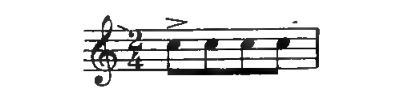
for 83 bars with a crescendo from pppp to fff —a common French
e typical the 1th Tenor ya a all corPs of Swis Brums and Fifes became celebrated throughout Europe the instrument was reintroduced to England in an improved and enlarged form. It was no longer held in the lett hand and beaten with the right, but "Slung " in the modern fashion. At the same time the players were organized into the regular corps of Drums and Fifes which still exist.